Taylor Swift and J.R.R. Tolkien in Conversation About My Cancer During the Season of Advent

Gray November, I’ve been down since July.” The opening lyric from the “Evermore” title track hits different now. In July, the surgeon removed the polyp that revealed the presence of stage 3 rectal cancer. And I spent the entire month of November in daily chemoradiation to treat it.

I’m 46. This all emerged after my first routine colonoscopy. If you are 45 or older, get one; if you are 40 or older, and you have any ability to have a colonoscopy done, I hope you will. It is a very good idea and not as onerous as people make it sound. I certainly wish I had. I’d go back in time and change that, but I can’t.

Since 2009, Taylor Swift’s music has been a constant companion in the journey of my life. And so it has been in the shadowy and uncertain journey of cancer.

During my screening MRIs, I asked the technicians to play Taylor Swift while I was in the tube. It was a practical decision as well as an emotional one. I know the length of many Swift songs, at least roughly, so when they told me the scan would take about 45 minutes, Taylor both entertained me and let me know how much time I had remaining.

Fast forward to October 27, the first day of radiation treatment. The nurses asked what music I wanted, and when I said Swift, one of the nurses lit up. “We don’t get many Swifties around here!” she said.

“Are you a Swiftie?” I asked. Indeed she was! Later, I learned that she rearranged her schedule so she could have me as a patient and listen to Taylor Swift with me during my treatment. By the end, Nurse Allison even knew how to seed the Pandora station so that it gravitated toward my favorites.

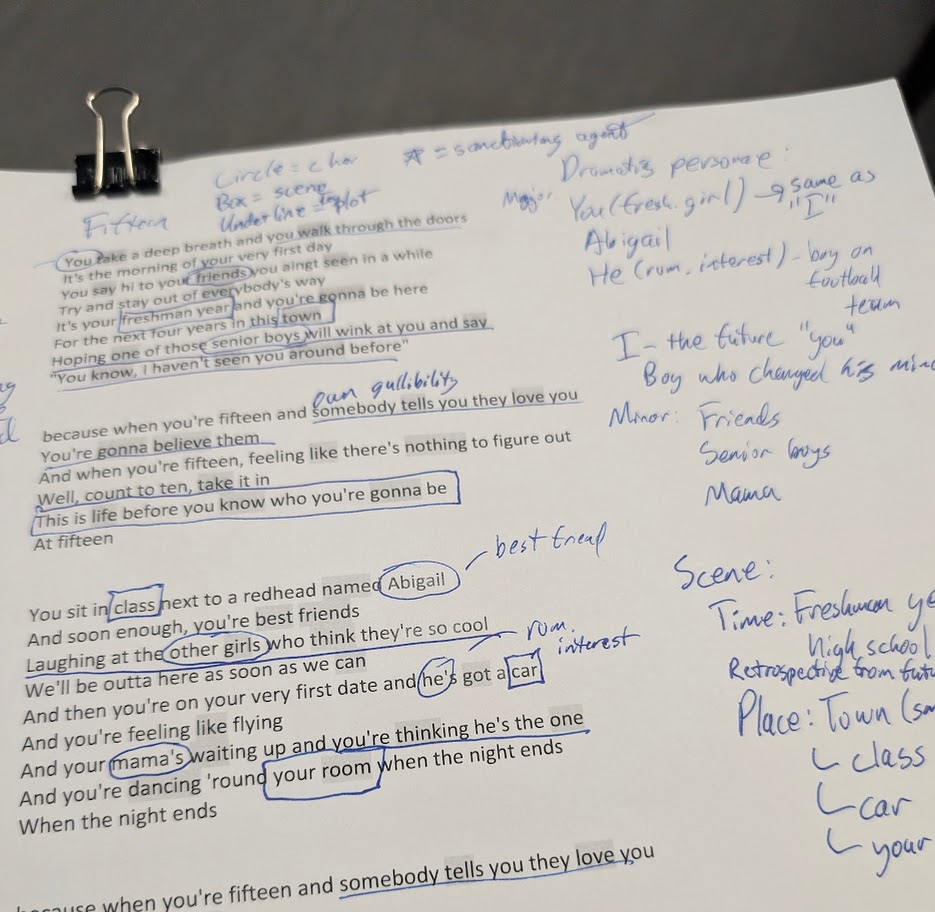
Then there’s the waiting for appointments, an inevitable part of any major medical issue. Early in the treatment cycle, I printed out the lyrics of some of Swift’s most semantically-central songs. I don’t want to steal my own thunder for what might become a future paper, but suffice it to say that, as I sat waiting for radiation therapy, a hospital robe my only clothing to speak of, I busied and distracted myself with a pen and paper, conducting rhetorical analysis of some of her most famous lyrics. I hate it here, so analyzing those lyrics became lunar valleys in my mind.
Now we are back to December, the season of Advent (and, for many Swifties, of the Evermore album). I have finished five weeks of chemoradiation, and later this month, I will begin a chemotherapy regimen that will last 3 months. The hope is that this will take care of the cancer, and that future scans and scopes will reveal no tumor. If so, life continues. If not—and there is a substantial chance the treatment will not be completely effective—I likely will need surgery to remove my rectum. That would be life-changing.

If the opening line of “Evermore” is uncanny, the bridge, that powerful duet between Justin Vernon and Taylor Swift, is an emotional gut-punch. I mean, so many of her bridges are, but this one has taken on deep subjective meaning for me. It’s likely not with meaning she intended, but that’s ok; such is art, whose meaning often is a joint creation between the artist and the audience.

Vernon:
Can’t not think of all the cost, and the things that will be lost.
Oh, can we just get a pause? To be certain we’ll be tall again.
Whether weather be the frost, or the violence of the dog days
I’m on waves, out being tossed; is there a line that I could just go cross?


Taylor (as Vernon repeats his section in call-and-response):
And when I was shipwrecked, I thought of you.
In the cracks of light, I dreamed of you.
It was real enough to get me through.
But I swear, you were there.

I’ve already felt the cost of my cancer, the things lost: time, energy, professional opportunities, mental drain, the pain of side effects, the burden on my family. And much greater costs may lie ahead. I’ve longed for the kind of pause that Vernon describes, and have appreciated those times of rest when they have come. I’ve also felt shipwrecked, storm-tossed, and the imagery here calls to mind the lament of the psalmist in pain: “All your breakers and your waves have gone over me” (Psalm 42:7, ESV).

A foundational aspect of the lyrical anatomy of almost every Taylor Swift song is this: It is sung in first person, by an “I” (usually but not always Taylor Swift) singing to a “you.” There’s almost nothing in the way of a third-person story about a girl named Lucky, and when Taylor gets close to something like that, she still shows up to buy the Rhode Island mansion at the end of the song. Normally the “you” is easy to identify, at least generally, if not specifically. Often “you” shows up in the first verse.

Not in “Evermore.” “You” doesn’t show up until this bridge. And it’s never entirely clear who this “you” is, present in the cracks of light in the midst of a shipwreck storm.

The imagery calls to mind the “Cardigan” music video, too.

I don’t know how much overlap there is between the Swiftie and Tolkien fan bases, but I’m in the center of that Venn diagram. I adore Tolkien, not only as a fantasy author, but as an academic who put his faith in conversation with his scholarship. During my cancer journey, I’ve thought not only of Taylor shipwrecked on the sea, but also of suffering Frodo, faithful Sam, and the grace of God that brought about the culminating victory at Mount Doom.

Tolkien wrote fantasy, and he theorized about it. As a communication theory textbook author, I approve. In his essay “On Fairy Stories,” he coined a memorable new word: “eucatastrophe.” In a letter to his son, he defined the term succinctly: “the sudden happy turn in a story which pierces you with a joy that brings tears.” The endings of Lord of the Rings, Harry Potter, and The Lion, the Witch, and the Wardrobe are good examples. In the Taylorverse, examples might include “Love Story” (with her dad’s unexpected change of heart) and “Long Live” (where the “band of thieves of ripped up jeans” unexpectedly gets to “rule the world”).

For Tolkien, the eucatastrophe is more than a literary device. It is a window into a deeper truth about the way the world works. Much of human life involves sorrow, pain, heartbreak, and death. We inhabit a world filled with conflict and war, cancer and disease, decay and loss.

It would be easy to conclude that this is the permanent, inevitable way of things. But Tolkien did not believe this. Nor do I. The eucatastrophe “denies (in the face of much evidence, if you will) universal final defeat and in so far is [gospel], giving a fleeting glimpse of Joy, Joy beyond the walls of the world, poignant as grief.

Here, in this season of Advent, Tolkien’s most famous quote about the eucatastrophe clarifies why he had such hope: “The Birth of Christ is the eucatastrophe of Man’s history. The Resurrection is the eucatastrophe of the story of the Incarnation. This story begins and ends in joy.

What does this have to do with ‘Evermore’??“, the patient Swiftie reading this may wonder. Well, further into Tolkien’s letter, I was struck by the parallel between his words and the lyrics of “Evermore:” “In the Primary Miracle (the Resurrection) . . . you have not only that sudden glimpse of the truth behind the apparent [nature] of our world, but a glimpse that is actually a ray of light through the very chinks of the universe about us.” That sounds a lot like cracks of light through the storm clouds on a shipwrecked sea.

Tolkien further describes riding his bicycle past an infirmary, when he “had one of those sudden clarities which sometimes come in dreams. . . . I remember saying aloud with absolute conviction: ‘But of course! Of course that’s how things really do work’. But I could not reproduce any argument that had led to this, though the sensation was the same as having been convinced by reason (if without reasoning).” Swift expresses a similar sentiment, more concisely and beautifully, in the closing verse of “Evermore”:

And I was catching my breath
Floors of a cabin creaking under my step
And I couldn’t be sure
I had a feeling so peculiar
This pain wouldn’t be for
Evermore

Let me be clear: I’m not saying that Taylor Swift wrote “Evermore” to express faith-based ideas. The popular theory is that the song is about her famously difficult year in 2016 and how Joe Alwyn (a.k.a. William Bowery, who has songwriter credit on “Evermore”) brought joy out of that season. It’s also a song released during the pandemic, and during that long season, I certainly longed for a pause to be certain we’d all be tall again.

Yet it is also a song that is a powerful, beautiful, and general artistic description of pain, grief, and loss. And in writing about such things, I cannot help but have the sense that the lyrics find their way to something deep and true for those who are in Christ.

If I may be permitted one more moment of listener interpretation that surely moves beyond what the writers of “Evermore” intended, I was struck by Vernon’s cry: “Is there a line that we could just go cross?” The lyric seems to express a desire for relief, for refuge, maybe even in death. Of course, “cross” here is used as a verb; but the word is also a noun. A particularly sacred noun. In my pain, in my fear, in my longing to not be a burden on my family, in my guilt about not paying attention to those very few signals that might have led me to get a colonoscopy sooner—in those moments most overwhelming, the cross of Jesus, an emblem of brutal death that has become an emblem of unending life, has been my only refuge, the only place I can go to find relief.

I long for my current story to be one that ends in eucatastrophe during my mortal life, to get scans that speak to a cancer thoroughly destroyed, whether as a miraculous answer to prayer or the Lord working through the power of modern medicine. That may not happen. But the cross and the empty tomb speak to a more-than-certain hope, a feeling so peculiar, an absolute conviction that, one day, the world will be made right and I will have a resurrected body, like that of Jesus, that is cured of cancer. It is a hope “beyond the walls of the world” available to all who put their faith and trust in Christ.

I cannot speak definitively to the authorial intent of “Evermore,” and I am not a postmodernist; I believe authorial intent matters. But in the corridors of my mind, the shipwreck is my cancer diagnosis; the waves are the challenges and suffering of treatment. And the cracks of light are the love and support of family and friends, in part. But that undimmable light, more real than even the reality of my suffering, is most supremely the gospel, the good news in which is all my hope: that Christ came as a baby, fully God and fully human, lived the perfect life I could not, died the death and took the wrath of God that I deserved, and three days later walked out of his own tomb.

And the mysterious “you” in “Evermore” is for me, then, Emmanuel, God with us: the Wonderful Counselor, the Mighty God, the Everlasting Father, the Prince of Peace. This December, as I sing Advent songs with tears in my eyes, this is my joy and hope, and why I am certain my pain won’t be for evermore.
Ranking Taylor Swift’s Songs, Statistically, by Centrality to the Taylorverse

[Edited on 10-9-25 to include The Life of a Showgirl.]

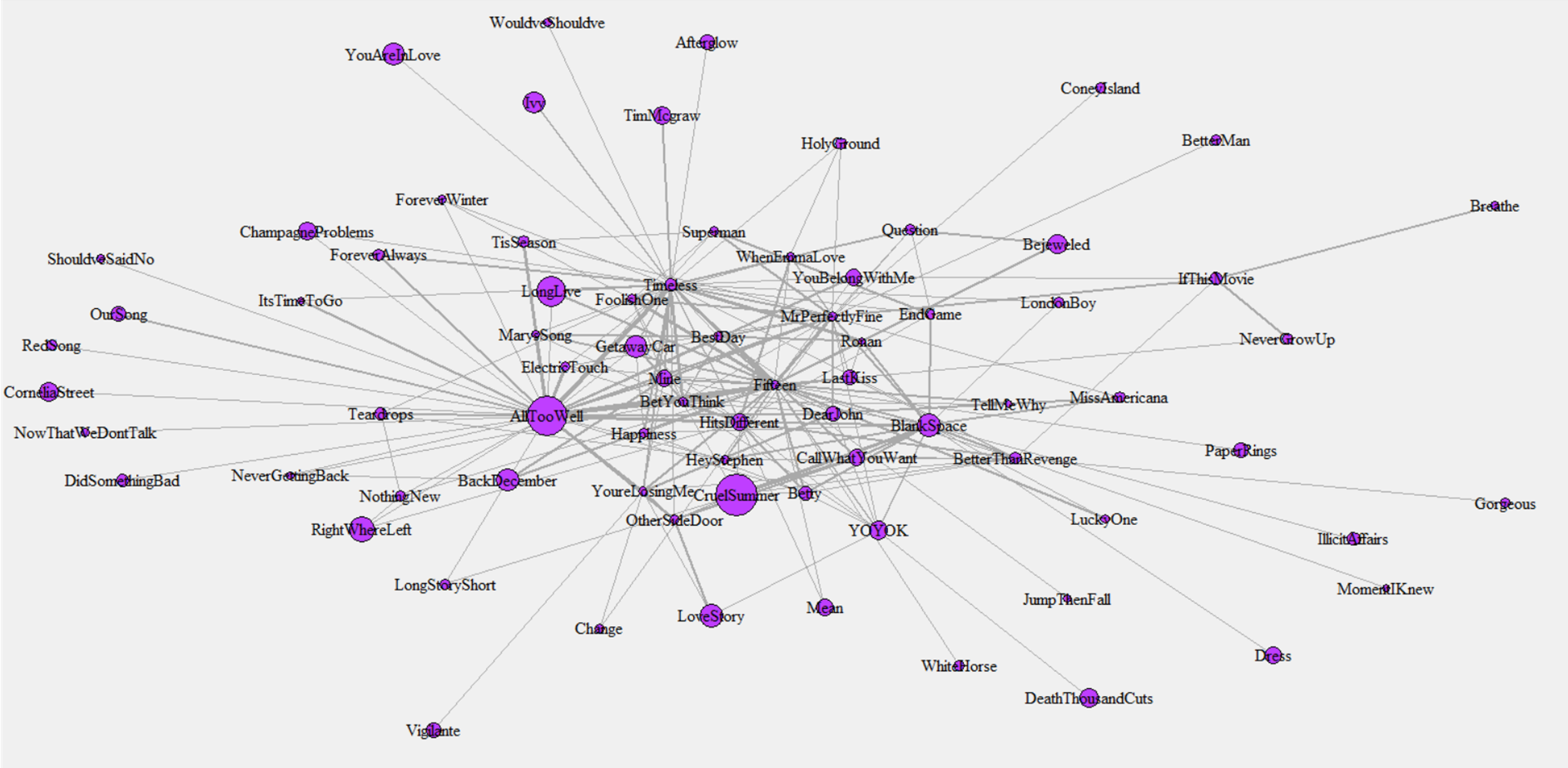
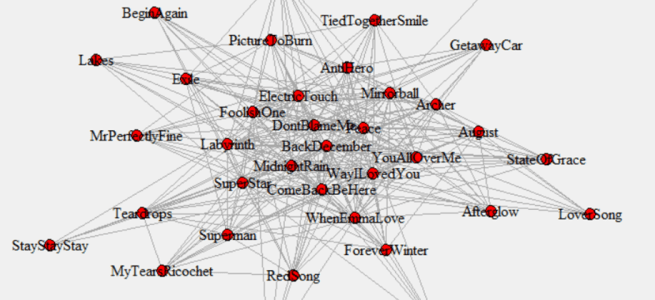
I published a peer-reviewed academic journal article that conducted a semantic network analysis of all of Taylor Swift’s songs on her debut album through Midnights. Essentially, the analysis created a “map” showing how these songs were related to each other, and in a previous post I described the four song types identified in this map. In order to be connected, songs needed to have at least 13 words in common (of course, 13!), with more words indicating a stronger connection. Here’s an example of what part of the map looks like:

From this map, we can calculate the “centrality” of the song. This refers to how well-connected the song is to other Taylor Swift songs; in other words, it tells us how central the song is in the “Taylorverse.” One of the main findings from the anlaysis was that songs with higher centrality are more popular (as measured by stream count, expert rankings, and social media conversation). So, although there are certainly exceptions, the songs at the center of the Taylorverse are more beloved than those at the periphery.

But, which are the songs that are most central? Well, here’s the complete list (as of October 9, 2025), going from most central to least central. It includes all songs on the main studio albums, and, unlike the published analysis, I’ve included The Tortured Poets Department and The Life of a Showgirl! In addition to listing the songs in descending order of centrality, I’ve also broken them into five groups based on their centrality.

Before we begin, it’s worth remembering that this isn’t a ranking of the best Taylor Swift songs, nor my personal opinion (you can find my complete ranking of her songs that list elsewhere). Rather, it is a list of which songs share the most word overlap with other songs. But, as you scan the list, I think you’ll see that the central songs do tend to be more popular (with exceptions), and those on the periphery less popular (again, with exceptions).

The Center of the Taylorverse

  1. Fifteen
  2. Timeless
  3. All Too Well
  4. But Daddy I Love Him
  5. Mr. Perfectly Fine
  6. Blank Space
  7. Hits Different
  8. I Bet You Think About Me
  9. Better Than Revenge
  10. Betty
  11. Mine

In addition to being the top ten eleven, all of these songs have centrality scores that exceed the traditional threshold for statistical significance (for fellow stats nerds, z > 1.96). Aside from the Speak Now Vault track “Timeless,” which wasn’t particularly well received, the others are fan favorites. Most are singles and/or Eras Tour songs; of course megahit “All Too Well” would end up here. And with oft-repeated Swiftian words like love, door[s], boys, girls, time, just, and dancing, “Fifteen” is a prime example of core Swiftian language and, as of this analysis, is at the very heart of the discography, semantically speaking.

Also in the Taylorverse’s Core

  1. You’re Losing Me
  2. Foolish One
  3. You’re On Your Own, Kid
  4. Dear John
  5. Ronan
  6. When Emma Falls in Love
  7. imgonnagetyouback
  8. Electric Touch
  9. The Life of a Showgirl
  10. If This Was a Movie
  11. Call it What You Want
  12. The Other Side of the Door
  13. End Game
  14. Teardrops on My Guitar
  15. Happiness
  16. Last Kiss
  17. So Long London
  18. loml
  19. The Moment I Knew
  20. Cruel Summer
  21. Superman
  22. Love Story
  23. The Best Day
  24. Long Live
  25. Florida!!!
  26. … Question?
  27. Forever & Always
  28. You Belong With Me
  29. Miss Americana & the Heartbreak Prince
  30. Mary’s Song
  31. I Hate it Here

These songs don’t quite break the top 10, but do exceed one standard deviation above the average for centrality. It makes sense that “You’re On Your Own, Kid,” which metaphorically narrates Swift’s career, would score toward the center. Other big hits in this group include “Dear John,” “Teardrops on My Guitar,” “Love Story,” and “Cruel Summer.”

Above Average Centrality

  1. Hey Stephen
  2. Never Grow Up
  3. The Story of Us
  4. We Are Never Ever Getting Back Together
  5. The Bolter
  6. Better Man
  7. Haunted
  8. I Did Something Bad
  9. Getaway Car
  10. Right Where You Left Me
  11. Back to December
  12. Forever Winter
  13. The Lucky One
  14. Tell Me Why
  15. Nothing New
  16. Holy Ground
  17. Peter
  18. Breathe
  19. Death by a Thousand Cuts
  20. You Are in Love
  21. White Horse
  22. Thank You Aimee
  23. Cancelled!
  24. Jump Then Fall
  25. So High School
  26. ‘Tis the Damn Season
  27. I Can See You
  28. Now That We Don’t Talk
  29. Bejeweled
  30. Sparks Fly
  31. Stay Beautiful
  32. I Wish You Would
  33. Delicate
  34. Mean
  35. Red
  36. Our Song
  37. Long Story Short
  38. Enchanted
  39. Begin Again
  40. Daylight
  41. … Ready For It?
  42. Tim McGraw
  43. The Way I Loved You
  44. Should’ve Said No
  45. Fresh Out the Slammer
  46. Eldest Daughter
  47. Change
  48. Opalite
  49. Wonderland
  50. SuperStar
  51. London Boy
  52. Style
  53. Paper Rings
  54. Innocent
  55. Illicit Affairs
  56. Dress
  57. Come Back, Be Here
  58. Gorgeous
  59. Speak Now

These songs have a centrality score between the mean and one standard deviation above it. You’ll recognize lots of Taylor classics here, including the debut single “Tim McGraw,” hits like “We Are Never Ever Getting Back Together” and “Style,” and the song that anchored the Speak Now Eras Tour set, “Enchanted.”

Below Average Song Centrality

  1. Me!
  2. Guilty as Sin
  3. New Romantics
  4. Elizabeth Taylor
  5. High Infidelity
  6. You All Over Me
  7. Mad Woman
  8. Everything Has Changed
  9. Cardigan
  10. Bad Blood
  11. The 1
  12. Coney Island
  13. Would’ve, Could’ve, Should’ve
  14. It’s Time to Go
  15. Girl at Home
  16. Afterflow
  17. Bye Bye Baby
  18. Champagne Problems
  19. Honey
  20. The Great War
  21. Ivy
  22. Run
  23. Cold as You
  24. Dancing With Our Hands Tied
  25. Who’s Afraid of Little Old Me?
  26. Cornelia Street
  27. Today was a Fairytale
  28. My Tears Ricochet
  29. Ours
  30. I Can Do It With a Broken Heart
  31. Chloe or Sam or Sophia or Marcus
  32. August
  33. You’re Not Sorry
  34. The Very First Night
  35. Exile
  36. Actually Romantic
  37. Fearless
  38. I Think He Knows
  39. Castles Crumbling
  40. My Boy Only Breaks His Favorite Toys
  41. Mastermind
  42. Clara Bow
  43. False God
  44. Willow
  45. Wildest Dreams
  46. So It Goes
  47. Vigilante Shit
  48. Tolerate It
  49. The Prophecy
  50. Invisible String
  51. I Almost Do
  52. Anti-Hero
  53. Snow on the Beach
  54. Wi$h Li$t
  55. The Black Dog
  56. Don’t Blame Me
  57. The Tortured Poets Department
  58. Say Don’t Go
  59. Dear Reader
  60. Picture to Burn
  61. Dorothea
  62. Starlight
  63. King of My Heart
  64. The Manuscript
  65. I Knew You Were Trouble.
  66. State of Grace
  67. Is it Over Now?
  68. Down Bad
  69. Stay Stay Stay
  70. Look What You Made Me Do
  71. Suburban Legends
  72. Peace
  73. Father Figure
  74. I’m Only Me When I’m With You
  75. Slut!
  76. Soon You’ll Get Better
  77. That’s When
  78. Tied Together with a Smile
  79. 22
  80. Out of the Woods
  81. Cassandra
  82. Clean
  83. The Fate of Ophelia
  84. Mirrorball
  85. Ruin the Friendship
  86. Maroon
  87. Karma
  88. No Body No Crime
  89. I Know Places
  90. Seven
  91. Labyrinth
  92. The Archer
  93. Shake It Off
  94. Sad Beautiful Tragic
  95. The Last Time
  96. Don’t You
  97. Message in a Bottle
  98. The Outside
  99. Come in With the Rain
  100. This Love
  101. I Forgot That You Existed
  102. The Alchemy
  103. How You Get the Girl
  104. You Need to Calm Down
  105. Lover
  106. This is Me Trying

With centrality scores from the mean down to one standard deviation below it, these songs have less than average word overlap with other songs. Although there are certainly some hits here (“I Can Do it With a Broken Heart”; “Champagne Problems”; “Out of the Woods”), many songs are deeper cuts on their respective albums.

The Edge of the Taylorverse

  1. Midnight Rain
  2. Hoax
  3. Place in This World
  4. Gold Rush
  5. Treacherous
  6. Invisible
  7. The Last Great American Dynasty
  8. How Did It End?
  9. Babe
  10. Closure
  11. This is Why We Can’t Have Nice Things
  12. All You Had to Do Was Stay
  13. Marjorie
  14. Evermore
  15. Wood
  16. Welcome to New York
  17. New Year’s Day
  18. The Man
  19. We Were Happy
  20. I Can Fix Him (No, Really I Can)
  21. Fortnight
  22. I Look in People’s Windows
  23. It’s Nice to Have a Friend
  24. A Perfectly Good Heart
  25. Paris
  26. Lavender Haze
  27. Sweet Nothing
  28. Untouchable
  29. Bigger Than the Whole Sky
  30. Glitch
  31. The Albatross
  32. The Lakes
  33. Robin
  34. Epiphany

Again, it’s worth remembering that having low song centrality doesn’t mean a song is bad. Here, at the semantic fringe of the Taylorverse, I find songs I personally enjoy, such as “Midnight Rain,” “Treacherous,” “Evermore,” and “The Lakes.” But, with the exception of “The Man” and “Fortnight,” this is generally a list of lesser-known songs. It makes sense that “Epiphany,” which concerns the experiences of Swift’s grandfather in World War II and doctors during COVID, would have the lowest centrality: its subject matter differs from any other song in the discography.

This isn’t a list I plan to update regularly, if ever, because updating the map takes some effort. [Edit: OK, I couldn’t resist when TLOAS came out.] Nevertheless, I hope it provides a different perspective on how we might consider, rank, and understand the amazing body of work that is the Taylorverse.

Popular Taylor Swift Songs Share Words with Other Taylor Swift Songs

What makes a Taylor Swift song popular? Several answers could come to mind: the poetic beauty of her songwriting, the deft skill of her producers, the power of the bridge, her emotive vocal performance. Certainly, these matter. But each of these answers is also limited because each focuses on the characteristics of one song in isolation. My semantic analysis of Taylor Swift’s lyrics suggests a different kind of answer: A Taylor Swift song’s popularity arises from its connection to other Taylor Swift songs.

I’ll discuss the data supporting that claim in a moment, but I want to do so by way of something I’ve never written about here: My own story of how I became a Swiftie.

My journey into the Taylorverse

In my childhood, I listened to a number of female country artists, and in my mid-twenties, I enjoyed singers that were, at the time, also catering to a similar audience as Taylor Swift (Hilary Duff, Aly & AJ, Miley Cyrus). That was good preparation, and although I can’t pinpoint the first time I heard Taylor, it was probably on the radio or on Yahoo’s music streaming service.

I do know that, in June 2009, I was driving down New Hampshire St. in Lawrence, Kansas. I was on a business trip as a young assistant professor, attending a weeklong seminar on advanced social science statistics. “Love Story” came on the radio. It wasn’t the first time I’d heard the song, but I remember thinking to myself, “Yeah, this is good stuff—I could be a Taylor Swift fan.” That’s the point when I’d say my journey into the Taylorverse began.

Later, I bought a used copy of Fearless, then Speak Now, then debut, and then I bought Red when it was a new release. As I listened, I began to appreciate that Taylor wasn’t writing just songs; she was writing albums. That’s maybe not the case with debut, which feels like a (very good) group of songs, but in Fearless and especially Speak Now, it was becoming evident that her albums were cohesive artistic statements as a whole. Fearless celebrates the closeness and challenges of teenage girls’ relationships; Speak Now is about finding one’s voice in the journey of growing up. By Red, a tour de force of romantic passion and heartbreak, the deeply thematic nature of her albums was undeniable. Yes, the songs matter; but the song’s context, what we would now call its era, deeply shapes her work.

Then, moving into 1989 and Reputation and beyond, I realized the connections weren’t only within albums, but between them. “A circus ain’t a love story” ties Reputation to Fearless. “Blank Space” wryly caricatures her media persona in her early albums. “I once believed love would be burning red,” she sings in Lover’s “Daylight.” Then “Bad Blood” is playing in a cab on Folklore, and then “You’re on Your Own, Kid” summarizes her entire career… you get the idea, and there are so many other examples.

To call these lyrical connections “Easter eggs” is a bit too trite. Perhaps these connections are more than a bonus for astute fans, but rather part of the fabric—the ‘invisible string,’ if you will—that unites the art. That’s what my research tried to examine quantitatively.

Which Taylor Swift songs have the most word overlap with other songs?

In the previous post, I described how 13 shared words is the minimum threshold where it made sense to treat two Taylor Swift songs as connected. Of course, the more words in common, the stronger the connection. We can use that information to create a map of the links between songs (again, discussed in the last post; also, see here for a list of all songs ranked by centrality, including TTPD).

Once we have that map, we can calculate something called a song’s centrality. (For those interested in the technical details, I used eigenvector centrality in the analysis.) Some songs are highly connected to other songs; their centrality is high. Here are the 15 songs that are most highly connected to other songs, in ascending order of centrality:

  • #15: “When Emma Falls in Love”
  • #14: “You’re On Your Own, Kid”
  • #13: “Dear John”
  • #12: “Foolish One”
  • #11: “You’re Losing Me”
  • #10: “Better Than Revenge”
  • #9: “Betty”
  • #8: “Mine”
  • #7: “I Bet You Think About Me”
  • #6: “Hits Different”
  • #5: “Blank Space”
  • #4: “Mr. Perfectly Fine”
  • #3: “Timeless”
  • #2: “All Too Well” [original; I didn’t include 10-minute in the analysis]
  • #1: “Fifteen”

You might already have a rough sense of what’s going on here… not all of these are stone-cold Taylor classics, but there’s a decent number of singles, big hits, and fan favorites among the most central songs.

Other songs are on the fringe of the map, with few connections to other songs; their centrality is low. Here are the songs with the lowest centrality:

  • #186: “Evermore”
  • #187: “This is Why We Can’t Have Nice Things”
  • #188: “The Man”
  • #189: “Welcome to New York”
  • #190: “A Perfectly Good Heart”
  • #191: “We Were Happy”
  • #192: “Paris”
  • #193: “It’s Nice to Have a Friend”
  • #194: “Sweet Nothing”
  • #195: “Untouchable”
  • #196: “Lavender Haze”
  • #197: “Glitch”
  • #198: “Bigger Than the Whole Sky”
  • #199: “The Lakes”
  • #200: “Epiphany” (a song so disconnected it was excluded from all further analysis)

Now, I imagine every Swiftie has a song or two (or more) they like among these least central songs (I’m partial to “Evermore” and “The Lakes,” myself). But, aside from “The Man,” it’s hard to argue any of these are among her most beloved songs. Also, I was curious, so just now I checked Spotify stream counts again. As I write this, four of these songs (“A Perfectly Good Heart,” “It’s Nice to Have a Friend,” “Epiphany,” and “Glitch”) have the lowest number of streams on their respective albums (Taylor Swift, Lover, Folklore, and Midnights).

Song centrality predicts song popularity

So, just by eyeballing the list of central and not-central songs, we might have a sense that song centrality is positively associated (correlated) with song popularity. In other words, the more central the song, the more popular it is. But, as I tell my students, we can’t conduct statistical tests with our eyeballs. We need to conduct statistical tests with… um… statistics.

But to get statistics, we need to know how to measure what we want to measure. We’ve already measured song centrality. But what about song popularity? How should we measure something as debatable as that?

Because song popularity is somewhat vague, I chose to measure it three ways that combine into a fourth:

  • Spotify stream count. One day, in a meeting that was kind of boring, I manually wrote down every Spotify stream count for all of the songs in a spreadsheet. Time well spent, for sure.
  • Expert ranking. Yes, I’ve ranked the songs myself, but that would be a bit of a conflict of interest to include my own rankings in the analysis, wouldn’t it? So, I used an aggregation of Rob Sheffield’s rankings at Rolling Stone and Nate Jones at Vulture.
  • Twitter/X conversation. Using the resources available in our Schieffer Media Insights Lab at TCU, I obtained 17,092 unique tweets, posted between February 1, 2022 and February 15, 2024, about the poster’s favorite Taylor Swift songs. The paper contains more detail about how this data was processed to get a measure of how frequently each song was mentioned.
  • Overall popularity: We can combine the three measures together into an overall index of the song’s popularity.

Now, you might already see some problems with this approach, particularly for Twitter/X conversation (I’ll just call it Twitter from now on, to keep it simple, and sorry, that’s just a better brand name than X). Taylor released some albums during that time window (Midnights, Speak Now TV, and 1989 TV), so we might expect those songs to show up more in the Twitter data. Same for any song performed in the North American Eras Tour, which was vibrant during that time. Even Spotify data isn’t a perfect indicator of song popularity, because Taylor’s first three albums were released before Spotify was available in the United States, and she then removed her music from Spotify during the 1989 era. Even critics’ evaluations might be subject to these influences.

This is a common occurrence in social science: We want to look at the association between two things (in this case, song centrality and song popularity), but confounding variables get in the way. We can solve that by controlling for those confounding variables. And, doing that actually told an interesting story about some other factors that shape popularity:

  • Album: Critics prefer the later albums, and later albums are more popular overall.
  • Track: Tracks earlier on an album tend to be preferred across the board: They are streamed more, talked about on Twitter more, critics like them more, and they are more popular overall. Said differently, later tracks on an album are less popular (ever push “play” on an album and stop halfway through, maybe because you’re bored or the car ride ends?).
  • Release date: Later releases have more streams, and songs released in the 2-year window are talked about more on Twitter.
  • Eras setlist: Songs on the Eras Tour setlist were more popular on Twitter and among critics, as well as overall.

Finally, we can address the main question (“Question…?” 😉): Are songs with greater word overlap with other songs (i.e., with higher song centrality) more popular? And the answer is, yes, they are! Songs with higher centrality are more popular with critics, more popular on Twitter, almost more popular on streams (barely missed the threshold of statistical significance), and more popular overall.

This is hard to visualize, in part because Taylor has so many songs. (And we Swifties are grateful for that!) Here’s a plot I used to demonstrate this to an audience recently, using a smaller selection of songs. Larger circles indicate more popular songs, with thicker lines meaning that the song shares more words in common. And, songs toward the center of the graph are more central, with those on the outside more peripheral. It seems that there is a knot of very popular songs at the center with lots of word overlap with other songs (“Cruel Summer,” “All Too Well,” “Long Live,” “Blank Space,” “Getaway Car”), while songs on the periphery are less popular.

Summary and Conclusion

So, then, yes: These results are consistent with the idea that the connection between Taylor’s songs is part of the appeal of her art. A caution, though, that we social scientists like to give: Just because two things are associated does not necessarily mean that one causes the other. Yes, it could be that audiences gravitate toward cohesive albums that connect to other parts of an artist’s work. Or, it could be that Taylor sees which songs audiences like, and makes those songs central by writing songs more like them.

My guess as to what’s going is, well, “both of these things can be true” (“Happiness”). Any artist’s popularity is crafted together with the fans who support them, something that Taylor has emphasized throughout her career. This again calls back to connections: It is the connections between the songs, as well as the artist and her fans, that animates her art and fuels its success.

In summary, my semantic network analysis found that:

  • We can map Taylor Swift songs based on their word overlap with other Swift songs.
  • The songs cluster into four core stories of (1) Villains and Heroes, (2) Longing and Regret, (3) Extraordinary Meaning in the Ordinary, and (4) Empowered Voice.
  • Taken all together, these four core stories form an overarching narrative of a woman moving from victim to voice, a journey of finding feminine meaning and worth in a masculine world that devalues such things.
  • Songs with high centrality (i.e., word overlap) tend to be more popular than songs with low centrality.
  • This is consistent with the claim that the discography forms a “Taylorverse” of interconnected meanings, and these connections are part of the appeal of her music.

The Four Types of Taylor Swift Songs (as Identified by Semantic Network and Fantasy Theme Analysis)

Many have claimed that Taylor Swift has built her own “Cinematic Universe,” and that this “Taylorverse” is part of the reason for her success. I decided to apply the tools of social science to find out whether, and how, that is the case.

Long story short: The data backs it up! If you want to see the full paper, it’s published here in Communication Quarterly. And if you can’t access it, or want a more accessible summary… keep reading. In this post, I’ll talk about how the analysis categorized Taylor Swift’s songs into four types, and how these types reveal the central meaning of the Taylorverse. In the next post, I talk about how the lyrical content of songs is associated with song popularity, as measured by stream count, expert rankings (but no, I didn’t include my own rankings in the analysis!), and social media mentions.

How are Taylor Swift’s songs connected?

Swifties have a habit of looking for connections among Taylor Swift’s songs, so much so that it is a meme. Sure, such fan theories are fun (if sometimes farfetched). And Taylor’s work seems to invite that kind of inspection, through repeated objects, scenes, and ideas: rain, cars, midnights, dancing, dresses, parties, heartbreak…

So, it seemed to me that, when taking a social scientific approach to the lyrics the Taylorverse, it was appropriate to focus on the words themselves. For example, several songs talk about doors: “The Way I Loved You,” “All Too Well,” “Everything Has Changed,” “Holy Ground,” “How You Get the Girl,” “Tolerate It,” and “Hits Different.” At least one word (“door”) connects these songs… but one word could be a random connection. How many words are needed before we can say that it seems like two songs have meaningful overlap in their vocabulary?

After feeding the lyrics for all songs on debut through Midnights (The Tortured Poets Department was announced while the work was already in progress and so isn’t included in the analysis), I got an answer to that question. It’s an answer I liked, and if you’re a Swiftie you’ll like it too. The number is… 13. If two Taylor Swift songs share at least 13 words in common, that’s above average and semantically meaningful overlap. Yes, that’s actually a mathematical answer based in the data… but I was also rather happy about it, for reasons beyond science. 😉

This approach allowed me to make a map of which songs connect to each other. Just one of the 200 songs from debut to Midnights wasn’t connected to any others, and that was “Epiphany.” That makes since, given the distinct subject matter of that song (World War 2; COVID). But, all of the other 199 songs are on the map, although there are so many connections that it is hard for a human being to see the patterns. Although the remainder of the post will focus on the albums through Midnights, I did calculate song centrality rankings for all songs through TTPD (click here).

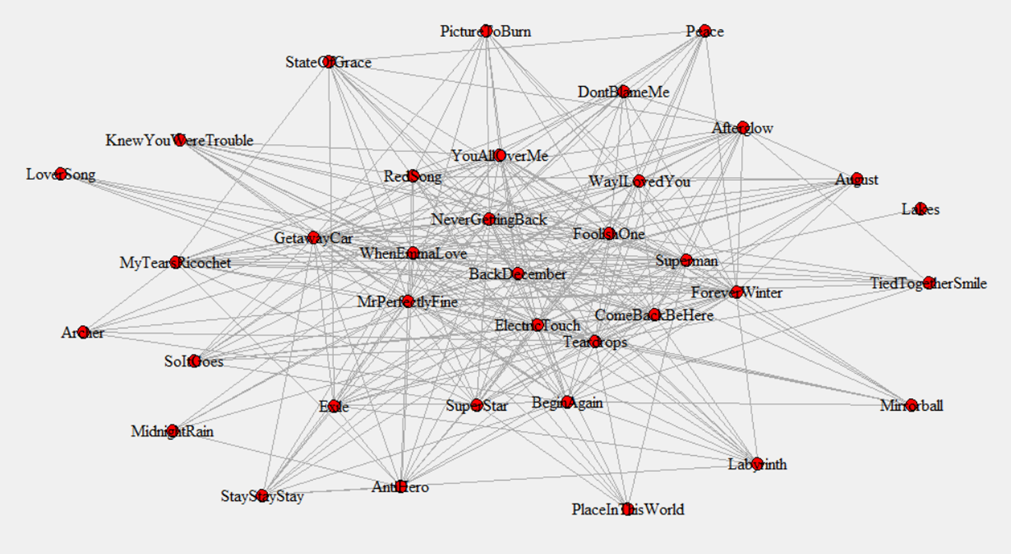
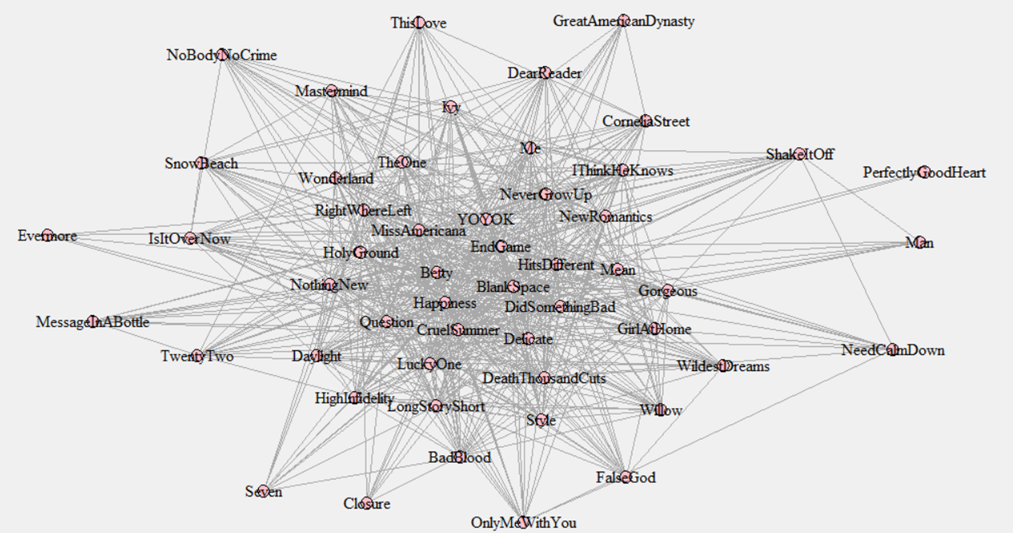
A messy map of how Taylor Swift songs are connected to each other.

Four Types of Taylor Swift Songs

However, there are patterns in the connections that the computer can detect. Using a clustering algorithm, my analysis found that we can arrange these 199 songs into four groups. Here’s that grouping, with songs in italics in the periphery of the group (i.e., less central in the group overall), with those in italics more representative of the group overall. I’ve put the song groupings in chart form at the bottom of this post, organized by album. Even at a glance it is apparent that different albums seem to contain different song types (and stats supports that: album is significantly associated with song group).

Once these groups were identified, I used tools from rhetorical analysis to discern the meaning of these groups. Specifically, I used symbolic convergence theory, because it focuses on how large groups of people are held together by shared stories, symbols, and meanings. Think about any given night of The Eras Tour, as fans exchanged friendship bracelets, held their hands in the air like a heart, gave a long standing ovation for “Champagne Problems,” and dressed in outfits referring to specific songs and albums. Spotify’s image recognizing her as the 2023 top global artist depicts the deep, rich well of symbolic meanings that exist within the Taylorverse, meanings that outsiders find confusing but fans celebrate and enjoy.

Symbolic convergence theory refers to such shared meanings as fantasy themes, and helps discern those themes by calling attention to four elements of the story within each theme: (a) the characters, (b) the plot, (c) the setting, and (d) the “sanctioning agent,” which is a term for the authority that gives legitimacy to the vision. With this in mind, I considered each song group as representing a core story that that runs throughout the Taylorverse. In chronological order of emphasis, these core stories are: 

1. Stories of Villains and Heroes: These songs feature Taylor as the recipient of good or bad male behavior. Her boyfriends may be pure heroes, as in “Stay Beautiful” and “Hey Stephen”; more often they are clear villains, as in “Cold as You,” “Forever and Always,” and “Dear John.” The early hit “Love Story” is an example of both the heroic (boyfriend) and the villain male (the stubborn father), with Taylor the innocent victim. These songs are most frequent in the first three albums and become very rare from Reputation onward (although “You’re Losing Me” from Midnights is a modern example of the type). Following symbolic convergence theory, this story type emphasizes the characters in the unfolding drama.

Group 1 song map: Villains and Heroes

2. Stories of Longing and Regret: Moving into Speak Now and especially Red, Taylor’s identity and that of her boyfriends becomes more three-dimensional. She is no longer free of blame; she would “go back and time and change it, but [she] can’t” (“Back to December”), and she knew he was trouble when he walked in (“so shame on me”). Likewise the men are a more complex blend, as in “State of Grace,” where she accepts that the man she is with was “never a saint” and that she has “loved in shades of wrong.” These songs become less frequent after Red (but see “Getaway Car,” “Exile,” and “Anti-Hero”). Following symbolic convergence theory, this story type emphasizes the plot, usually of faded romance.

Group 2 song map: Longing and Regret

3. Stories of Finding the Extraordinary in the Ordinary: These songs are most scattered throughout the discography. Although they find their peak prominence in Folklore and especially Evermore, they appear early on too; indeed, her very first single “Tim McGraw” is an example of this song type. In these songs, rich sensory details serve as a window into deeper meanings in Taylor’s inner life. In “Tim McGraw” it’s the “old faded blue jeans” and the “moon like a spotlight on the lake”; in “All Too Well” it is that iconic red scarf; in “Champagne Problems,” it’s the “Midas touch on the Chevy door,” among many other details. Again, although these songs shine in the two indie albums, really it’s a foundational form of sensory storytelling throughout the Taylorverse. Following symbolic convergence theory, this story type emphasizes the setting and how it resonates with the emotional meaning of the story.

Group 3 song map: Finding the Extraordinary in the Ordinary

4. Stories of Empowered Voice: These are virtually absent in the early albums, until “Mean.” Doing this research project helped me see how important this song is in the discography. No longer is Taylor singing about romantic partners, but about a music critic; she’s addressing her career, and the challenges she faces within it as a woman. That song was a seed that grew a genre of story that is common from 1989 onward, characterized by sarcastic humor (“Blank Space,” “I Did Something Bad”), social commentary (“The Man,” “You Need to Calm Down”) and continued reflection on her own career (“The Last Great American Dynasty,” “You’re on Your Own, Kid,” “Mastermind,” “Long Story Short”). Following symbolic convergence theory, Taylor Swift is no longer a victim; she has become the sanctioning agent, or authority, that grants legitimacy to her (and her audience’s) perspectives and experiences.

Group 4 song map: Empowered Voice

Taylor Swift’s Rhetorical Vision: From Victim to Voice

The final step of a symbolic convergence theory analysis is to look for the overarching story that seems to unite the community. This is known as a rhetorical vision. In the published paper, I summarize the overarching story of the Taylorverse as this:

“The overarching rhetorical vision of the Swift discography, then, is a story of a woman transforming from heartbroken victim to empowered poet. She takes her audience through a journey of finding (feminine) worth, agency, and voice in a world of (often masculine) characters that try to deny her (and her audience) those things through abandonment, neglect, betrayal, or simple unwillingness to understand. The scene reinforces the vision, as setting her stories in commonplace (often domestic) locations builds a strong sense of identification between Swift and her audience (Morris, 2024), and the movement from rural to urban represents growing voice and confidence. The locus of the vision is not so much an external quest for influence, but rather an internal quest for self-value and understanding while ‘living in a world built for someone else’ (Heggeness, 2024).” (Ledbetter, 2024, pp. 20-21)

So, those are the four types of Taylor Swift songs identified in the analysis, and the overarching vision these four core stories create. Clearly, this overarching vision has artistic, cultural, and economic impact. But, not all Taylor Swift songs are equally popular; there seems to be a real difference in enthusiasm between “Blank Space” and “All Too Well” on one hand and, say, “Girl at Home” and “How You Get the Girl” on the same albums. (No disrespect intended if you like the latter two songs!… just looking at stream count…) In the next post, I consider the other major part of the paper, and that is how the semantic overlap between songs predicts a song’s popularity.

And, here is how the song types break down by album era:

AlbumGroup 1: Villains and HeroesGroup 2: Longing and RegretGroup 3: Extraordinary MeaningGroup 4: Empowered Voice
DebutCold as You
The Outside
Stay Beautiful
Should’ve Said No
Invisible
Picture to Burn
Teardrops… Guitar
Place in This World
Tied… With a Smile
Tim McGraw
Mary’s Song
Our Song
Only Me… With You
Perfectly Good Heart
FearlessLove Story
Hey Stephen
White Horse
Breathe
Tell Me Why
You’re Not Sorry
Forever & Always
Change
Jump Then Fall
Other Side… Door
Today… Fairytale
That’s When
Bye Bye Baby
Way I Loved You
SuperStar
You All Over Me
Mr. Perfectly Fine
Fearless
Fifteen
You Belong With Me
The Best Day
Untouchable
Come in… Rain
We Were Happy
Don’t You
NONE
Speak NowMine
Sparks Fly
Speak Now
Dear John
Story of Us
Better Than Revenge
Innocent
Haunted
Ours
If This Was a Movie
I Can See You
Back to December
Superman
Electric Touch
Foolish One
When Emma…
Enchanted
Last Kiss
Long Live
Castles Crumbling
Timeless
Mean
Never Grow Up
RedI Almost Do
Better Man Babe
State of Grace
Red
I Knew… Trouble
Never Getting Back…
Stay Stay Stay
Begin Again
Come Back… Be Here
Forever Winter
Treacherous
All Too Well
The Last Time
Sad Beautiful Tragic
Everything Has Changed
Starlight
The Moment I Knew
Ronan
Bet You Think…
Run
The Very First Night
22
Holy Ground
The Lucky One
Girl at Home
Nothing New
Message in a Bottle
1989All… Was Stay
I Wish You Would
How You Get the Girl
I Know Places
Clean
Slut!
Say Don’t Go Now… We Don’t Talk
NONEWelcome to NY
Out of the Woods
You Are in Love
Suburban Legends  
Blank Space
Style
Shake it Off
Bad Blood
Wildest Dreams
This Love
Wonderland
New Romantics
Is It Over Now?
Reputation… Ready For It?
Dress
Can’t… Nice Things
Call… You Want
Don’t Blame Me
So It Goes…
Getaway Car
Look What… Do
King of My Heart
Dancing… Tied
New Year’s Day
End Game
I Did Something Bad
Delicate
Gorgeous
LoverNONELover
The Archer
Afterglow
Forgot… You Existed
Paper Rings
London Boy
Soon… Get Better
Nice to Have a Friend    
Cruel Summer
The Man
I Think He Knows
Miss Americana…
Cornelia Street
Death… 1000 Cuts
False God
Need to Calm Down
ME!
Daylight
FolkloreThis is Me Trying
Mad Woman  
Exile
My Tears Ricochet
Mirrorball
August
Peace
The Lakes
Cardigan
Illicit Affairs
Invisible String
Hoax
The One
Great American Dynasty
Seven
Betty
EvermoreDorotheaNONEChampagne Problems
Gold Rush
‘Tis the Damn Season
Tolerate It
Coney Island
Cowboy Like Me
Marjorie
It’s Time to Go
Willow
No Body, No Crime
Happiness
Ivy
Long Story Short
Closure
Evermore
Right Where…
MidnightsLavender Haze
Vigilante Shit
Sweet Nothing
The Great War
Glitch
You’re Losing Me
Anti-Hero
Midnight Rain
Labyrinth
Maroon
Bejeweled
Karma
Bigger… Whole Sky
Paris
Would’ve… Could’ve
Snow on the Beach
You’re on Your Own, Kid
Question…?
Mastermind
High Infidelity
Dear Reader
Hits Different