What I’ve been up to lately…

… no, I promise you, I haven’t forgotten about this blog! Rather, I’ve been writing and working on other things. Today, I’d like to share three of them with you!

1. ADVISING AWESOME MASTER’S STUDENTS

I’m SO incredibly proud of these two:

Katie_cropped Natalie_cropped

Katherine (Katie) Fearer (left) and Natalie Fech (right) did absolutely fantastic work on their master’s theses. Both theses addressed relational uncertainty and relational maintenance (Natalie’s in romantic relationships, Katie’s in friendships), and both found really really nifty findings that I fully expect will appear in press soon. Neither are pursuing a PhD at the moment, but if any of y’all reading this are looking to add great doctoral students to your program, these two are well worth recruiting!

2. RESEARCH ON TEACHER TECHNOLOGY POLICIES

I’ve talked with many professors who have wondered how they should manage students’ technology use in the classroom: “Should I allow laptops only? Or cell phones too? Maybe I should ban all technology use?” My wonderful TCU friend/colleague Dr. Amber Finn and I have set out to provide answers to these questions.

In a study that’s soon to appear in Communication Education (and is already available online), we examined how a teacher’s technology policies predict student learner empowerment–in other words, the student’s belief that s/he can perform effectively in the class.

Based on previous research (i.e., Turman & Schrodt, 2005), we expected learner empowerment would be highest when teachers moderately encourage course-relevant technology use and moderately discourage non-course use. But, that’s not what we found!

For encouraging policies, we found nothing but a positive effect. The more teachers encourage course-relevant technology use, the more empowered students feel. (IMO–This should give teachers some pause about banning all tech use in the classroom.)

For discouraging policies, we found the effect depended on the student’s level of apprehension about communicating online. These findings led to this graph, which I’ll share here just because I think it looks kinda cool (well, ‘cool’ in a geeky way… :-):
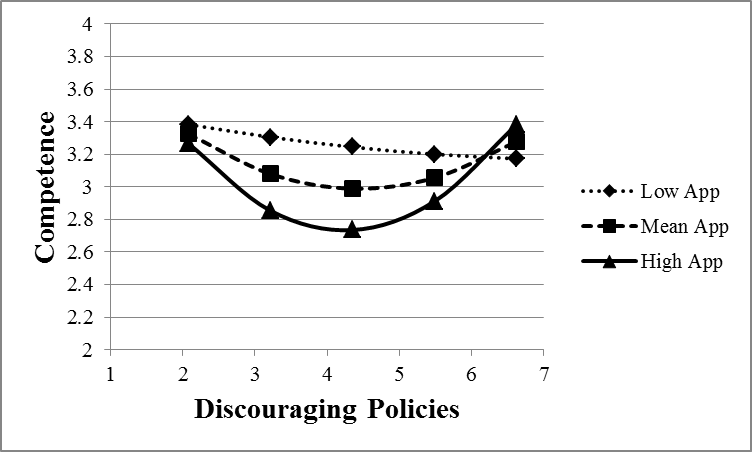
disc_graph
What does this mean? Well, the most important line is that dark, solid line–that’s the highly apprehensive students. The curve of the line is lowest in the middle–in other words, they feel least empowered when teachers are moderately discouraging of non-course tech use!

The upshot here? We think clarity is important. As an instructor, you can discourage non-course tech use as long as you’re clear about it. If you’re wishy-washy, you’ll ‘freak out’ the apprehensive students because they won’t know what to expect–and, consequently, they’ll fell less empowered.

3. A FIRST LOOK AT COMMUNICATION THEORY

afl_8th

Several years ago, my dear friend and mentor Em Griffin invited me to serve as a “special consultant,” and now as a co-author, on his textbook A First Look at Communication Theory. It’s the book that, as a college student at Wheaton, got me all fired up about being a communication professor–so I was delighted to accept his invitation!

We (Em and Glenn Sparks at Purdue University) have been working on the upcoming 9th edition. (The image above is the 8th edition; the cover hasn’t been finalized for the 9th edition yet.) I won’t say much about it now, except that I’m excited about the updates we’ve been making to the book! Much of my work has involved a new organizational communication theory… I’m very excited to see the feedback on it from long-time users of the book.

I should probably also mention that, this April, I was awarded tenure and promotion to associate professor at TCU. Thanks to all of you who helped me on the journey to this point in my career! I feel very blessed to work at such a wonderful university with truly excellent colleagues.

Do colleges really “close” during the summer?: A critique of Fay Vincent in the WSJ

So yesterday, I read an article in the WSJ by former MLB commissioner Fay Vincent (this link may/may not allow you to see it without a WSJ subscription).

In the article, he argues that universities can become “more efficient” if they don’t “close for the summer.” Um, I wonder if he’s ever been on a college campus during the summer? Every school I’ve seen firsthand runs a slew of revenue-generating summer classes and conferences.

He also attacks faculty, arguing they are “underutilized” and could “be used more productively” during the summer. Um, has he ever observed faculty during the summer? The faculty I know produce a lot during the summer across the domains of teaching, research, and service.

Finally, he addresses time, claiming “As school administrations over the years have steadily shortened the educational year, students were the losers. It is difficult not to conclude that my generation got a better education because we got more of it.” He fails to consider that the relationship between time and learning isn’t linear. I guarantee you my students aren’t learning as much during the 14th week of the semester as they are the 3rd–the comparison between the 74th and 6th minutes of class is also apt.

I agree we need to ask serious questions about higher education practices and consider creative answers. And speaking of productivity, such brainstorming is most productive when it doesn’t betray basic ignorance about fundamental facts of academic life.

Is talk cheap?: Relational maintenance and scarcity, part II

In Part I, I discussed some of my recent research on romantic couples. My results suggested some things we do to maintain our relationships are scarce, and others are not. If a behavior is scarce, then if I give it to you, I can’t give it to someone else. That post mainly addressed shared media (e.g., TV/movies) as one such scarce behavior (as well as time and resources).

But, I hope we’d agree that only watching TV doesn’t make a relationship strong. After all, by way of analogy, we need to do many different things to keep a car on the road. Changing the oil is important maintenance work, but it isn’t going to fix your brakes! Likewise, relationships need a variety of behaviors to stay healthy—and human relationships are much more complex than cars!

Among the ways we maintain our relationships, the kind of talk we use is of utmost importance. Consider the Hebrew proverb: “Death and life are in the power of the tongue, and those who love it will eat its fruits.” (Proverbs 18:21, ESV). Between couples, talk can craft a relationship of shining beauty or soul-crushing brokenness. The words we use in our close relationships matter.

But, what kind of talk are we talking about (ha!)? Not all talk is equivalent; chatting about the weather is not the same as discussing politics, and neither are the same as telling someone “I love you” (at least, I hope not!)

This study identified five types of talk romantic couples use to maintain their relationships. To make them concrete, I’ve included one survey item that measured the type of talk:

  1. Verbal affection (“We say ‘I love you’ to each other.”)
  2. Deep talk (“We disclose deeply personal, private information about ourselves to each other.”)
  3. Conflict management (“We handle disagreements with each other.”)
  4. Informal talk (“We talk about what’s up and about what happened during the day.”)
  5. Humor (“We tell jokes and humorous stories to each other.”)

Of course, the next logical question is: Which of these types of talk is most important to the health of a relationship? The answer is: all of the above! Close couples were more likely to use all types of talk in their relationships!

A few “take-away” points:

  1. It isn’t just the deep conversations. We typically think of our closest relationships as those where we can share our deepest thoughts and feelings. But, that’s not always a sign of a super-close relationship. Some people disclose very private thoughts to counselors or clergy, but don’t share the mundane details of their lives with them. In some ways, sharing our daily events over a period of time is much more intimate than one episode of deep sharing.
  2. Conflict can be healthy. This study wasn’t mainly about conflict, and certainly conflict can be destructive. When approached with the desire to sacrificially love the other person, and the heart to work toward the best solution possible, conflict also can improve our relationships and make them resilient. In this study, the closest couples didn’t always run from conflict.
  3. Variety is key. These talk types are remarkably diverse! If your conversation is always light and fluffy, or always super-duper-deep, that could be a problem. Just as the body needs a variety of foods to stay healthy, so romantic relationships need a variety of talk.

Finally, one type of talk emerged as uniquely important. All the talk types reflected a close relationship, but one especially did, and that’s verbal affection. In other words, the closest couples say “I love you” to each other frequently! It strikes me that some couples probably don’t say those words enough, and for others they say it without much meaning. My gut feeling is that it’s best not only to verbalize affection, but also to mean it when we say it.

So is talk cheap? Maybe—but it certainly isn’t scarce. And it’s important. What kind of talk would your romantic partner most like to hear today?

Whether it’s revealing the secrets of your heart, facing a long-standing conflict, or simply chatting about your day, that talk could improve the health of your relationship.

My social networking site course featured in TCU Magazine!

The newest issue of TCU Magazine features a story on my social networking site seminar – one of my favorite classes to teach! The course takes students through the history of communication technology, then applying this history to understand our social media / smartphone world.

You can read the TCU Magazine article, or visit my teaching page to find the syllabi for both undergraduate and master’s-level seminars.

Does Watching TV Together Help Maintain a Healthy Relationship?: Relational Maintenance and Scarcity, Part I

As my wife and close friends can attest, I’m just not much of a movie guy. I fully respect those who are, but for some reason movies have never really been my cup o’ root beer. But I know many couples who spend a lot of time watching movies together. For my wife and me, it’s not so much movies, but TV – after working and taking care of young kids during the day, watching an episode of The Office or Friday Night Lights can be awfully relaxing.

But could it be that watching TV/movies together isn’t just recreational, but also a sign of a healthy relationship? One of my recent studies suggests the answer may be “yes.”

I surveyed 123 romantic couples about things they do to maintain their relationships with each other. The couples were diverse – most were married, but some were dating; some were in their 20s, and others in their 60s and 70s, etc.

The first paper from this data set has been accepted as the top paper in the interpersonal communication division of the Central States Communication Association. You can read and comment on that paper here.

In this study, I wanted to examine the idea, advanced by psychologist Arthur Aron and his colleagues, that the things we do to maintain our relationships arise from something called “including the other person in your sense of the self.” The basic idea is that when you become really close with someone, you don’t think of them as a separate person, but rather as part of who you are. If they’re happy, you’re happy. If they’re hurting, you’re hurting. If they need money, you give it to them. We don’t think of our resources as “mine” and “yours,” but rather “ours.” I don’t know if Aron had the biblical “… and they shall become one flesh” (Genesis 2:24) in mind, but that description of utter husband/wife unity seems very similar.

My study identified eleven different behaviors people do to maintain their romantic relationships. What seemed to distinguish these behaviors is whether or not they are scarce. Giving money is a great example of scarcity. If I give you a dollar, I can’t give that dollar to another person. But if I give you some deep conversation, I can still give deep conversation to someone else. Both giving money or deep conversation could maintain a relationship, but one behavior is scarce and the other is not. In this post, I want to talk for a moment about scarce maintenance behaviors. I’ll discuss the non-scarce behaviors in my next post!

What are these “scarce” maintenance behaviors, then? This study identified three.

One is resources—basically, money and possessions. Another is time. Couples who didn’t include each other in the sense of the self—basically, who weren’t “into” each other—didn’t share much resources or time. Couples only shared a lot of time and resources with each other when both people were “into” each other. Only one person being “into” the other didn’t cut it.

The third scarce behavior was shared media, or watching TV/movies together. I had to scratch my head on that one—is sharing media really a scarce behavior? After thinking about it (and after seeing my daughter’s ire when I change channels from Dora to CNN), I realized: “Yeah, it sure is!” Think of the cliché argument over the TV remote (or these days, the DVR). An hour together watching “his” show can’t also go to “her” show. The couple could watch separate shows on separate TVs in separate rooms, but this study focused on shared viewing, not that kind of individual activity.

And like time and possessions, the pattern held: The highest amount of shared media use only occurred when both people were really “into” each other! This seems a bit counterintuitive—vegging in front of the ‘tube’ doesn’t sound like a particularly romantic activity. But, this study suggests watching TV together has something to do with being a close couple.

Now, this finding could be just a side effect of time: Closer couples spend more time together, so they also spend more time watching TV together. Also, it could reflect similarity: Couples watch TV together because they like the same shows.

But nevertheless, I’m intrigued by another explanation: that sharing media might actually help a couple stay close. Perhaps watching TV together provides shared experiences, and maybe it doesn’t just reflect similarity, but also helps build it. Shared media can generate discussion about characters, plot, and actors, and who hasn’t enjoyed in-jokes with fellow fans of favorite shows and movies?

So, I leave the question to you: Do you think the media you share with your romantic partner strengthens your relationship in any way? If so, why; if not, why not?