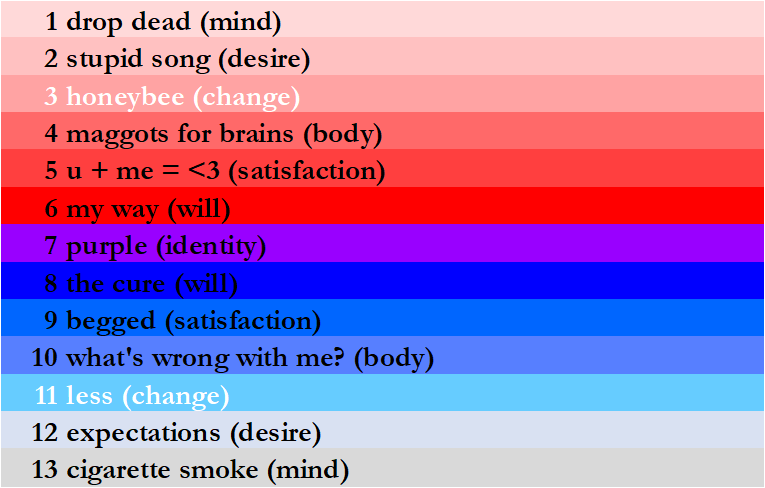
Within close relationships research, some scholars have examined relational turning points. A first date, a big fight, a wedding, or the birth of a child are some examples. When scholars do this type of research, sometimes they have people draw a chart of the relationship’s ups and downs over time, using that graph to identity those turning points.
If Olivia were drawing such a graph, “honeybee” would be a high point and “less” a low point. And these two piano-driven songs both mark big turning points: In the first, the relationship formally starts, and in the second, the relationship formally ends.
The first verse of both songs take place in a nighttime setting, focusing on time and healing. In “honeybee” her outlook is optimistic, exclaiming that “it’s true time can heal even the worst of wounds.” In contrast, in “less” she isn’t feeling well, her “body and head protesting” with a “stomach” that is “in knots” (which flows from the symptom list in the prior song, “what’s wrong with me?”). Now, the idea that time will heal is a vain hope that flies in the face of evidence: “maybe it’ll fix itself tomorrow, but I’ve been saying that like every night.”
Both songs also feature Olivia’s quietness, but that silence has different meanings. In “honeybee” she assures him, “even when I’m quiet I love you, baby, I promise.” Yet in “less,” there’s no assurance to be found when she says “I don’t wanna talk, let’s just go to bed or something.”
There’s also contrast in the meaning of their time together. In “honeybee” it is sweet (like a “sticky sweet tangerine”), intimate, and fun, as they “walk in the dark, hop the fence in the park” and as he simply “pick[s] [her] up, walk[s] [her] home.” By “less,” these simple yet meaningful dates have been replaced by bigger, costly events that are joyless (“our trip to Big Sur only confirmed this isn’t what it should feel like”).
In “honeybee,” his face is the lyrical focus, and it’s a lyrical focus that foreshadows what will happen in less: “I hope I never see what your face looks like going.” Then “less” tells us what he is like when he is going; he isn’t leaving in anger, but rather does “the noble thing” by giving her a way out that she’s doesn’t want to take. In “less,” the focus turns to her face. He watches her cry twice, first in the chorus, and then “on the curb at LAX.” And in “less,” Olivia acknowledges that he’s “seen [her] truly happy, so [he] know[s] right now [she’s] not,” a callback to the sorts of light, joyous events described in “honeybee.”
The terms of endearment also move in opposite directions. The word “honeybee” only occurs once in the song, and in the same line she calls him “baby boy.” At the end of “less,” now he is the one calling her “babe” as he speaks the words that will terminate the relationship.
After instrumental breaks (that, perhaps coincidentally, end at the 2:41 mark in each), both songs move quickly to the end. And in each conclusion, the focus turns to hopes and wishes. In “honeybee,” the final line “here’s to hoping” foreshadows danger; in the final line “I wish you loved me less,” that danger has become reality.
Undoubtedly, the album treats “purple,” the song where Olivia realizes they have become too attached, as a key relational turning point as well. On either side of purple, and equally distant from it, “honeybee” and “less” chart the turning points before and after that chart their shift into and out of romance.
Other posts:


6 thoughts on ““honeybee” (track 3) & “less” (track 11): where is this relationship going? (Olivia Rodrigo’s YSPSFAGSIL, analyzed)”