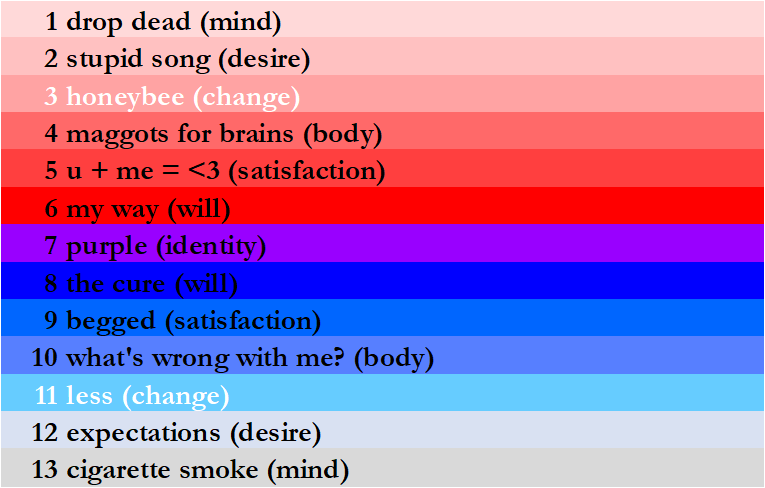
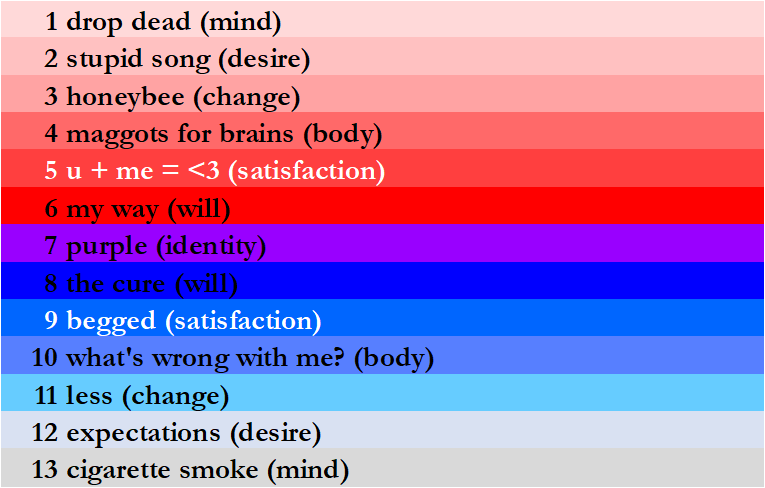
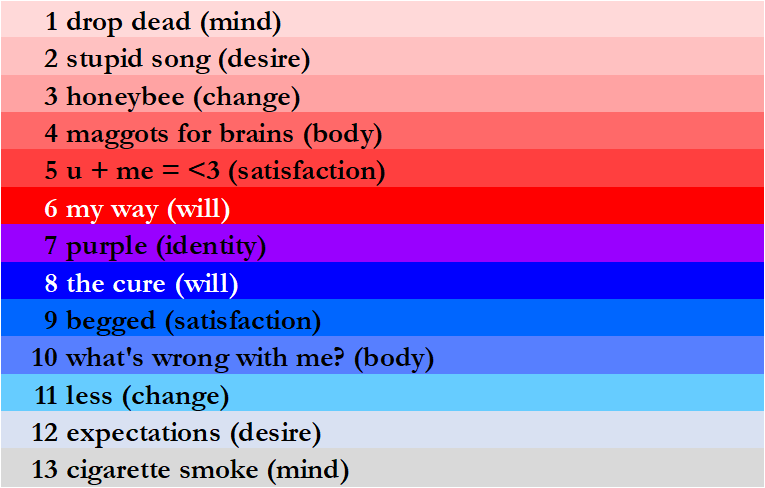
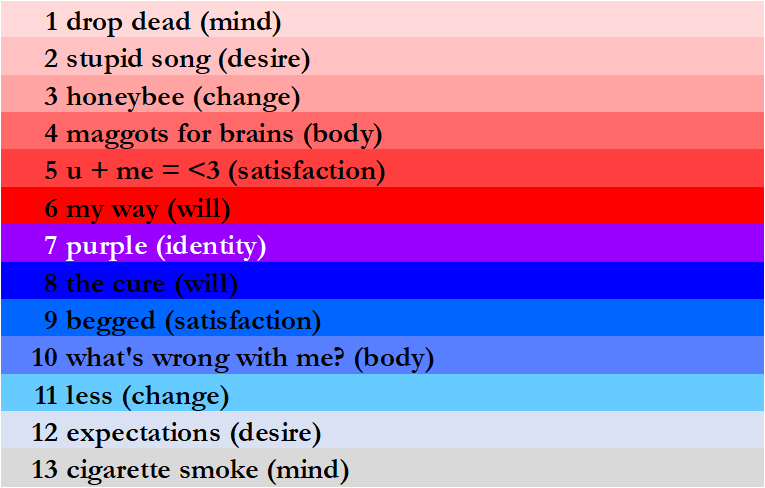
“I met him at a party,” Olivia sings at the start of “expectations.” Likewise, the first verse of “stupid song” describes a party where she feels insecure. At both there’s drug use, by her friends (“stupid song”) and her ex (“expectations”). Is it the same party? Narratively, I would say that seems to be the suggestion, whether or not that maps onto Olivia’s real-world relational history. This pair of songs presents different perspectives on that event and its consequences. As the tale unfolds, it demonstrates Olivia’s character growth across the album’s story.
And wow, what a difference in Olivia’s perspective on her (ex-)boyfriend between the two songs! In “stupid song,” she longs for him and dreams of him, speaking of her affection for him with allusion to Greek mythology (“I’m a heart made of wax and I’m melting in the sun.”) By the time of “expectations,” those wax wings have melted away, and having fallen back to Earth, she admits that his positive perception of him was a delusion (“he wasn’t smart or funny, I convinced myself he was”). Her fear in “drop dead” wasn’t just paranoia, in the end; she really did make him up.
The first verses of both songs end with an emphasis on communication, and as a communication professor that makes me happy. In “stupid song” she imagines their interaction, longing to speak with him. Yet in “expectations,” she has prevented communication by blocking his number.
The chorus of “stupid song” is a passionate statement of romantic desire, and it is a desire that is unchecked: Olivia feels like she is on fire, and like she is a “car… without a brake.” Meanwhile, “expectations” presents her brand-new relational brake system in a non-nonsense, deadpan tone: future guys can’t be passive, or indecisive, or have a fake job. She’s replaced her total insanity in “stupid song” with a grounded rationality, pouring the cold water of caution and self-respect on the flames of romantic desire, yet still holding to faith, drive, and heart.
The second verses of both songs live in the shadow of the party. In both, Olivia is in a dress: in “stupid song,” lying passively on her bed when she should be in pajamas, while in “expectations,” she’s “rocking [her] mini dress with a vodka cran and an open heart.” In “stupid song” she is a picture of desperation; in “expectations,” she is full of confidence, looking with disdain at the guys that are so “desperate for loving, but… I’m not.” Really, “expectations” proves her claim in “stupid song” wrong (“And all the girls at this party are so cool, that’s never been a thing that I could do”). Now, she has become the confident girl who owns the social scene.
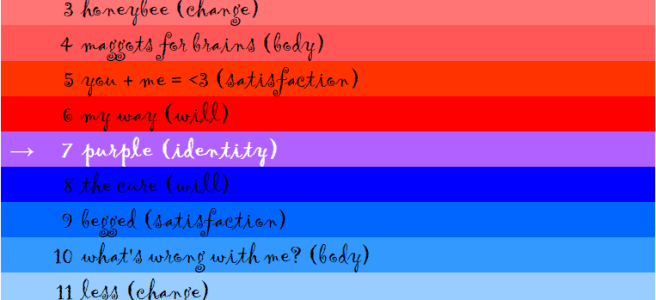
There’s also something to be said about the geography of these songs and the entire album. Toward the beginning of the saga, she is in New York City; by the pivot point in “purple,” she feels at home in London. After crying on the curb at LAX in “less,” she’s still back at home in Los Angeles in “expectations,” expecting to be disappointed by the guys at a bar in the suburbs. Geographically, we’re coming back around to where the album began, moving homeward; “cigarette smoke” will soon describe the scene of emotional devastation that her home has become.
When reflecting on “u + me = <3” and “begged,” I considered social exchange theory, which uses an economic lens to evaluate relationship choices. That theory says we compare our relationships to our comparison level. That level is essentially a threshold we need to meet in order to be satisfied. When I teach my students about this concept, I tell them that the comparison level is, essentially, how “high maintenance” someone is. In “expectations,” Olivia is saying that comparison level has risen; it will take more to keep her happy than what she tolerated in her last relationship.
No other pair of songs so clearly demonstrates Olivia’s character growth across the arc of the album. One line succinctly sums up this growth and the interplay between the two songs: “Gave my heart with zero stipulations [in ‘stupid song’], now [in ‘expectations’] I take careful consideration”.
Previous posts: