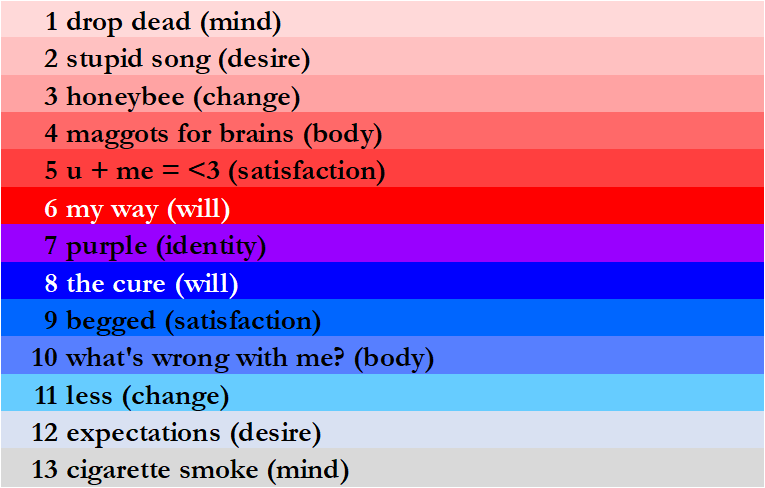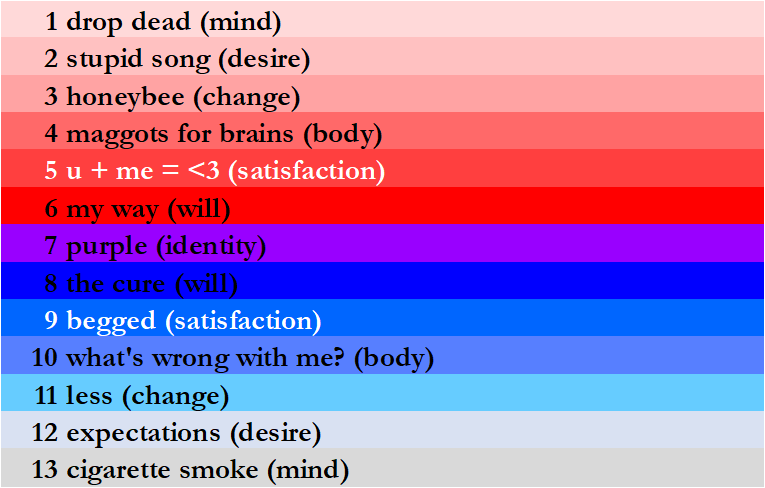
“u + me = <3” (track 5) & “begged” (track 9): am I satisfied in this relationship? (Olivia Rodrigo’s YPSPFAGSIL, analyzed)

Social exchange theory views interpersonal relationships in quasi-economic terms. Relationships give us rewards: affection, status, support, gifts, belonging, etc. But, relationships also carry costs, whether it’s the emotional toll of listening to an upset friend, paying the restaurant bill at the end of a date, or the time and effort spent helping someone move their things.

According to the theory, we calculate the approximate rewards we get and subtract the costs, keeping a sort of “balance sheet” that tells us the “bottom line” of the relationship. Are we making a “profit,” or is this relationship a “loss”? We then compare that bottom line to what we expect to get out of the relationship, and if we’re meeting “expectations” (… more on that later…), we’ll be happy; if not, we’re unhappy. And, we also compare that bottom line to our forecast about what we could get elsewhere. If another relationship would give us a better “profit,” we might dump our current relationship and seek another.

Both “u + me = <3” and “begged” show Olivia running this cost/reward analysis in the spreadsheet of her mind. In “u + me,” the Board will be happy because profits are looking good. She’s excited about how he will “take [her] out to dinner” and “take her anywhere”; she anticipates that he will “buy [her] silver jewelry and all [her] favorite Cadbury.” Meals, bling, and chocolate; it’s a windfall! And she even gets a new big sister, too. No wonder she is satisfied, and she is committed, too, with “the feeling that [she’ll] never want somebody else.”

But by “begged,” her commitment (or “devotion”) remains, though her satisfaction has faltered. Per social exchange theory, she doesn’t see a better option than her current partner, but he certainly isn’t meeting her expectations, “overwhelmed” and “underfed.” No longer is she enamored with the idea of her man taking her out to dinner, instead preferring “to sit here silently and watch movies on TV.” Yes, she “will take what [he’s] giving,” but as the title of the song says, she’s only getting her meager relational profit because she “begged.” Like stockholders who expected the company to make $50 million last quarter when it only got $10 million, she’s dissatisfied with the bottom line.

So, while in “u + me” she dismisses those who say that “modern love’s a cruel endeavor,” in “begged” she wonders if it is a normal thing to fight against love becoming dreadful. In “begged” she’s hurting; in “u + me,” the opposite, as “wounds are healing.” And in “u + me” her satisfaction drives her to impatience, getting “way too far ahead of myself” and even pondering marriage at the age of 25, while in “begged,” her dissatisfaction generates a sort of stoic, patient pretending.

In a ring structure, the echoes point back toward the pivot point (here, track 7, “purple”). In “u + me” she is rushing forward in the car without a brake (see “stupid song”), and she’s even carving their names into the seats. It’s exciting and fun, but it foreshadows danger. Meanwhile, “begged” looks back on the wreck, wondering if there is a way to rescue a relationship that has become static from overattachment. One variant of social exchange theory predicts that relationships are most satisfying and stable when partners have roughly equal costs and rewards. “Begged” is a picture of a relationship without such an equitable distribution of relational profits; but, I would argue that “u + me” suggests they really never did.

Next up: Bodily reactions in “maggots for brains” and “what’s wrong with me?”

Previous posts:

“my way” (track 6) & “the cure” (track 8): what is my will for this relationship? (Olivia Rodrigo’s YPSPFAGSIL, analyzed)

In the previous post, I noted that “purple” is the track at the center of the ring. On either side of it are tracks that pertain to confidence, strength, and the will.

Their contrast is striking. In “my way,” Olivia is defiant, self-assured of victory: “So, where’d you get that confidence from? Last time that I checked, I won!” Just two tracks later, she is full of poison and doubt, “unraveled,” longing for a cure she can’t seem to find. In one song her will is strong; in the other, it’s shattered. The two tracks are a mirror, reflected around the pivot point. After the crisis of identity narrated at the end of “purple,” Olivia’s iron will has vanished, suggesting it was perhaps a show of bravado all along.

Some other lyrical details demonstrate this mirror:

  • In “my way,” Olivia is drawing the lines on the map, warning another woman to stay away from her man. But, at the start of “the cure,” the ones who are “moving the line” are “all the pretty girls in the foreground of [her] mind.”
  • In “my way,” Olivia believes the other woman is “insane,” but in “the cure,” Olivia is the one fighting “bad thoughts.”
  • The threatening woman in “my way” finds her worth in winning Olivia’s man, yet in “the cure,” Olivia realizes that she has been finding her worth in her man too (even though “it’s not enough”).
  • And so “my way” Olivia tries to convince the other woman to leave (to no effect), while her boyfriend tries to convince “the cure” Olivia to quiet her doubts (to no effect).
  • The other woman lingers “like a bad perfume” in “my way,” while Olivia’s doubts linger in “the cure.”
  • The “my way” girl plays a game with “amateur moves,” and the Olivia in “the cure” plays a mind game with herself (“I used to play a game in my head when I’d date a guy…”).

Perhaps the greatest point of connection between the two songs is the presence of female competition. More than any other tracks, both “my way” and “the cure” present other women as a threat to the romantic relationship. In “my way” it is a specific woman who is pursuing Olivia’s man, and in “the cure” it is a broader chorus of “pretty girls,” including those her boyfriend has slept with in the past.

Speaking of mirrors, George Herbert Mead’s symbolic interactionism (a foundational theory in the social sciences) believes we understand who we are via a process called the looking-glass self. To know our physical self, we look in a mirror. But to know our social self, the “looking-glass” is the reactions of other people. How they treat us tell us something about who we are.

That looking-glass self is at play in the games described by this pair of songs. In “my way,” the actions of the other woman make Olivia feel how committed and defensive she is about the relationship. She’s willing to play the game and she’s sure that she’ll win it.

But, “the cure” takes place after the all-important pivot in “purple.” After that crisis of relationship identity, female competition makes Olivia feel like she doesn’t measure up, like she’s never “done enough.” And now, in her state of mental paralysis, it is her boyfriend fighting for the relationships, trying to remove the “toxins in [her] bloodstream.”

Rodrigo has said that “the cure” is the album’s thesis statement. That fits the ring cycle theory: after setting the stage with the album’s first half, it makes sense to put a thesis statement about the entire work right at the start of the second half. Elaborating on the doubts first voiced at the end of “purple,” “the cure” makes it clear that this album is a tragedy. Olivia has been trying to find ultimate satisfaction in a romantic relationship, but it will never be the cure, and instead her flaws will contribute to the relationship’s demise.

Not her flaws alone, of course. She’ll aim criticism at her man in the coming tracks. But in “the cure,” she owns that her own fears have shattered the force of will she had back in “my way.” The overidentification described in “purple” now reveals that a romantic partner, as important and meaningful as they can be, cannot solve all of a person’s problems. If we expect another person to do so, that is unreasonable and will damage the relationship, perhaps even leading to its demise.

Other posts: