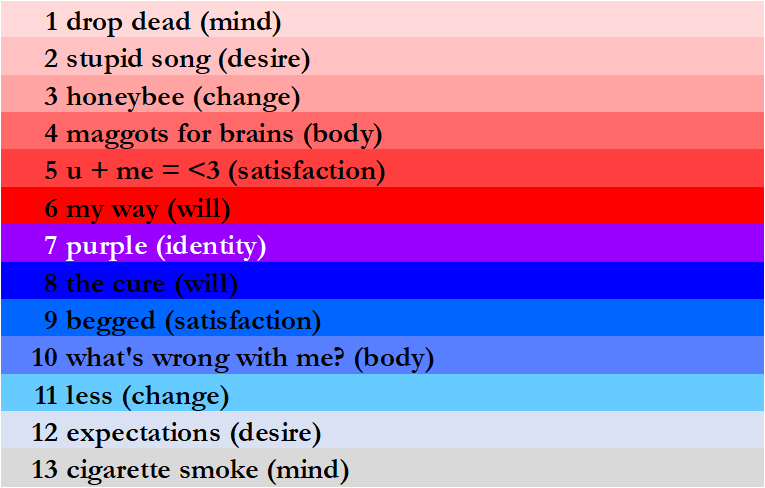
In a marriage, people might say something like, “I don’t know where I end and my spouse begins.” Over time, in a close relationship, our identity becomes fused with the other person. But we don’t want to lose ourselves completely; we want to be connected, but not so connected that we lose our individuality. That tension is at the heart of “purple” (track 7), which is the track at the center of Olivia Rodrigo’s powerhouse third album you seem pretty sad for a girl so in love.
In my previous post, I presented, in broad strokes, the idea that the album is a ring structure. Specifically, I argued that the album’s tracks are arranged in pairs around the pivot track in the center, “purple.” I’d like to explore this idea further by looking at the details in those contrasting pairs. As I do so, I will try to stay close to the lyrics, while also drawing on communication theory to understand them.
This exploration should start at the “purple” pivot. Why begin there? As some have pointed out to me, the ring structure can also be described as a chiastic structure. Those familiar with analysis of Bible passages may have heard of it (yes, this literary structure is that old!), because it is common there. The term chiastic comes from the Greek letter chi, which in capital form looks like our letter X; just as the letter’s lines cross at the center point, so the ideas in the chiastic structure cross at the central theme. The purpose of such a literary arrangement is to emphasize that central pivot point. Therefore, it’s the place to start to understand this album and its contrasting song pairs.
This central track is about identity. Who is Olivia, who is her partner, and most crucially, who are they as a couple? Who have they become together, and who are they now individually?
On my first listen to the track, the superficial picture seemed sweet, even cute: “And I melt with you, your red and my blue, now I see the world in purple.” The color metaphor indicates their individual identities have combined, and become something different than the component parts. I think many couples, families, and friends would say that is a desirable, even beautiful, thing. And it can be… but there is a danger.
Much of my scholarship has focused on interpersonal relationships, and I also author a communication theory textbook, and so this song brings to my mind one of the most popular and influential interpersonal communication theories: Relational dialectics theory (RDT). This theory claims that we create our relationships through talk, and as we do, we generate and navigate relational tensions. Over time, research on this theory has discovered some key tensions that occur again and again across different types of relationships. And the most central, most fundamental relational tension is connection versus autonomy.
Examples of this tension abound. A teenage daughter wishes her parents would get off her back and give her some space, some autonomy. A father wishes he had more time to talk so he could connect with his adult son. Healthy relationships often strike a balance between connection and autonomy. In “purple,” Olivia seems to celebrate their connection… but despite her positivity, something seems wrong. Autonomy is missing, and at first, she doesn’t seem quite able to recognize that.
The first sign of trouble occurs in the second verse: “And we fight over who I’m hanging out with like a real couple.” RDT recognizes this as a common point of tension among couples: How much time do we spend together versus apart? When do we hang out with friends in common, versus friends that are our own? Healthy relationships honor that balance; as I write this, I’m glad my wife is going to see friends at a book club tonight rather than hanging out with me. In “purple,” given that Olivia and her partner are fighting about just that kind of thing, they don’t seem to be navigating this tension well.
The next pre-chorus drives home that Olivia and her partner are emphasizing their connection while ignoring desire for autonomy: “It’s a small world when it only can revolve around us two” sounds sweet on one hand, yet also lonely, and ominous. Then a deeper warning bell: “I had big dreams ’til I tied myself to you; now I’m all-consumed.” Olivia’s sense of personal identity, her autonomy, has disappeared into a black hole of overconnection.
One of my musical core memories is the first time I listened to this song’s outro. It’s a shocker, sending the album careening in a different direction than the first half. Almost as if she were an RDT scholar, Olivia asks the questions: “Are we so in love? Are we too attached?” No longer is their relationship a vibrant purple; instead, their color combination has ruined, “melt[ing]” into “black,” until “it just feels sad.”
I’ve ignored a relevant piece of RDT which might have fans of the theory screaming at the screen right now, and that is the idea of monologue versus dialogue. RDT celebrates the many voices that bring a relationship, family, or group into being. A family would be a boring place if all members thought, talked, and acted the same! But some families are stifling like that. They are a monologue, where one point of view dominates. RDT would rather our relationships be a dialogue, where the different voices, ideas, and perspectives of people combine into something beautiful. Really, music is that way, as different notes maintain their distinctiveness yet synthesize into a song.
What I find so captivating about “purple” is that it captures the experience of a relationship that has become a monologue rather than a dialogue, and not only in the lyrics. The song’s music feels peaceful on the surface, but uneasy underneath, as though something is being suppressed that shouldn’t, and that thing is about to explode. The song’s shocking outro is the first flash of that explosion.
So that is what Olivia has placed at the center of her ring/chiastic album: the question of identity, of “who am I in this relationship?,” of what happens when we ignore that question, and what happens when we finally confront it. The subsequent song pairs will address several facets of romantic relationships, yet will also connect to this central question of identity, which academic theory also identifies as a foundational question in any relationship.
Finally, I think this song also hints at the structure of the album. In the second verse, she notes that “now a toothbrush, a coat, and a pair of shoes all come in doubles (double, doubles, doubles).” It’s a clue, perhaps, that the tracks surrounding “purple” also occur in doubles. And there’s also the chorus, which describes how “our paths intersect ’til the lines formed a circle.” I don’t think Olivia is only talking about relationship formation. She’s also describing the structure of the album, where a “girl so in love” line and a “you seem pretty sad” line intersect (like an X!), here at the central pivot point, and form a circle: the album’s ring structure.
Other posts:


6 thoughts on ““purple” (track 7): what is my identity in this relationship? (Olivia Rodrigo’s YSPSFAGSIL, analyzed)”