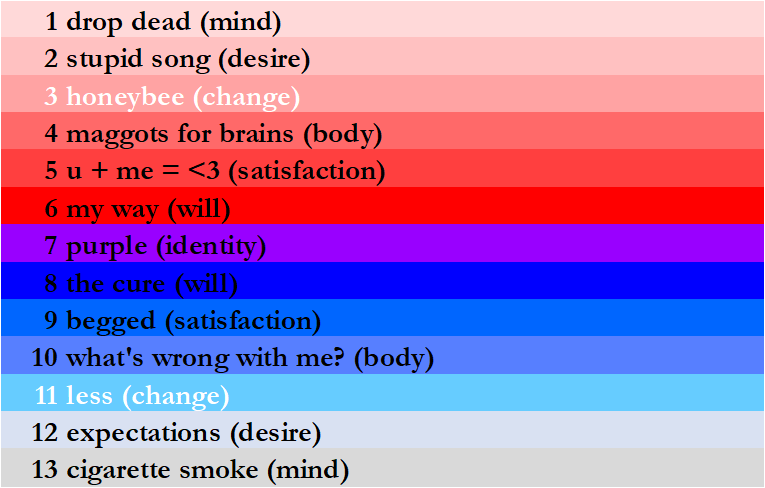
“I met him at a party,” Olivia sings at the start of “expectations.” Likewise, the first verse of “stupid song” describes a party where she feels insecure. At both there’s drug use, by her friends (“stupid song”) and her ex (“expectations”). Is it the same party? Narratively, I would say that seems to be the suggestion, whether or not that maps onto Olivia’s real-world relational history. This pair of songs presents different perspectives on that event and its consequences. As the tale unfolds, it demonstrates Olivia’s character growth across the album’s story.
And wow, what a difference in Olivia’s perspective on her (ex-)boyfriend between the two songs! In “stupid song,” she longs for him and dreams of him, speaking of her affection for him with allusion to Greek mythology (“I’m a heart made of wax and I’m melting in the sun.”) By the time of “expectations,” those wax wings have melted away, and having fallen back to Earth, she admits that his positive perception of him was a delusion (“he wasn’t smart or funny, I convinced myself he was”). Her fear in “drop dead” wasn’t just paranoia, in the end; she really did make him up.
The first verses of both songs end with an emphasis on communication, and as a communication professor that makes me happy. In “stupid song” she imagines their interaction, longing to speak with him. Yet in “expectations,” she has prevented communication by blocking his number.
The chorus of “stupid song” is a passionate statement of romantic desire, and it is a desire that is unchecked: Olivia feels like she is on fire, and like she is a “car… without a brake.” Meanwhile, “expectations” presents her brand-new relational brake system in a non-nonsense, deadpan tone: future guys can’t be passive, or indecisive, or have a fake job. She’s replaced her total insanity in “stupid song” with a grounded rationality, pouring the cold water of caution and self-respect on the flames of romantic desire, yet still holding to faith, drive, and heart.
The second verses of both songs live in the shadow of the party. In both, Olivia is in a dress: in “stupid song,” lying passively on her bed when she should be in pajamas, while in “expectations,” she’s “rocking [her] mini dress with a vodka cran and an open heart.” In “stupid song” she is a picture of desperation; in “expectations,” she is full of confidence, looking with disdain at the guys that are so “desperate for loving, but… I’m not.” Really, “expectations” proves her claim in “stupid song” wrong (“And all the girls at this party are so cool, that’s never been a thing that I could do”). Now, she has become the confident girl who owns the social scene.
There’s also something to be said about the geography of these songs and the entire album. Toward the beginning of the saga, she is in New York City; by the pivot point in “purple,” she feels at home in London. After crying on the curb at LAX in “less,” she’s still back at home in Los Angeles in “expectations,” expecting to be disappointed by the guys at a bar in the suburbs. Geographically, we’re coming back around to where the album began, moving homeward; “cigarette smoke” will soon describe the scene of emotional devastation that her home has become.
When reflecting on “u + me = <3” and “begged,” I considered social exchange theory, which uses an economic lens to evaluate relationship choices. That theory says we compare our relationships to our comparison level. That level is essentially a threshold we need to meet in order to be satisfied. When I teach my students about this concept, I tell them that the comparison level is, essentially, how “high maintenance” someone is. In “expectations,” Olivia is saying that comparison level has risen; it will take more to keep her happy than what she tolerated in her last relationship.
No other pair of songs so clearly demonstrates Olivia’s character growth across the arc of the album. One line succinctly sums up this growth and the interplay between the two songs: “Gave my heart with zero stipulations [in ‘stupid song’], now [in ‘expectations’] I take careful consideration”.
Within close relationships research, some scholars have examined relational turning points. A first date, a big fight, a wedding, or the birth of a child are some examples. When scholars do this type of research, sometimes they have people draw a chart of the relationship’s ups and downs over time, using that graph to identity those turning points.
If Olivia were drawing such a graph, “honeybee” would be a high point and “less” a low point. And these two piano-driven songs both mark big turning points: In the first, the relationship formally starts, and in the second, the relationship formally ends.
The first verse of both songs take place in a nighttime setting, focusing on time and healing. In “honeybee” her outlook is optimistic, exclaiming that “it’s true time can heal even the worst of wounds.” In contrast, in “less” she isn’t feeling well, her “body and head protesting” with a “stomach” that is “in knots” (which flows from the symptom list in the prior song, “what’s wrong with me?”). Now, the idea that time will heal is a vain hope that flies in the face of evidence: “maybe it’ll fix itself tomorrow, but I’ve been saying that like every night.”
Both songs also feature Olivia’s quietness, but that silence has different meanings. In “honeybee” she assures him, “even when I’m quiet I love you, baby, I promise.” Yet in “less,” there’s no assurance to be found when she says “I don’t wanna talk, let’s just go to bed or something.”
There’s also contrast in the meaning of their time together. In “honeybee” it is sweet (like a “sticky sweet tangerine”), intimate, and fun, as they “walk in the dark, hop the fence in the park” and as he simply “pick[s] [her] up, walk[s] [her] home.” By “less,” these simple yet meaningful dates have been replaced by bigger, costly events that are joyless (“our trip to Big Sur only confirmed this isn’t what it should feel like”).
In “honeybee,” his face is the lyrical focus, and it’s a lyrical focus that foreshadows what will happen in less: “I hope I never see what your face looks like going.” Then “less” tells us what he is like when he is going; he isn’t leaving in anger, but rather does “the noble thing” by giving her a way out that she’s doesn’t want to take. In “less,” the focus turns to her face. He watches her cry twice, first in the chorus, and then “on the curb at LAX.” And in “less,” Olivia acknowledges that he’s “seen [her] truly happy, so [he] know[s] right now [she’s] not,” a callback to the sorts of light, joyous events described in “honeybee.”
The terms of endearment also move in opposite directions. The word “honeybee” only occurs once in the song, and in the same line she calls him “baby boy.” At the end of “less,” now he is the one calling her “babe” as he speaks the words that will terminate the relationship.
After instrumental breaks (that, perhaps coincidentally, end at the 2:41 mark in each), both songs move quickly to the end. And in each conclusion, the focus turns to hopes and wishes. In “honeybee,” the final line “here’s to hoping” foreshadows danger; in the final line “I wish you loved me less,” that danger has become reality.
Undoubtedly, the album treats “purple,” the song where Olivia realizes they have become too attached, as a key relational turning point as well. On either side of purple, and equally distant from it, “honeybee” and “less” chart the turning points before and after that chart their shift into and out of romance.
Last time, I considered how “u + me = <3” and “begged” are about the exchanges that happen in relationships. And an exchange-oriented approach to relationships is inherently individualistic: it’s about what I get out of the relationship versus what you get out of the relationship. But, when we get really close to someone, our mental “balance sheet” changes. We no longer think of you and I, but rather, we think of we. My costs are your costs; really, they’re our costs. Same for our rewards. That’s the subject of self-expansion theory, which claims that when we get close to someone, we include that person in our sense of the self.
That’s the focus of “maggots for brains” (track 4) and “what’s wrong with me?” (track 10). Both tracks use medical language to describe how that self/other overlap makes Olivia feel. There’s perhaps more subject matter similarity here than any two tracks on the album. In both, Olivia is sick and her relationship is the reason why.
In the first verse of both songs, Olivia is at home, bored, and not feeling well. She’s also unable to communicate these psycho-bodily sensations clearly: In “maggots,” she “tried to write, nothing came out,” and in “what’s wrong?”, she “can’t describe this feeling [she’s] got in [her] head.” Throughout both songs she remains homebound, but with one futile exception in each, going “to a party but only on principle” or “to the doctor, and she said I was fine.”
The chorus of both songs is a description of her illnesses, a bit like the list of symptoms she’s entering into Google on “what’s wrong?” In “maggots,” she is a “zombie in her body”; “what’s wrong?” echoes this in verse 1, as she is “out of body in [her] bed.” In both songs she is helpless in the face of her symptoms (“nothing ever seems to help” and “what can I do but think of you?”). And both choruses conclude with the diagnosis: in the first case, this is “just the thing that happens when my baby goes away”; in the second case, “I think you’re what’s wrong with me.” In other words, the problem is his presence, and then later the problem is his absence.
There’s even similarity in how Olivia tries to cope with her sickness: by drinking large quantities of beverages. In “maggots” it’s “a pot of coffee”; in “what’s wrong?”, a “bottle of wine.” One is a stimulant, and the other a depressant, which fits both songs and their respective halves of the album.
In terms of self-expansion theory, these songs reflect the deep level of self-other inclusion Olivia feels in this romantic relationship. When we are so close to someone, it’s natural to feel like part of you is missing when the one you care about is gone. In many cases that’s healthy, but as “this song “maggots” looks ahead to the pivot point, we know Olivia will ultimately decide it’s not. And as “what’s wrong?” looks back on that pivot point, Olivia’s heartache is that she isn’t certain she wants to have this level of self-other inclusion anymore. Her prescription has shifted quite a bit from wishing for anything, even “a tragedy,” that would bring him near.
Finally, there’s Olivia’s curious observation on “what’s wrong?”: “lately I’ve been spiraling.” A spiral is a circle… like a ring. Perhaps this is a subtle hint that the album is spiraling around, revisiting themes. The next theme we’ll consider are the songs before/after, which chronicle the relationship’s beginning (“honeybee”) and its end (“less”).
Social exchange theory views interpersonal relationships in quasi-economic terms. Relationships give us rewards: affection, status, support, gifts, belonging, etc. But, relationships also carry costs, whether it’s the emotional toll of listening to an upset friend, paying the restaurant bill at the end of a date, or the time and effort spent helping someone move their things.
According to the theory, we calculate the approximate rewards we get and subtract the costs, keeping a sort of “balance sheet” that tells us the “bottom line” of the relationship. Are we making a “profit,” or is this relationship a “loss”? We then compare that bottom line to what we expect to get out of the relationship, and if we’re meeting “expectations” (… more on that later…), we’ll be happy; if not, we’re unhappy. And, we also compare that bottom line to our forecast about what we could get elsewhere. If another relationship would give us a better “profit,” we might dump our current relationship and seek another.
Both “u + me = <3” and “begged” show Olivia running this cost/reward analysis in the spreadsheet of her mind. In “u + me,” the Board will be happy because profits are looking good. She’s excited about how he will “take [her] out to dinner” and “take her anywhere”; she anticipates that he will “buy [her] silver jewelry and all [her] favorite Cadbury.” Meals, bling, and chocolate; it’s a windfall! And she even gets a new big sister, too. No wonder she is satisfied, and she is committed, too, with “the feeling that [she’ll] never want somebody else.”
But by “begged,” her commitment (or “devotion”) remains, though her satisfaction has faltered. Per social exchange theory, she doesn’t see a better option than her current partner, but he certainly isn’t meeting her expectations, “overwhelmed” and “underfed.” No longer is she enamored with the idea of her man taking her out to dinner, instead preferring “to sit here silently and watch movies on TV.” Yes, she “will take what [he’s] giving,” but as the title of the song says, she’s only getting her meager relational profit because she “begged.” Like stockholders who expected the company to make $50 million last quarter when it only got $10 million, she’s dissatisfied with the bottom line.
So, while in “u + me” she dismisses those who say that “modern love’s a cruel endeavor,” in “begged” she wonders if it is a normal thing to fight against love becoming dreadful. In “begged” she’s hurting; in “u + me,” the opposite, as “wounds are healing.” And in “u + me” her satisfaction drives her to impatience, getting “way too far ahead of myself” and even pondering marriage at the age of 25, while in “begged,” her dissatisfaction generates a sort of stoic, patient pretending.
In a ring structure, the echoes point back toward the pivot point (here, track 7, “purple”). In “u + me” she is rushing forward in the car without a brake (see “stupid song”), and she’s even carving their names into the seats. It’s exciting and fun, but it foreshadows danger. Meanwhile, “begged” looks back on the wreck, wondering if there is a way to rescue a relationship that has become static from overattachment. One variant of social exchange theory predicts that relationships are most satisfying and stable when partners have roughly equal costs and rewards. “Begged” is a picture of a relationship without such an equitable distribution of relational profits; but, I would argue that “u + me” suggests they really never did.
Their contrast is striking. In “my way,” Olivia is defiant, self-assured of victory: “So, where’d you get that confidence from? Last time that I checked, I won!” Just two tracks later, she is full of poison and doubt, “unraveled,” longing for a cure she can’t seem to find. In one song her will is strong; in the other, it’s shattered. The two tracks are a mirror, reflected around the pivot point. After the crisis of identity narrated at the end of “purple,” Olivia’s iron will has vanished, suggesting it was perhaps a show of bravado all along.
Some other lyrical details demonstrate this mirror:
In “my way,” Olivia is drawing the lines on the map, warning another woman to stay away from her man. But, at the start of “the cure,” the ones who are “moving the line” are “all the pretty girls in the foreground of [her] mind.”
In “my way,” Olivia believes the other woman is “insane,” but in “the cure,” Olivia is the one fighting “bad thoughts.”
The threatening woman in “my way” finds her worth in winning Olivia’s man, yet in “the cure,” Olivia realizes that she has been finding her worth in her man too (even though “it’s not enough”).
And so “my way” Olivia tries to convince the other woman to leave (to no effect), while her boyfriend tries to convince “the cure” Olivia to quiet her doubts (to no effect).
The other woman lingers “like a bad perfume” in “my way,” while Olivia’s doubts linger in “the cure.”
The “my way” girl plays a game with “amateur moves,” and the Olivia in “the cure” plays a mind game with herself (“I used to play a game in my head when I’d date a guy…”).
Perhaps the greatest point of connection between the two songs is the presence of female competition. More than any other tracks, both “my way” and “the cure” present other women as a threat to the romantic relationship. In “my way” it is a specific woman who is pursuing Olivia’s man, and in “the cure” it is a broader chorus of “pretty girls,” including those her boyfriend has slept with in the past.
Speaking of mirrors, George Herbert Mead’s symbolic interactionism (a foundational theory in the social sciences) believes we understand who we are via a process called the looking-glass self. To know our physical self, we look in a mirror. But to know our social self, the “looking-glass” is the reactions of other people. How they treat us tell us something about who we are.
That looking-glass self is at play in the games described by this pair of songs. In “my way,” the actions of the other woman make Olivia feel how committed and defensive she is about the relationship. She’s willing to play the game and she’s sure that she’ll win it.
But, “the cure” takes place after the all-important pivot in “purple.” After that crisis of relationship identity, female competition makes Olivia feel like she doesn’t measure up, like she’s never “done enough.” And now, in her state of mental paralysis, it is her boyfriend fighting for the relationship, trying to remove the “toxins in [her] bloodstream.”
Rodrigo has said that “the cure” is the album’s thesis statement. That fits the ring cycle theory: after setting the stage with the album’s first half, it makes sense to put a thesis statement about the entire work right at the start of the second half. Elaborating on the doubts first voiced at the end of “purple,” “the cure” makes it clear that this album is a tragedy. Olivia has been trying to find ultimate satisfaction in a romantic relationship, but it will never be the cure, and instead her flaws will contribute to the relationship’s demise.
Not her flaws alone, of course. She’ll aim criticism at her man in the coming tracks. But in “the cure,” she owns that her own fears have shattered the force of will she had back in “my way.” The overidentification described in “purple” now reveals that a romantic partner, as important and meaningful as they can be, cannot solve all of a person’s problems. If we expect another person to do so, that is unreasonable and will damage the relationship, perhaps even leading to its demise.
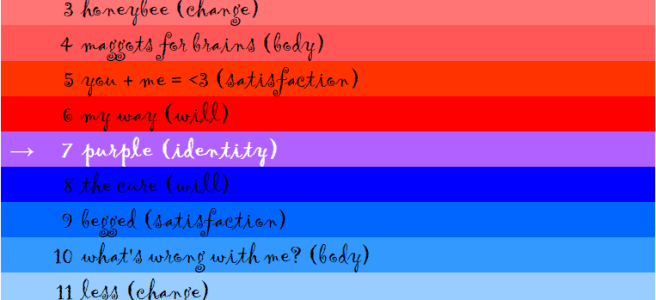
In a marriage, people might say something like, “I don’t know where I end and my spouse begins.” Over time, in a close relationship, our identity becomes fused with the other person. But we don’t want to lose ourselves completely; we want to be connected, but not so connected that we lose our individuality. That tension is at the heart of “purple” (track 7), which is the track at the center of Olivia Rodrigo’s powerhouse third album you seem pretty sad for a girl so in love.
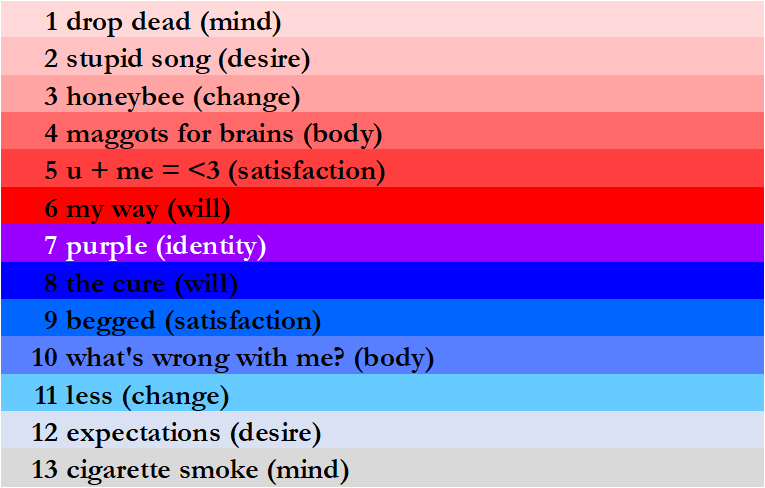
In my previous post, I presented, in broad strokes, the idea that the album is a ring structure. Specifically, I argued that the album’s tracks are arranged in pairs around the pivot track in the center, “purple.” I’d like to explore this idea further by looking at the details in those contrasting pairs. As I do so, I will try to stay close to the lyrics, while also drawing on communication theory to understand them.
This exploration should start at the “purple” pivot. Why begin there? As some have pointed out to me, the ring structure can also be described as a chiastic structure. Those familiar with analysis of Bible passages may have heard of it (yes, this literary structure is that old!), because it is common there. The term chiastic comes from the Greek letter chi, which in capital form looks like our letter X; just as the letter’s lines cross at the center point, so the ideas in the chiastic structure cross at the central theme. The purpose of such a literary arrangement is to emphasize that central pivot point. Therefore, it’s the place to start to understand this album and its contrasting song pairs.
This central track is about identity. Who is Olivia, who is her partner, and most crucially, who are they as a couple? Who have they become together, and who are they now individually?
On my first listen to the track, the superficial picture seemed sweet, even cute: “And I melt with you, your red and my blue, now I see the world in purple.” The color metaphor indicates their individual identities have combined, and become something different than the component parts. I think many couples, families, and friends would say that is a desirable, even beautiful, thing. And it can be… but there is a danger.
Much of my scholarship has focused on interpersonal relationships, and I also author a communication theory textbook, and so this song brings to my mind one of the most popular and influential interpersonal communication theories: Relational dialectics theory (RDT). This theory claims that we create our relationships through talk, and as we do, we generate and navigate relational tensions. Over time, research on this theory has discovered some key tensions that occur again and again across different types of relationships. And the most central, most fundamental relational tension is connection versus autonomy.
Examples of this tension abound. A teenage daughter wishes her parents would get off her back and give her some space, some autonomy. A father wishes he had more time to talk so he could connect with his adult son. Healthy relationships often strike a balance between connection and autonomy. In “purple,” Olivia seems to celebrate their connection… but despite her positivity, something seems wrong. Autonomy is missing, and at first, she doesn’t seem quite able to recognize that.
The first sign of trouble occurs in the second verse: “And we fight over who I’m hanging out with like a real couple.” RDT recognizes this as a common point of tension among couples: How much time do we spend together versus apart? When do we hang out with friends in common, versus friends that are our own? Healthy relationships honor that balance; as I write this, I’m glad my wife is going to see friends at a book club tonight rather than hanging out with me. In “purple,” given that Olivia and her partner are fighting about just that kind of thing, they don’t seem to be navigating this tension well.
The next pre-chorus drives home that Olivia and her partner are emphasizing their connection while ignoring desire for autonomy: “It’s a small world when it only can revolve around us two” sounds sweet on one hand, yet also lonely, and ominous. Then a deeper warning bell: “I had big dreams ’til I tied myself to you; now I’m all-consumed.” Olivia’s sense of personal identity, her autonomy, has disappeared into a black hole of overconnection.
One of my musical core memories is the first time I listened to this song’s outro. It’s a shocker, sending the album careening in a different direction than the first half. Almost as if she were an RDT scholar, Olivia asks the questions: “Are we so in love? Are we too attached?” No longer is their relationship a vibrant purple; instead, their color combination has ruined, “melt[ing]” into “black,” until “it just feels sad.”
I’ve ignored a relevant piece of RDT which might have fans of the theory screaming at the screen right now, and that is the idea of monologue versus dialogue. RDT celebrates the many voices that bring a relationship, family, or group into being. A family would be a boring place if all members thought, talked, and acted the same! But some families are stifling like that. They are a monologue, where one point of view dominates. RDT would rather our relationships be a dialogue, where the different voices, ideas, and perspectives of people combine into something beautiful. Really, music is that way, as different notes maintain their distinctiveness yet synthesize into a song.
What I find so captivating about “purple” is that it captures the experience of a relationship that has become a monologue rather than a dialogue, and not only in the lyrics. The song’s music feels peaceful on the surface, but uneasy underneath, as though something is being suppressed that shouldn’t, and that thing is about to explode. The song’s shocking outro is the first flash of that explosion.
So that is what Olivia has placed at the center of her ring/chiastic album: the question of identity, of “who am I in this relationship?,” of what happens when we ignore that question, and what happens when we finally confront it. The subsequent song pairs will address several facets of romantic relationships, yet will also connect to this central question of identity, which academic theory also identifies as a foundational question in any relationship.
Finally, I think this song also hints at the structure of the album. In the second verse, she notes that “now a toothbrush, a coat, and a pair of shoes all come in doubles (double, doubles, doubles).” It’s a clue, perhaps, that the tracks surrounding “purple” also occur in doubles. And there’s also the chorus, which describes how “our paths intersect ’til the lines formed a circle.” I don’t think Olivia is only talking about relationship formation. She’s also describing the structure of the album, where a “girl so in love” line and a “you seem pretty sad” line intersect (like an X!), here at the central pivot point, and form a circle: the album’s ring structure.
“Gray November, I’ve been down since July.” The opening lyric from the “Evermore” title track hits different now. In July, the surgeon removed the polyp that revealed the presence of stage 3 rectal cancer. And I spent the entire month of November in daily chemoradiation to treat it.
I’m 46. This all emerged after my first routine colonoscopy. If you are 45 or older, get one; if you are 40 or older, and you have any ability to have a colonoscopy done, I hope you will. It is a very good idea and not as onerous as people make it sound. I certainly wish I had. I’d go back in time and change that, but I can’t.
During my screening MRIs, I asked the technicians to play Taylor Swift while I was in the tube. It was a practical decision as well as an emotional one. I know the length of many Swift songs, at least roughly, so when they told me the scan would take about 45 minutes, Taylor both entertained me and let me know how much time I had remaining.
Fast forward to October 27, the first day of radiation treatment. The nurses asked what music I wanted, and when I said Swift, one of the nurses lit up. “We don’t get many Swifties around here!” she said.
“Are you a Swiftie?” I asked. Indeed she was! Later, I learned that she rearranged her schedule so she could have me as a patient and listen to Taylor Swift with me during my treatment. By the end, Nurse Allison even knew how to seed the Pandora station so that it gravitated toward my favorites.
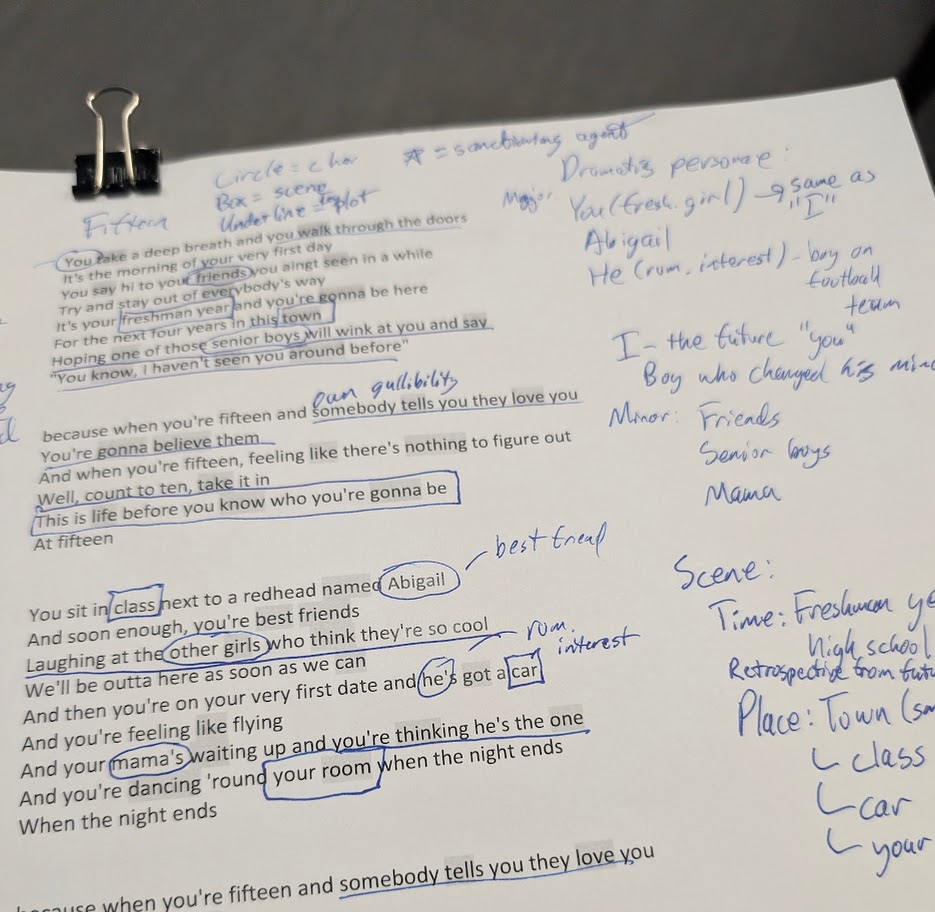
Then there’s the waiting for appointments, an inevitable part of any major medical issue. Early in the treatment cycle, I printed out the lyrics of some of Swift’s most semantically-central songs. I don’t want to steal my own thunder for what might become a future paper, but suffice it to say that, as I sat waiting for radiation therapy, a hospital robe my only clothing to speak of, I busied and distracted myself with a pen and paper, conducting rhetorical analysis of some of her most famous lyrics. I hate it here, so analyzing those lyrics became lunar valleys in my mind.
Now we are back to December, the season of Advent (and, for many Swifties, of the Evermore album). I have finished five weeks of chemoradiation, and later this month, I will begin a chemotherapy regimen that will last 3 months. The hope is that this will take care of the cancer, and that future scans and scopes will reveal no tumor. If so, life continues. If not—and there is a substantial chance the treatment will not be completely effective—I likely will need surgery to remove my rectum. That would be life-changing.
If the opening line of “Evermore” is uncanny, the bridge, that powerful duet between Justin Vernon and Taylor Swift, is an emotional gut-punch. I mean, so many of her bridges are, but this one has taken on deep subjective meaning for me. It’s likely not with meaning she intended, but that’s ok; such is art, whose meaning often is a joint creation between the artist and the audience.
Vernon: Can’t not think of all the cost, and the things that will be lost. Oh, can we just get a pause? To be certain we’ll be tall again. Whether weather be the frost, or the violence of the dog days I’m on waves, out being tossed; is there a line that I could just go cross?
Taylor (as Vernon repeats his section in call-and-response): And when I was shipwrecked, I thought of you. In the cracks of light, I dreamed of you. It was real enough to get me through. But I swear, you were there.
I’ve already felt the cost of my cancer, the things lost: time, energy, professional opportunities, mental drain, the pain of side effects, the burden on my family. And much greater costs may lie ahead. I’ve longed for the kind of pause that Vernon describes, and have appreciated those times of rest when they have come. I’ve also felt shipwrecked, storm-tossed, and the imagery here calls to mind the lament of the psalmist in pain: “All your breakers and your waves have gone over me” (Psalm 42:7, ESV).
A foundational aspect of the lyrical anatomy of almost every Taylor Swift song is this: It is sung in first person, by an “I” (usually but not always Taylor Swift) singing to a “you.” There’s almost nothing in the way of a third-person story about a girl named Lucky, and when Taylor gets close to something like that, she still shows up to buy the Rhode Island mansion at the end of the song. Normally the “you” is easy to identify, at least generally, if not specifically. Often “you” shows up in the first verse.
Not in “Evermore.” “You” doesn’t show up until this bridge. And it’s never entirely clear who this “you” is, present in the cracks of light in the midst of a shipwreck storm.
The imagery calls to mind the “Cardigan” music video, too.
I don’t know how much overlap there is between the Swiftie and Tolkien fan bases, but I’m in the center of that Venn diagram. I adore Tolkien, not only as a fantasy author, but as an academic who put his faith in conversation with his scholarship. During my cancer journey, I’ve thought not only of Taylor shipwrecked on the sea, but also of suffering Frodo, faithful Sam, and the grace of God that brought about the culminating victory at Mount Doom.
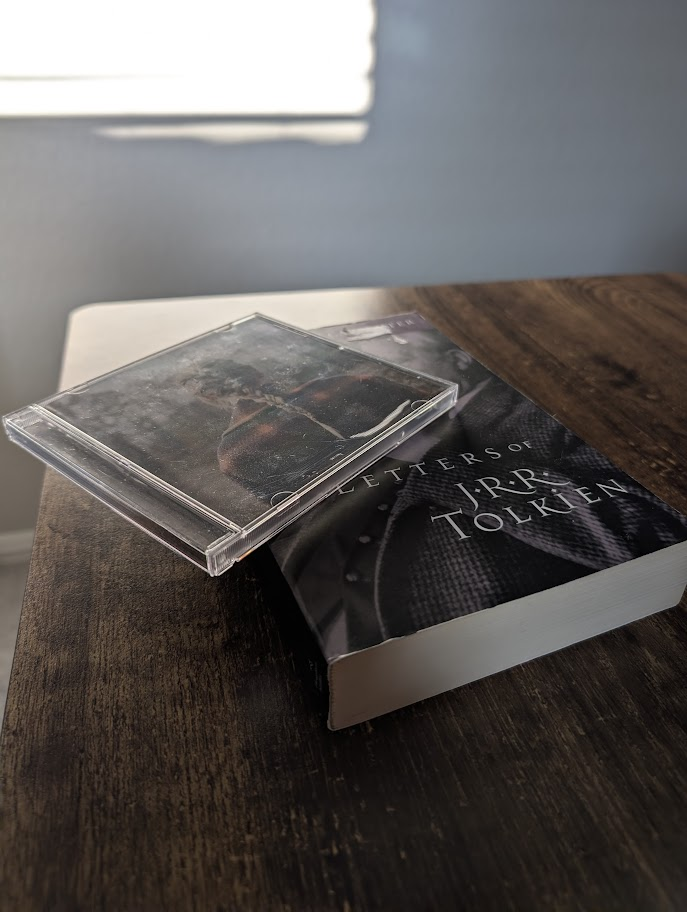
Tolkien wrote fantasy, and he theorized about it. As a communication theory textbook author, I approve. In his essay “On Fairy Stories,” he coined a memorable new word: “eucatastrophe.” In a letter to his son, he defined the term succinctly: “the sudden happy turn in a story which pierces you with a joy that brings tears.” The endings of Lord of the Rings, Harry Potter, and The Lion, the Witch, and the Wardrobe are good examples. In the Taylorverse, examples might include “Love Story” (with her dad’s unexpected change of heart) and “Long Live” (where the “band of thieves of ripped up jeans” unexpectedly gets to “rule the world”).
For Tolkien, the eucatastrophe is more than a literary device. It is a window into a deeper truth about the way the world works. Much of human life involves sorrow, pain, heartbreak, and death. We inhabit a world filled with conflict and war, cancer and disease, decay and loss.
It would be easy to conclude that this is the permanent, inevitable way of things. But Tolkien did not believe this. Nor do I. The eucatastrophe “denies (in the face of much evidence, if you will) universal final defeat and in so far is [gospel], giving a fleeting glimpse of Joy, Joy beyond the walls of the world, poignant as grief.“
Here, in this season of Advent, Tolkien’s most famous quote about the eucatastrophe clarifies why he had such hope: “The Birth of Christ is the eucatastrophe of Man’s history. The Resurrection is the eucatastrophe of the story of the Incarnation. This story begins and ends in joy.“
“What does this have to do with ‘Evermore’??“, the patient Swiftie reading this may wonder. Well, further into Tolkien’s letter, I was struck by the parallel between his words and the lyrics of “Evermore:” “In the Primary Miracle (the Resurrection) . . . you have not only that sudden glimpse of the truth behind the apparent [nature] of our world, but a glimpse that is actually a ray of light through the very chinks of the universe about us.” That sounds a lot like cracks of light through the storm clouds on a shipwrecked sea.
Tolkien further describes riding his bicycle past an infirmary, when he “had one of those sudden clarities which sometimes come in dreams. . . . I remember saying aloud with absolute conviction: ‘But of course! Of course that’s how things really do work’. But I could not reproduce any argument that had led to this, though the sensation was the same as having been convinced by reason (if without reasoning).” Swift expresses a similar sentiment, more concisely and beautifully, in the closing verse of “Evermore”:
And I was catching my breath Floors of a cabin creaking under my step And I couldn’t be sure I had a feeling so peculiar This pain wouldn’t be for Evermore
Let me be clear: I’m not saying that Taylor Swift wrote “Evermore” to express faith-based ideas. The popular theory is that the song is about her famously difficult year in 2016 and how Joe Alwyn (a.k.a. William Bowery, who has songwriter credit on “Evermore”) brought joy out of that season. It’s also a song released during the pandemic, and during that long season, I certainly longed for a pause to be certain we’d all be tall again.
Yet it is also a song that is a powerful, beautiful, and general artistic description of pain, grief, and loss. And in writing about such things, I cannot help but have the sense that the lyrics find their way to something deep and true for those who are in Christ.
If I may be permitted one more moment of listener interpretation that surely moves beyond what the writers of “Evermore” intended, I was struck by Vernon’s cry: “Is there a line that we could just go cross?” The lyric seems to express a desire for relief, for refuge, maybe even in death. Of course, “cross” here is used as a verb; but the word is also a noun. A particularly sacred noun. In my pain, in my fear, in my longing to not be a burden on my family, in my guilt about not paying attention to those very few signals that might have led me to get a colonoscopy sooner—in those moments most overwhelming, the cross of Jesus, an emblem of brutal death that has become an emblem of unending life, has been my only refuge, the only place I can go to find relief.
I long for my current story to be one that ends in eucatastrophe during my mortal life, to get scans that speak to a cancer thoroughly destroyed, whether as a miraculous answer to prayer or the Lord working through the power of modern medicine. That may not happen. But the cross and the empty tomb speak to a more-than-certain hope, a feeling so peculiar, an absolute conviction that, one day, the world will be made right and I will have a resurrected body, like that of Jesus, that is cured of cancer. It is a hope “beyond the walls of the world” available to all who put their faith and trust in Christ.
I cannot speak definitively to the authorial intent of “Evermore,” and I am not a postmodernist; I believe authorial intent matters. But in the corridors of my mind, the shipwreck is my cancer diagnosis; the waves are the challenges and suffering of treatment. And the cracks of light are the love and support of family and friends, in part. But that undimmable light, more real than even the reality of my suffering, is most supremely the gospel, the good news in which is all my hope: that Christ came as a baby, fully God and fully human, lived the perfect life I could not, died the death and took the wrath of God that I deserved, and three days later walked out of his own tomb.
And the mysterious “you” in “Evermore” is for me, then, Emmanuel, God with us: the Wonderful Counselor, the Mighty God, the Everlasting Father, the Prince of Peace. This December, as I sing Advent songs with tears in my eyes, this is my joy and hope, and why I am certain my pain won’t be for evermore.
That reason is that the vocabulary here is a bit different than her previous work. Lyrically, these songs aren’t all that connected to what has come before. Here’s some evidence.
My research article created a giant “map” of Taylor Swift’s songs and how they are connected to each other in terms of word overlap. Specifically, if a song shared 13 words in common, it was treated as connected. (There is a mathematical rationale for 13, in addition to the Swiftian rationale, but I won’t get into that here.) We can then compute how central a song is on that map: The more connected it is to other songs, the more central it is. It turns out that more central songs tend to be the more popular songs. To give a few examples, very central songs include “All Too Well,” “Blank Space,” “Fifteen,” “But Daddy I Love Him,” “You’re on Your Own, Kid,” and “Mine.”
Here’s some plots of the number of songs that fall within certain centrality ranges across the three most recent pop, post-Folklore/Evermore albums. Interpretively, if a song scores above 0.6 (and especially above 0.8), it is likely to be a ‘tentpole’ song: one of those songs that holds the Taylorverse together and, often, is highly popular. Songs in the 0.4-0.6 range are still connected to other songs and, usually, are well-received. Below 0.4, it’s a song that is peripheral to the Taylorverse, at least in terms of the words used in the song, and might be a less popular song.
Here’s Midnights:
We have one clear tentpole song, and that is “Hits Different,” a big hit with fans. “You’re Losing Me” and “You’re on Your Own, Kid” also score above 0.6. “Question…?” is in the midrange. Although a number of songs on Midnights are less central (look at the high number of songs at the low end of the range), there are clear ‘signposts’ that connect to other songs in the discography.
Now, Tortured Poets:
The ‘tentpole’ at the far right here is “But Daddy I Love Him,” a song that has classically Swiftian vocabulary. Midrange songs include “So Long London,” “loml,” and “Florida!!!” Although there’s a lot of peripheral songs here (perhaps indicating why Tortured Poets had its own somewhat mixed reception at launch) the Swiftian core vocabulary is still unambiguously here.
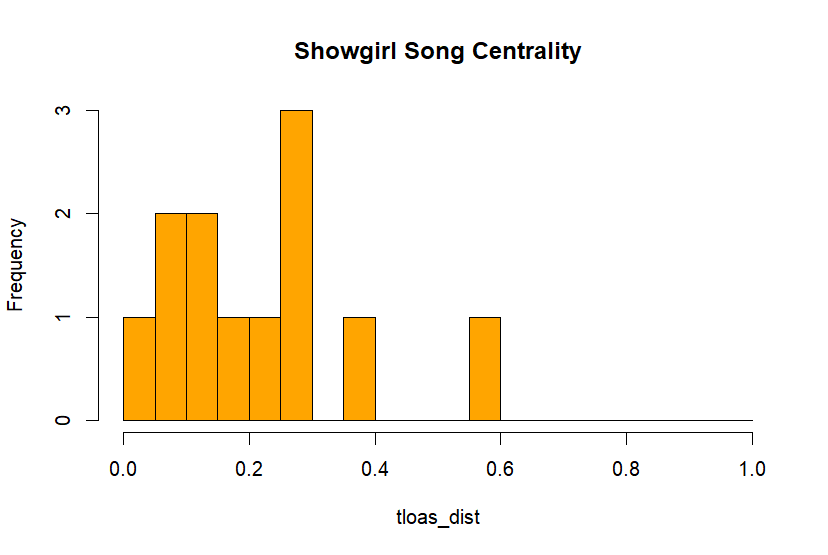
Now, Showgirl:
Look at that big blank space on the right side of the graph. The closest thing to a ‘tentpole’ song here is the title track, which scores just below 0.6. There are no mid-range songs scoring between 0.4 and 0.6. The second most central song is “CANCELLED!” at 0.35. The rest are below that, and in terms of vocabulary, really aren’t that similar to earlier works.
So maybe the problem isn’t just that some people find the lyrics cringey. Maybe the album needed less “Gucci,” “terminal uniqueness,” “toy Chihuahua,” and “Plaza Athénée,” and more words that emphasize commonplace, relatable experiences, such as dress, walk, day, room, boy, and feel — words common in the broader discography, but almost or entirely absent here.
From this map, we can calculate the “centrality” of the song. This refers to how well-connected the song is to other Taylor Swift songs; in other words, it tells us how central the song is in the “Taylorverse.” One of the main findings from the anlaysis was that songswith higher centrality are more popular(as measured by stream count, expert rankings, and social media conversation). So, although there are certainly exceptions, the songs at the center of the Taylorverse are more beloved than those at the periphery.
But, which are the songs that are most central? Well, here’s the complete list (as of October 9, 2025), going from most central to least central. It includes all songs on the main studio albums, and, unlike the published analysis, I’ve included The Tortured Poets Department and The Life of a Showgirl! In addition to listing the songs in descending order of centrality, I’ve also broken them into five groups based on their centrality.
Before we begin, it’s worth remembering that this isn’t a ranking of the best Taylor Swift songs, nor my personal opinion (you can find my complete ranking of her songs that list elsewhere). Rather, it is a list of which songs share the most word overlap with other songs. But, as you scan the list, I think you’ll see that the central songs do tend to be more popular (with exceptions), and those on the periphery less popular (again, with exceptions).
The Center of the Taylorverse
Fifteen
Timeless
All Too Well
But Daddy I Love Him
Mr. Perfectly Fine
Blank Space
Hits Different
I Bet You Think About Me
Better Than Revenge
Betty
Mine
In addition to being the top ten eleven, all of these songs have centrality scores that exceed the traditional threshold for statistical significance (for fellow stats nerds, z > 1.96). Aside from the Speak Now Vault track “Timeless,” which wasn’t particularly well received, the others are fan favorites. Most are singles and/or Eras Tour songs; of course megahit “All Too Well” would end up here. And with oft-repeated Swiftian words like love, door[s], boys, girls,time, just, and dancing, “Fifteen” is a prime example of core Swiftian language and, as of this analysis, is at the very heart of the discography, semantically speaking.
Also in the Taylorverse’s Core
You’re Losing Me
Foolish One
You’re On Your Own, Kid
Dear John
Ronan
When Emma Falls in Love
imgonnagetyouback
Electric Touch
The Life of a Showgirl
If This Was a Movie
Call it What You Want
The Other Side of the Door
End Game
Teardrops on My Guitar
Happiness
Last Kiss
So Long London
loml
The Moment I Knew
Cruel Summer
Superman
Love Story
The Best Day
Long Live
Florida!!!
… Question?
Forever & Always
You Belong With Me
Miss Americana & the Heartbreak Prince
Mary’s Song
I Hate it Here
These songs don’t quite break the top 10, but do exceed one standard deviation above the average for centrality. It makes sense that “You’re On Your Own, Kid,” which metaphorically narrates Swift’s career, would score toward the center. Other big hits in this group include “Dear John,” “Teardrops on My Guitar,” “Love Story,” and “Cruel Summer.”
Above Average Centrality
Hey Stephen
Never Grow Up
The Story of Us
We Are Never Ever Getting Back Together
The Bolter
Better Man
Haunted
I Did Something Bad
Getaway Car
Right Where You Left Me
Back to December
Forever Winter
The Lucky One
Tell Me Why
Nothing New
Holy Ground
Peter
Breathe
Death by a Thousand Cuts
You Are in Love
White Horse
Thank You Aimee
Cancelled!
Jump Then Fall
So High School
‘Tis the Damn Season
I Can See You
Now That We Don’t Talk
Bejeweled
Sparks Fly
Stay Beautiful
I Wish You Would
Delicate
Mean
Red
Our Song
Long Story Short
Enchanted
Begin Again
Daylight
… Ready For It?
Tim McGraw
The Way I Loved You
Should’ve Said No
Fresh Out the Slammer
Eldest Daughter
Change
Opalite
Wonderland
SuperStar
London Boy
Style
Paper Rings
Innocent
Illicit Affairs
Dress
Come Back, Be Here
Gorgeous
Speak Now
These songs have a centrality score between the mean and one standard deviation above it. You’ll recognize lots of Taylor classics here, including the debut single “Tim McGraw,” hits like “We Are Never Ever Getting Back Together” and “Style,” and the song that anchored the Speak Now Eras Tour set, “Enchanted.”
Below Average Song Centrality
Me!
Guilty as Sin
New Romantics
Elizabeth Taylor
High Infidelity
You All Over Me
Mad Woman
Everything Has Changed
Cardigan
Bad Blood
The 1
Coney Island
Would’ve, Could’ve, Should’ve
It’s Time to Go
Girl at Home
Afterflow
Bye Bye Baby
Champagne Problems
Honey
The Great War
Ivy
Run
Cold as You
Dancing With Our Hands Tied
Who’s Afraid of Little Old Me?
Cornelia Street
Today was a Fairytale
My Tears Ricochet
Ours
I Can Do It With a Broken Heart
Chloe or Sam or Sophia or Marcus
August
You’re Not Sorry
The Very First Night
Exile
Actually Romantic
Fearless
I Think He Knows
Castles Crumbling
My Boy Only Breaks His Favorite Toys
Mastermind
Clara Bow
False God
Willow
Wildest Dreams
So It Goes
Vigilante Shit
Tolerate It
The Prophecy
Invisible String
I Almost Do
Anti-Hero
Snow on the Beach
Wi$h Li$t
The Black Dog
Don’t Blame Me
The Tortured Poets Department
Say Don’t Go
Dear Reader
Picture to Burn
Dorothea
Starlight
King of My Heart
The Manuscript
I Knew You Were Trouble.
State of Grace
Is it Over Now?
Down Bad
Stay Stay Stay
Look What You Made Me Do
Suburban Legends
Peace
Father Figure
I’m Only Me When I’m With You
Slut!
Soon You’ll Get Better
That’s When
Tied Together with a Smile
22
Out of the Woods
Cassandra
Clean
The Fate of Ophelia
Mirrorball
Ruin the Friendship
Maroon
Karma
No Body No Crime
I Know Places
Seven
Labyrinth
The Archer
Shake It Off
Sad Beautiful Tragic
The Last Time
Don’t You
Message in a Bottle
The Outside
Come in With the Rain
This Love
I Forgot That You Existed
The Alchemy
How You Get the Girl
You Need to Calm Down
Lover
This is Me Trying
With centrality scores from the mean down to one standard deviation below it, these songs have less than average word overlap with other songs. Although there are certainly some hits here (“I Can Do it With a Broken Heart”; “Champagne Problems”; “Out of the Woods”), many songs are deeper cuts on their respective albums.
The Edge of the Taylorverse
Midnight Rain
Hoax
Place in This World
Gold Rush
Treacherous
Invisible
The Last Great American Dynasty
How Did It End?
Babe
Closure
This is Why We Can’t Have Nice Things
All You Had to Do Was Stay
Marjorie
Evermore
Wood
Welcome to New York
New Year’s Day
The Man
We Were Happy
I Can Fix Him (No, Really I Can)
Fortnight
I Look in People’s Windows
It’s Nice to Have a Friend
A Perfectly Good Heart
Paris
Lavender Haze
Sweet Nothing
Untouchable
Bigger Than the Whole Sky
Glitch
The Albatross
The Lakes
Robin
Epiphany
Again, it’s worth remembering that having low song centrality doesn’t mean a song is bad. Here, at the semantic fringe of the Taylorverse, I find songs I personally enjoy, such as “Midnight Rain,” “Treacherous,” “Evermore,” and “The Lakes.” But, with the exception of “The Man” and “Fortnight,” this is generally a list of lesser-known songs. It makes sense that “Epiphany,” which concerns the experiences of Swift’s grandfather in World War II and doctors during COVID, would have the lowest centrality: its subject matter differs from any other song in the discography.
This isn’t a list I plan to update regularly, if ever, because updating the map takes some effort. [Edit: OK, I couldn’t resist when TLOAS came out.] Nevertheless, I hope it provides a different perspective on how we might consider, rank, and understand the amazing body of work that is the Taylorverse.
What makes a Taylor Swift song popular? Several answers could come to mind: the poetic beauty of her songwriting, the deft skill of her producers, the power of the bridge, her emotive vocal performance. Certainly, these matter. But each of these answers is also limited because each focuses on the characteristics of one song in isolation. My semantic analysis of Taylor Swift’s lyrics suggests a different kind of answer: A Taylor Swiftsong’s popularity arises from its connection to other Taylor Swift songs.
I’ll discuss the data supporting that claim in a moment, but I want to do so by way of something I’ve never written about here: My own story of how I became a Swiftie.
My journey into the Taylorverse
In my childhood, I listened to a number of female country artists, and in my mid-twenties, I enjoyed singers that were, at the time, also catering to a similar audience as Taylor Swift (Hilary Duff, Aly & AJ, Miley Cyrus). That was good preparation, and although I can’t pinpoint the first time I heard Taylor, it was probably on the radio or on Yahoo’s music streaming service.
I do know that, in June 2009, I was driving down New Hampshire St. in Lawrence, Kansas. I was on a business trip as a young assistant professor, attending a weeklong seminar on advanced social science statistics. “Love Story” came on the radio. It wasn’t the first time I’d heard the song, but I remember thinking to myself, “Yeah, this is good stuff—I could be a Taylor Swift fan.” That’s the point when I’d say my journey into the Taylorverse began.
Later, I bought a used copy of Fearless, then Speak Now, then debut, and then I bought Red when it was a new release. As I listened, I began to appreciate that Taylor wasn’t writing just songs; she was writing albums. That’s maybe not the case with debut, which feels like a (very good) group of songs, but in Fearless and especially Speak Now, it was becoming evident that her albums were cohesive artistic statements as a whole. Fearless celebrates the closeness and challenges of teenage girls’ relationships; Speak Now is about finding one’s voice in the journey of growing up. By Red, a tour de force of romantic passion and heartbreak, the deeply thematic nature of her albums was undeniable. Yes, the songs matter; but the song’s context, what we would now call its era, deeply shapes her work.
Then, moving into 1989 and Reputation and beyond, I realized the connections weren’t only within albums, but between them. “A circus ain’t a love story” ties Reputation to Fearless. “Blank Space” wryly caricatures her media persona in her early albums. “I once believed love would be burning red,” she sings in Lover’s “Daylight.” Then “Bad Blood” is playing in a cab on Folklore, and then “You’re on Your Own, Kid” summarizes her entire career… you get the idea, and there are so many other examples.
To call these lyrical connections “Easter eggs” is a bit too trite. Perhaps these connections are more than a bonus for astute fans, but rather part of the fabric—the ‘invisible string,’ if you will—that unites the art. That’s what my research tried to examine quantitatively.
Which Taylor Swift songs have the most word overlap with other songs?
In the previous post, I described how 13 shared words is the minimum threshold where it made sense to treat two Taylor Swift songs as connected. Of course, the more words in common, the stronger the connection. We can use that information to create a map of the links between songs (again, discussed in the last post; also, see here for a list of all songs ranked by centrality, including TTPD).
Once we have that map, we can calculate something called a song’s centrality. (For those interested in the technical details, I used eigenvector centrality in the analysis.) Some songs are highly connected to other songs; their centrality is high. Here are the 15 songs that are most highly connected to other songs, in ascending order of centrality:
#15: “When Emma Falls in Love”
#14: “You’re On Your Own, Kid”
#13: “Dear John”
#12: “Foolish One”
#11: “You’re Losing Me”
#10: “Better Than Revenge”
#9: “Betty”
#8: “Mine”
#7: “I Bet You Think About Me”
#6: “Hits Different”
#5: “Blank Space”
#4: “Mr. Perfectly Fine”
#3: “Timeless”
#2: “All Too Well” [original; I didn’t include 10-minute in the analysis]
#1: “Fifteen”
You might already have a rough sense of what’s going on here… not all of these are stone-cold Taylor classics, but there’s a decent number of singles, big hits, and fan favorites among the most central songs.
Other songs are on the fringe of the map, with few connections to other songs; their centrality is low. Here are the songs with the lowest centrality:
Now, I imagine every Swiftie has a song or two (or more) they like among these least central songs (I’m partial to “Evermore” and “The Lakes,” myself). But, aside from “The Man,” it’s hard to argue any of these are among her most beloved songs. Also, I was curious, so just now I checked Spotify stream counts again. As I write this, four of these songs (“A Perfectly Good Heart,” “It’s Nice to Have a Friend,” “Epiphany,” and “Glitch”) have the lowest number of streams on their respective albums (Taylor Swift, Lover, Folklore, and Midnights).
Song centrality predicts song popularity
So, just by eyeballing the list of central and not-central songs, we might have a sense that song centrality is positively associated (correlated) with song popularity. In other words, the more central the song, the more popular it is. But, as I tell my students, we can’t conduct statistical tests with our eyeballs. We need to conduct statistical tests with… um… statistics.
But to get statistics, we need to know how to measure what we want to measure. We’ve already measured song centrality. But what about song popularity? How should we measure something as debatable as that?
Because song popularity is somewhat vague, I chose to measure it three ways that combine into a fourth:
Spotify stream count. One day, in a meeting that was kind of boring, I manually wrote down every Spotify stream count for all of the songs in a spreadsheet. Time well spent, for sure.
Twitter/X conversation. Using the resources available in our Schieffer Media Insights Lab at TCU, I obtained 17,092 unique tweets, posted between February 1, 2022 and February 15, 2024, about the poster’s favorite Taylor Swift songs. The paper contains more detail about how this data was processed to get a measure of how frequently each song was mentioned.
Overall popularity: We can combine the three measures together into an overall index of the song’s popularity.
Now, you might already see some problems with this approach, particularly for Twitter/X conversation (I’ll just call it Twitter from now on, to keep it simple, and sorry, that’s just a better brand name than X). Taylor released some albums during that time window (Midnights, Speak Now TV, and 1989 TV), so we might expect those songs to show up more in the Twitter data. Same for any song performed in the North American Eras Tour, which was vibrant during that time. Even Spotify data isn’t a perfect indicator of song popularity, because Taylor’s first three albums were released before Spotify was available in the United States, and she then removed her music from Spotify during the 1989 era. Even critics’ evaluations might be subject to these influences.
This is a common occurrence in social science: We want to look at the association between two things (in this case, song centrality and song popularity), but confounding variables get in the way. We can solve that by controlling for those confounding variables. And, doing that actually told an interesting story about some other factors that shape popularity:
Album: Critics prefer the later albums, and later albums are more popular overall.
Track: Tracks earlier on an album tend to be preferred across the board: They are streamed more, talked about on Twitter more, critics like them more, and they are more popular overall. Said differently, later tracks on an album are less popular (ever push “play” on an album and stop halfway through, maybe because you’re bored or the car ride ends?).
Release date: Later releases have more streams, and songs released in the 2-year window are talked about more on Twitter.
Eras setlist: Songs on the Eras Tour setlist were more popular on Twitter and among critics, as well as overall.
Finally, we can address the main question (“Question…?” 😉): Are songs with greater word overlap with other songs (i.e., with higher song centrality) more popular? And the answer is, yes, they are! Songs with higher centrality are more popular with critics, more popular on Twitter, almost more popular on streams (barely missed the threshold of statistical significance), and more popular overall.
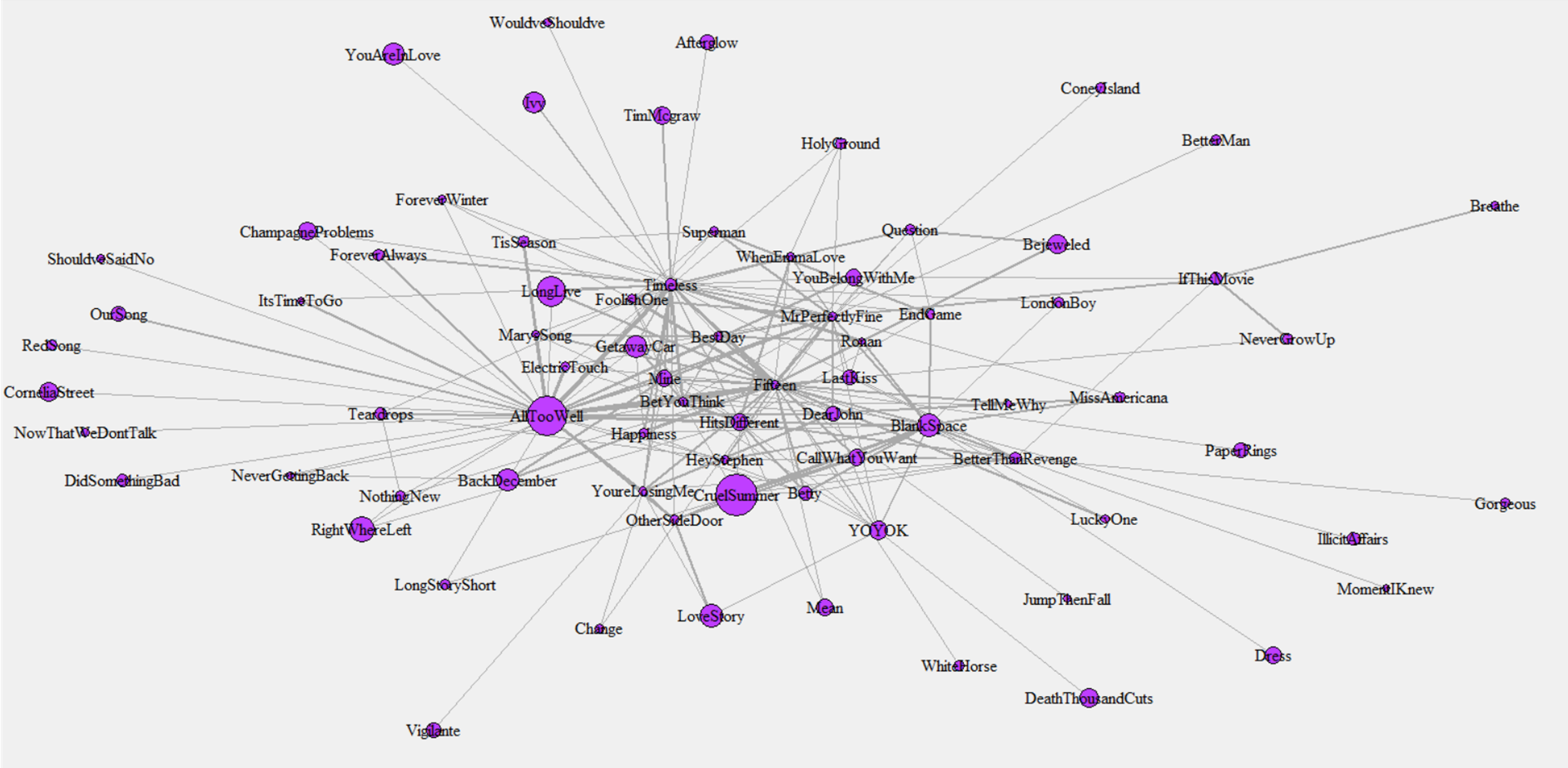
This is hard to visualize, in part because Taylor has so many songs. (And we Swifties are grateful for that!) Here’s a plot I used to demonstrate this to an audience recently, using a smaller selection of songs. Larger circles indicate more popular songs, with thicker lines meaning that the song shares more words in common. And, songs toward the center of the graph are more central, with those on the outside more peripheral. It seems that there is a knot of very popular songs at the center with lots of word overlap with other songs (“Cruel Summer,” “All Too Well,” “Long Live,” “Blank Space,” “Getaway Car”), while songs on the periphery are less popular.
Summary and Conclusion
So, then, yes: These results are consistent with the idea that the connection between Taylor’s songs is part of the appeal of her art. A caution, though, that we social scientists like to give: Just because two things are associated does not necessarily mean that one causes the other. Yes, it could be that audiences gravitate toward cohesive albums that connect to other parts of an artist’s work. Or, it could be that Taylor sees which songs audiences like, and makes those songs central by writing songs more like them.
My guess as to what’s going is, well, “both of these things can be true” (“Happiness”). Any artist’s popularity is crafted together with the fans who support them, something that Taylor has emphasized throughout her career. This again calls back to connections: It is the connections between the songs, as well as the artist and her fans, that animates her art and fuels its success.
We can map Taylor Swift songs based on their word overlap with other Swift songs.
The songs cluster into four core stories of (1) Villains and Heroes, (2) Longing and Regret, (3) Extraordinary Meaning in the Ordinary, and (4) Empowered Voice.
Taken all together, these four core stories form an overarching narrative of a woman moving from victim to voice, a journey of finding feminine meaning and worth in a masculine world that devalues such things.
Songs with high centrality (i.e., word overlap) tend to be more popular than songs with low centrality.
This is consistent with the claim that the discography forms a “Taylorverse” of interconnected meanings, and these connections are part of the appeal of her music.