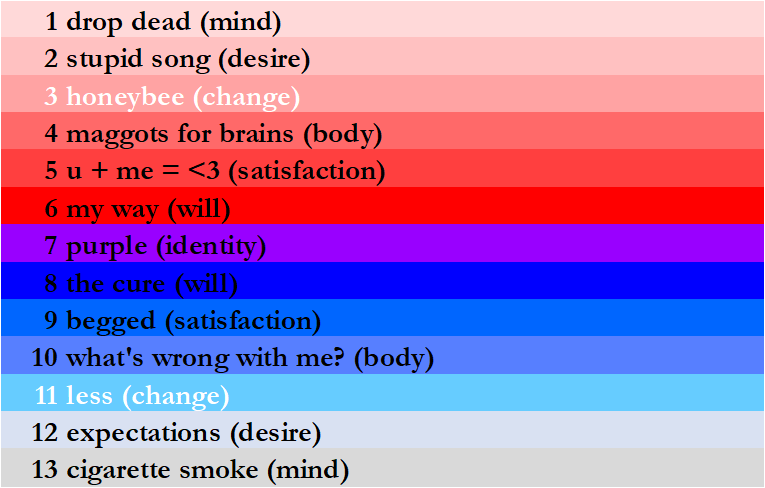
“I met him at a party,” Olivia sings at the start of “expectations.” Likewise, the first verse of “stupid song” describes a party where she feels insecure. At both there’s drug use, by her friends (“stupid song”) and her ex (“expectations”). Is it the same party? Narratively, I would say that seems to be the suggestion, whether or not that maps onto Olivia’s real-world relational history. This pair of songs presents different perspectives on that event and its consequences. As the tale unfolds, it demonstrates Olivia’s character growth across the album’s story.
And wow, what a difference in Olivia’s perspective on her (ex-)boyfriend between the two songs! In “stupid song,” she longs for him and dreams of him, speaking of her affection for him with allusion to Greek mythology (“I’m a heart made of wax and I’m melting in the sun.”) By the time of “expectations,” those wax wings have melted away, and having fallen back to Earth, she admits that his positive perception of him was a delusion (“he wasn’t smart or funny, I convinced myself he was”). Her fear in “drop dead” wasn’t just paranoia, in the end; she really did make him up.
The first verses of both songs end with an emphasis on communication, and as a communication professor that makes me happy. In “stupid song” she imagines their interaction, longing to speak with him. Yet in “expectations,” she has prevented communication by blocking his number.
The chorus of “stupid song” is a passionate statement of romantic desire, and it is a desire that is unchecked: Olivia feels like she is on fire, and like she is a “car… without a brake.” Meanwhile, “expectations” presents her brand-new relational brake system in a non-nonsense, deadpan tone: future guys can’t be passive, or indecisive, or have a fake job. She’s replaced her total insanity in “stupid song” with a grounded rationality, pouring the cold water of caution and self-respect on the flames of romantic desire, yet still holding to faith, drive, and heart.
The second verses of both songs live in the shadow of the party. In both, Olivia is in a dress: in “stupid song,” lying passively on her bed when she should be in pajamas, while in “expectations,” she’s “rocking [her] mini dress with a vodka cran and an open heart.” In “stupid song” she is a picture of desperation; in “expectations,” she is full of confidence, looking with disdain at the guys that are so “desperate for loving, but… I’m not.” Really, “expectations” proves her claim in “stupid song” wrong (“And all the girls at this party are so cool, that’s never been a thing that I could do”). Now, she has become the confident girl who owns the social scene.
There’s also something to be said about the geography of these songs and the entire album. Toward the beginning of the saga, she is in New York City; by the pivot point in “purple,” she feels at home in London. After crying on the curb at LAX in “less,” she’s still back at home in Los Angeles in “expectations,” expecting to be disappointed by the guys at a bar in the suburbs. Geographically, we’re coming back around to where the album began, moving homeward; “cigarette smoke” will soon describe the scene of emotional devastation that her home has become.
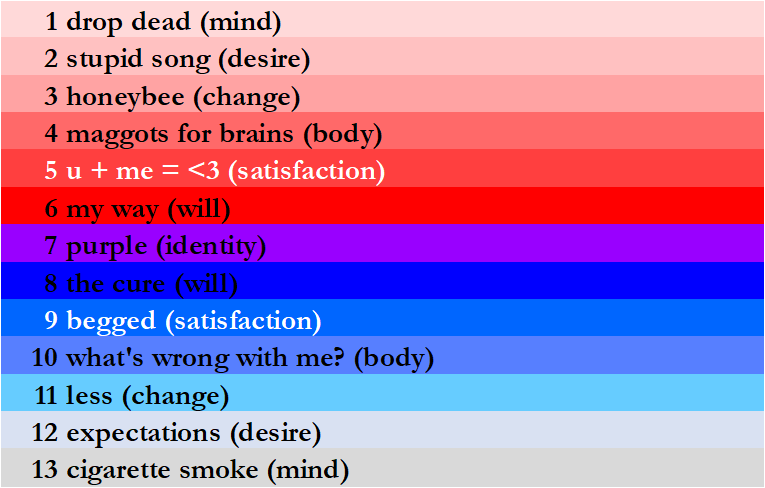
When reflecting on “u + me = <3” and “begged,” I considered social exchange theory, which uses an economic lens to evaluate relationship choices. That theory says we compare our relationships to our comparison level. That level is essentially a threshold we need to meet in order to be satisfied. When I teach my students about this concept, I tell them that the comparison level is, essentially, how “high maintenance” someone is. In “expectations,” Olivia is saying that comparison level has risen; it will take more to keep her happy than what she tolerated in her last relationship.
No other pair of songs so clearly demonstrates Olivia’s character growth across the arc of the album. One line succinctly sums up this growth and the interplay between the two songs: “Gave my heart with zero stipulations [in ‘stupid song’], now [in ‘expectations’] I take careful consideration”.
Within close relationships research, some scholars have examined relational turning points. A first date, a big fight, a wedding, or the birth of a child are some examples. When scholars do this type of research, sometimes they have people draw a chart of the relationship’s ups and downs over time, using that graph to identity those turning points.
If Olivia were drawing such a graph, “honeybee” would be a high point and “less” a low point. And these two piano-driven songs both mark big turning points: In the first, the relationship formally starts, and in the second, the relationship formally ends.
The first verse of both songs take place in a nighttime setting, focusing on time and healing. In “honeybee” her outlook is optimistic, exclaiming that “it’s true time can heal even the worst of wounds.” In contrast, in “less” she isn’t feeling well, her “body and head protesting” with a “stomach” that is “in knots” (which flows from the symptom list in the prior song, “what’s wrong with me?”). Now, the idea that time will heal is a vain hope that flies in the face of evidence: “maybe it’ll fix itself tomorrow, but I’ve been saying that like every night.”
Both songs also feature Olivia’s quietness, but that silence has different meanings. In “honeybee” she assures him, “even when I’m quiet I love you, baby, I promise.” Yet in “less,” there’s no assurance to be found when she says “I don’t wanna talk, let’s just go to bed or something.”
There’s also contrast in the meaning of their time together. In “honeybee” it is sweet (like a “sticky sweet tangerine”), intimate, and fun, as they “walk in the dark, hop the fence in the park” and as he simply “pick[s] [her] up, walk[s] [her] home.” By “less,” these simple yet meaningful dates have been replaced by bigger, costly events that are joyless (“our trip to Big Sur only confirmed this isn’t what it should feel like”).
In “honeybee,” his face is the lyrical focus, and it’s a lyrical focus that foreshadows what will happen in less: “I hope I never see what your face looks like going.” Then “less” tells us what he is like when he is going; he isn’t leaving in anger, but rather does “the noble thing” by giving her a way out that she’s doesn’t want to take. In “less,” the focus turns to her face. He watches her cry twice, first in the chorus, and then “on the curb at LAX.” And in “less,” Olivia acknowledges that he’s “seen [her] truly happy, so [he] know[s] right now [she’s] not,” a callback to the sorts of light, joyous events described in “honeybee.”
The terms of endearment also move in opposite directions. The word “honeybee” only occurs once in the song, and in the same line she calls him “baby boy.” At the end of “less,” now he is the one calling her “babe” as he speaks the words that will terminate the relationship.
After instrumental breaks (that, perhaps coincidentally, end at the 2:41 mark in each), both songs move quickly to the end. And in each conclusion, the focus turns to hopes and wishes. In “honeybee,” the final line “here’s to hoping” foreshadows danger; in the final line “I wish you loved me less,” that danger has become reality.
Undoubtedly, the album treats “purple,” the song where Olivia realizes they have become too attached, as a key relational turning point as well. On either side of purple, and equally distant from it, “honeybee” and “less” chart the turning points before and after that chart their shift into and out of romance.
Last time, I considered how “u + me = <3” and “begged” are about the exchanges that happen in relationships. And an exchange-oriented approach to relationships is inherently individualistic: it’s about what I get out of the relationship versus what you get out of the relationship. But, when we get really close to someone, our mental “balance sheet” changes. We no longer think of you and I, but rather, we think of we. My costs are your costs; really, they’re our costs. Same for our rewards. That’s the subject of self-expansion theory, which claims that when we get close to someone, we include that person in our sense of the self.
That’s the focus of “maggots for brains” (track 4) and “what’s wrong with me?” (track 10). Both tracks use medical language to describe how that self/other overlap makes Olivia feel. There’s perhaps more subject matter similarity here than any two tracks on the album. In both, Olivia is sick and her relationship is the reason why.
In the first verse of both songs, Olivia is at home, bored, and not feeling well. She’s also unable to communicate these psycho-bodily sensations clearly: In “maggots,” she “tried to write, nothing came out,” and in “what’s wrong?”, she “can’t describe this feeling [she’s] got in [her] head.” Throughout both songs she remains homebound, but with one futile exception in each, going “to a party but only on principle” or “to the doctor, and she said I was fine.”
The chorus of both songs is a description of her illnesses, a bit like the list of symptoms she’s entering into Google on “what’s wrong?” In “maggots,” she is a “zombie in her body”; “what’s wrong?” echoes this in verse 1, as she is “out of body in [her] bed.” In both songs she is helpless in the face of her symptoms (“nothing ever seems to help” and “what can I do but think of you?”). And both choruses conclude with the diagnosis: in the first case, this is “just the thing that happens when my baby goes away”; in the second case, “I think you’re what’s wrong with me.” In other words, the problem is his presence, and then later the problem is his absence.
There’s even similarity in how Olivia tries to cope with her sickness: by drinking large quantities of beverages. In “maggots” it’s “a pot of coffee”; in “what’s wrong?”, a “bottle of wine.” One is a stimulant, and the other a depressant, which fits both songs and their respective halves of the album.
In terms of self-expansion theory, these songs reflect the deep level of self-other inclusion Olivia feels in this romantic relationship. When we are so close to someone, it’s natural to feel like part of you is missing when the one you care about is gone. In many cases that’s healthy, but as “this song “maggots” looks ahead to the pivot point, we know Olivia will ultimately decide it’s not. And as “what’s wrong?” looks back on that pivot point, Olivia’s heartache is that she isn’t certain she wants to have this level of self-other inclusion anymore. Her prescription has shifted quite a bit from wishing for anything, even “a tragedy,” that would bring him near.
Finally, there’s Olivia’s curious observation on “what’s wrong?”: “lately I’ve been spiraling.” A spiral is a circle… like a ring. Perhaps this is a subtle hint that the album is spiraling around, revisiting themes. The next theme we’ll consider are the songs before/after, which chronicle the relationship’s beginning (“honeybee”) and its end (“less”).
Social exchange theory views interpersonal relationships in quasi-economic terms. Relationships give us rewards: affection, status, support, gifts, belonging, etc. But, relationships also carry costs, whether it’s the emotional toll of listening to an upset friend, paying the restaurant bill at the end of a date, or the time and effort spent helping someone move their things.
According to the theory, we calculate the approximate rewards we get and subtract the costs, keeping a sort of “balance sheet” that tells us the “bottom line” of the relationship. Are we making a “profit,” or is this relationship a “loss”? We then compare that bottom line to what we expect to get out of the relationship, and if we’re meeting “expectations” (… more on that later…), we’ll be happy; if not, we’re unhappy. And, we also compare that bottom line to our forecast about what we could get elsewhere. If another relationship would give us a better “profit,” we might dump our current relationship and seek another.
Both “u + me = <3” and “begged” show Olivia running this cost/reward analysis in the spreadsheet of her mind. In “u + me,” the Board will be happy because profits are looking good. She’s excited about how he will “take [her] out to dinner” and “take her anywhere”; she anticipates that he will “buy [her] silver jewelry and all [her] favorite Cadbury.” Meals, bling, and chocolate; it’s a windfall! And she even gets a new big sister, too. No wonder she is satisfied, and she is committed, too, with “the feeling that [she’ll] never want somebody else.”
But by “begged,” her commitment (or “devotion”) remains, though her satisfaction has faltered. Per social exchange theory, she doesn’t see a better option than her current partner, but he certainly isn’t meeting her expectations, “overwhelmed” and “underfed.” No longer is she enamored with the idea of her man taking her out to dinner, instead preferring “to sit here silently and watch movies on TV.” Yes, she “will take what [he’s] giving,” but as the title of the song says, she’s only getting her meager relational profit because she “begged.” Like stockholders who expected the company to make $50 million last quarter when it only got $10 million, she’s dissatisfied with the bottom line.
So, while in “u + me” she dismisses those who say that “modern love’s a cruel endeavor,” in “begged” she wonders if it is a normal thing to fight against love becoming dreadful. In “begged” she’s hurting; in “u + me,” the opposite, as “wounds are healing.” And in “u + me” her satisfaction drives her to impatience, getting “way too far ahead of myself” and even pondering marriage at the age of 25, while in “begged,” her dissatisfaction generates a sort of stoic, patient pretending.
In a ring structure, the echoes point back toward the pivot point (here, track 7, “purple”). In “u + me” she is rushing forward in the car without a brake (see “stupid song”), and she’s even carving their names into the seats. It’s exciting and fun, but it foreshadows danger. Meanwhile, “begged” looks back on the wreck, wondering if there is a way to rescue a relationship that has become static from overattachment. One variant of social exchange theory predicts that relationships are most satisfying and stable when partners have roughly equal costs and rewards. “Begged” is a picture of a relationship without such an equitable distribution of relational profits; but, I would argue that “u + me” suggests they really never did.
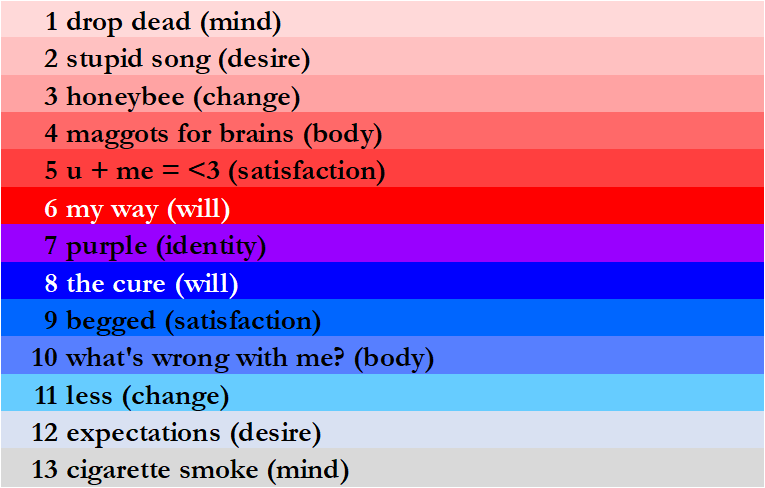
Their contrast is striking. In “my way,” Olivia is defiant, self-assured of victory: “So, where’d you get that confidence from? Last time that I checked, I won!” Just two tracks later, she is full of poison and doubt, “unraveled,” longing for a cure she can’t seem to find. In one song her will is strong; in the other, it’s shattered. The two tracks are a mirror, reflected around the pivot point. After the crisis of identity narrated at the end of “purple,” Olivia’s iron will has vanished, suggesting it was perhaps a show of bravado all along.
Some other lyrical details demonstrate this mirror:
In “my way,” Olivia is drawing the lines on the map, warning another woman to stay away from her man. But, at the start of “the cure,” the ones who are “moving the line” are “all the pretty girls in the foreground of [her] mind.”
In “my way,” Olivia believes the other woman is “insane,” but in “the cure,” Olivia is the one fighting “bad thoughts.”
The threatening woman in “my way” finds her worth in winning Olivia’s man, yet in “the cure,” Olivia realizes that she has been finding her worth in her man too (even though “it’s not enough”).
And so “my way” Olivia tries to convince the other woman to leave (to no effect), while her boyfriend tries to convince “the cure” Olivia to quiet her doubts (to no effect).
The other woman lingers “like a bad perfume” in “my way,” while Olivia’s doubts linger in “the cure.”
The “my way” girl plays a game with “amateur moves,” and the Olivia in “the cure” plays a mind game with herself (“I used to play a game in my head when I’d date a guy…”).
Perhaps the greatest point of connection between the two songs is the presence of female competition. More than any other tracks, both “my way” and “the cure” present other women as a threat to the romantic relationship. In “my way” it is a specific woman who is pursuing Olivia’s man, and in “the cure” it is a broader chorus of “pretty girls,” including those her boyfriend has slept with in the past.
Speaking of mirrors, George Herbert Mead’s symbolic interactionism (a foundational theory in the social sciences) believes we understand who we are via a process called the looking-glass self. To know our physical self, we look in a mirror. But to know our social self, the “looking-glass” is the reactions of other people. How they treat us tell us something about who we are.
That looking-glass self is at play in the games described by this pair of songs. In “my way,” the actions of the other woman make Olivia feel how committed and defensive she is about the relationship. She’s willing to play the game and she’s sure that she’ll win it.
But, “the cure” takes place after the all-important pivot in “purple.” After that crisis of relationship identity, female competition makes Olivia feel like she doesn’t measure up, like she’s never “done enough.” And now, in her state of mental paralysis, it is her boyfriend fighting for the relationship, trying to remove the “toxins in [her] bloodstream.”
Rodrigo has said that “the cure” is the album’s thesis statement. That fits the ring cycle theory: after setting the stage with the album’s first half, it makes sense to put a thesis statement about the entire work right at the start of the second half. Elaborating on the doubts first voiced at the end of “purple,” “the cure” makes it clear that this album is a tragedy. Olivia has been trying to find ultimate satisfaction in a romantic relationship, but it will never be the cure, and instead her flaws will contribute to the relationship’s demise.
Not her flaws alone, of course. She’ll aim criticism at her man in the coming tracks. But in “the cure,” she owns that her own fears have shattered the force of will she had back in “my way.” The overidentification described in “purple” now reveals that a romantic partner, as important and meaningful as they can be, cannot solve all of a person’s problems. If we expect another person to do so, that is unreasonable and will damage the relationship, perhaps even leading to its demise.
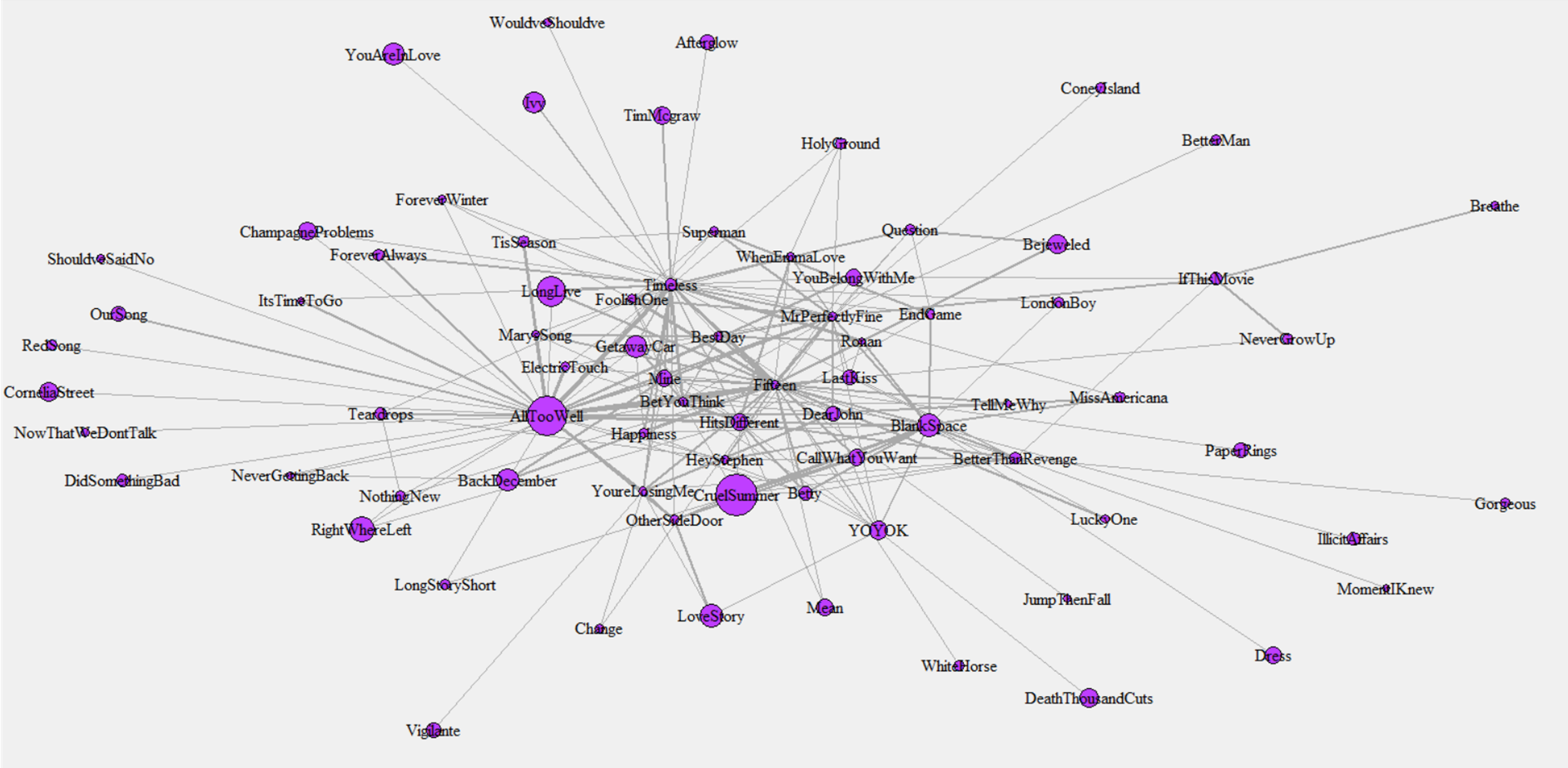
From this map, we can calculate the “centrality” of the song. This refers to how well-connected the song is to other Taylor Swift songs; in other words, it tells us how central the song is in the “Taylorverse.” One of the main findings from the anlaysis was that songswith higher centrality are more popular(as measured by stream count, expert rankings, and social media conversation). So, although there are certainly exceptions, the songs at the center of the Taylorverse are more beloved than those at the periphery.
But, which are the songs that are most central? Well, here’s the complete list (as of October 9, 2025), going from most central to least central. It includes all songs on the main studio albums, and, unlike the published analysis, I’ve included The Tortured Poets Department and The Life of a Showgirl! In addition to listing the songs in descending order of centrality, I’ve also broken them into five groups based on their centrality.
Before we begin, it’s worth remembering that this isn’t a ranking of the best Taylor Swift songs, nor my personal opinion (you can find my complete ranking of her songs that list elsewhere). Rather, it is a list of which songs share the most word overlap with other songs. But, as you scan the list, I think you’ll see that the central songs do tend to be more popular (with exceptions), and those on the periphery less popular (again, with exceptions).
The Center of the Taylorverse
Fifteen
Timeless
All Too Well
But Daddy I Love Him
Mr. Perfectly Fine
Blank Space
Hits Different
I Bet You Think About Me
Better Than Revenge
Betty
Mine
In addition to being the top ten eleven, all of these songs have centrality scores that exceed the traditional threshold for statistical significance (for fellow stats nerds, z > 1.96). Aside from the Speak Now Vault track “Timeless,” which wasn’t particularly well received, the others are fan favorites. Most are singles and/or Eras Tour songs; of course megahit “All Too Well” would end up here. And with oft-repeated Swiftian words like love, door[s], boys, girls,time, just, and dancing, “Fifteen” is a prime example of core Swiftian language and, as of this analysis, is at the very heart of the discography, semantically speaking.
Also in the Taylorverse’s Core
You’re Losing Me
Foolish One
You’re On Your Own, Kid
Dear John
Ronan
When Emma Falls in Love
imgonnagetyouback
Electric Touch
The Life of a Showgirl
If This Was a Movie
Call it What You Want
The Other Side of the Door
End Game
Teardrops on My Guitar
Happiness
Last Kiss
So Long London
loml
The Moment I Knew
Cruel Summer
Superman
Love Story
The Best Day
Long Live
Florida!!!
… Question?
Forever & Always
You Belong With Me
Miss Americana & the Heartbreak Prince
Mary’s Song
I Hate it Here
These songs don’t quite break the top 10, but do exceed one standard deviation above the average for centrality. It makes sense that “You’re On Your Own, Kid,” which metaphorically narrates Swift’s career, would score toward the center. Other big hits in this group include “Dear John,” “Teardrops on My Guitar,” “Love Story,” and “Cruel Summer.”
Above Average Centrality
Hey Stephen
Never Grow Up
The Story of Us
We Are Never Ever Getting Back Together
The Bolter
Better Man
Haunted
I Did Something Bad
Getaway Car
Right Where You Left Me
Back to December
Forever Winter
The Lucky One
Tell Me Why
Nothing New
Holy Ground
Peter
Breathe
Death by a Thousand Cuts
You Are in Love
White Horse
Thank You Aimee
Cancelled!
Jump Then Fall
So High School
‘Tis the Damn Season
I Can See You
Now That We Don’t Talk
Bejeweled
Sparks Fly
Stay Beautiful
I Wish You Would
Delicate
Mean
Red
Our Song
Long Story Short
Enchanted
Begin Again
Daylight
… Ready For It?
Tim McGraw
The Way I Loved You
Should’ve Said No
Fresh Out the Slammer
Eldest Daughter
Change
Opalite
Wonderland
SuperStar
London Boy
Style
Paper Rings
Innocent
Illicit Affairs
Dress
Come Back, Be Here
Gorgeous
Speak Now
These songs have a centrality score between the mean and one standard deviation above it. You’ll recognize lots of Taylor classics here, including the debut single “Tim McGraw,” hits like “We Are Never Ever Getting Back Together” and “Style,” and the song that anchored the Speak Now Eras Tour set, “Enchanted.”
Below Average Song Centrality
Me!
Guilty as Sin
New Romantics
Elizabeth Taylor
High Infidelity
You All Over Me
Mad Woman
Everything Has Changed
Cardigan
Bad Blood
The 1
Coney Island
Would’ve, Could’ve, Should’ve
It’s Time to Go
Girl at Home
Afterflow
Bye Bye Baby
Champagne Problems
Honey
The Great War
Ivy
Run
Cold as You
Dancing With Our Hands Tied
Who’s Afraid of Little Old Me?
Cornelia Street
Today was a Fairytale
My Tears Ricochet
Ours
I Can Do It With a Broken Heart
Chloe or Sam or Sophia or Marcus
August
You’re Not Sorry
The Very First Night
Exile
Actually Romantic
Fearless
I Think He Knows
Castles Crumbling
My Boy Only Breaks His Favorite Toys
Mastermind
Clara Bow
False God
Willow
Wildest Dreams
So It Goes
Vigilante Shit
Tolerate It
The Prophecy
Invisible String
I Almost Do
Anti-Hero
Snow on the Beach
Wi$h Li$t
The Black Dog
Don’t Blame Me
The Tortured Poets Department
Say Don’t Go
Dear Reader
Picture to Burn
Dorothea
Starlight
King of My Heart
The Manuscript
I Knew You Were Trouble.
State of Grace
Is it Over Now?
Down Bad
Stay Stay Stay
Look What You Made Me Do
Suburban Legends
Peace
Father Figure
I’m Only Me When I’m With You
Slut!
Soon You’ll Get Better
That’s When
Tied Together with a Smile
22
Out of the Woods
Cassandra
Clean
The Fate of Ophelia
Mirrorball
Ruin the Friendship
Maroon
Karma
No Body No Crime
I Know Places
Seven
Labyrinth
The Archer
Shake It Off
Sad Beautiful Tragic
The Last Time
Don’t You
Message in a Bottle
The Outside
Come in With the Rain
This Love
I Forgot That You Existed
The Alchemy
How You Get the Girl
You Need to Calm Down
Lover
This is Me Trying
With centrality scores from the mean down to one standard deviation below it, these songs have less than average word overlap with other songs. Although there are certainly some hits here (“I Can Do it With a Broken Heart”; “Champagne Problems”; “Out of the Woods”), many songs are deeper cuts on their respective albums.
The Edge of the Taylorverse
Midnight Rain
Hoax
Place in This World
Gold Rush
Treacherous
Invisible
The Last Great American Dynasty
How Did It End?
Babe
Closure
This is Why We Can’t Have Nice Things
All You Had to Do Was Stay
Marjorie
Evermore
Wood
Welcome to New York
New Year’s Day
The Man
We Were Happy
I Can Fix Him (No, Really I Can)
Fortnight
I Look in People’s Windows
It’s Nice to Have a Friend
A Perfectly Good Heart
Paris
Lavender Haze
Sweet Nothing
Untouchable
Bigger Than the Whole Sky
Glitch
The Albatross
The Lakes
Robin
Epiphany
Again, it’s worth remembering that having low song centrality doesn’t mean a song is bad. Here, at the semantic fringe of the Taylorverse, I find songs I personally enjoy, such as “Midnight Rain,” “Treacherous,” “Evermore,” and “The Lakes.” But, with the exception of “The Man” and “Fortnight,” this is generally a list of lesser-known songs. It makes sense that “Epiphany,” which concerns the experiences of Swift’s grandfather in World War II and doctors during COVID, would have the lowest centrality: its subject matter differs from any other song in the discography.
This isn’t a list I plan to update regularly, if ever, because updating the map takes some effort. [Edit: OK, I couldn’t resist when TLOAS came out.] Nevertheless, I hope it provides a different perspective on how we might consider, rank, and understand the amazing body of work that is the Taylorverse.
Many have claimed that Taylor Swift has built her own “Cinematic Universe,” and that this “Taylorverse” is part of the reason for her success. I decided to apply the tools of social science to find out whether, and how, that is the case.
Long story short: The data backs it up! If you want to see the full paper, it’s published here in Communication Quarterly. And if you can’t access it, or want a more accessible summary… keep reading. In this post, I’ll talk about how the analysis categorized Taylor Swift’s songs into four types, and how these types reveal the central meaning of the Taylorverse. In the next post, I talk about how the lyrical content of songs is associated with song popularity, as measured by stream count, expert rankings (but no, I didn’t include my own rankings in the analysis!), and social media mentions.
How are Taylor Swift’s songs connected?
Swifties have a habit of looking for connections among Taylor Swift’s songs, so much so that it is a meme. Sure, such fan theories are fun (if sometimes farfetched). And Taylor’s work seems to invite that kind of inspection, through repeated objects, scenes, and ideas: rain, cars, midnights, dancing, dresses, parties, heartbreak…
So, it seemed to me that, when taking a social scientific approach to the lyrics the Taylorverse, it was appropriate to focus on the words themselves. For example, several songs talk about doors: “The Way I Loved You,” “All Too Well,” “Everything Has Changed,” “Holy Ground,” “How You Get the Girl,” “Tolerate It,” and “Hits Different.” At least one word (“door”) connects these songs… but one word could be a random connection. How many words are needed before we can say that it seems like two songs have meaningful overlap in their vocabulary?
After feeding the lyrics for all songs on debut through Midnights (The Tortured Poets Department was announced while the work was already in progress and so isn’t included in the analysis), I got an answer to that question. It’s an answer I liked, and if you’re a Swiftie you’ll like it too. The number is… 13. If two Taylor Swift songs share at least 13 words in common, that’s above average and semantically meaningful overlap. Yes, that’s actually a mathematical answer based in the data… but I was also rather happy about it, for reasons beyond science. 😉
This approach allowed me to make a map of which songs connect to each other. Just one of the 200 songs from debut to Midnights wasn’t connected to any others, and that was “Epiphany.” That makes since, given the distinct subject matter of that song (World War 2; COVID). But, all of the other 199 songs are on the map, although there are so many connections that it is hard for a human being to see the patterns. Although the remainder of the post will focus on the albums through Midnights, I did calculate song centrality rankings for all songs through TTPD (click here).
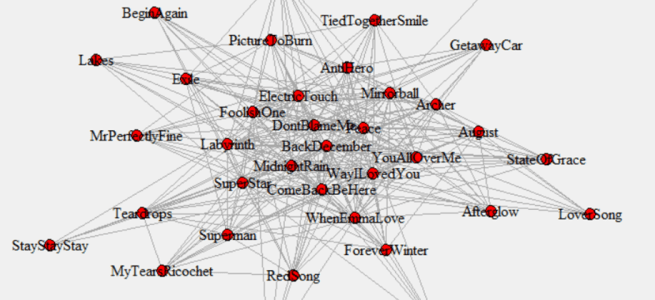
A messy map of how Taylor Swift songs are connected to each other.
Four Types of Taylor Swift Songs
However, there are patterns in the connections that the computer can detect. Using a clustering algorithm, my analysis found that we can arrange these 199 songs into four groups. Here’s that grouping, with songs in italics in the periphery of the group (i.e., less central in the group overall), with those in italics more representative of the group overall. I’ve put the song groupings in chart form at the bottom of this post, organized by album. Even at a glance it is apparent that different albums seem to contain different song types (and stats supports that: album is significantly associated with song group).
Symbolic convergence theory refers to such shared meanings as fantasy themes, and helps discern those themes by calling attention to four elements of the story within each theme: (a) the characters, (b) the plot, (c) the setting, and (d) the “sanctioning agent,” which is a term for the authority that gives legitimacy to the vision. With this in mind, I considered each song group as representing a core story that that runs throughout the Taylorverse. In chronological order of emphasis, these core stories are:
1. Stories of Villains and Heroes: These songs feature Taylor as the recipient of good or bad male behavior. Her boyfriends may be pure heroes, as in “Stay Beautiful” and “Hey Stephen”; more often they are clear villains, as in “Cold as You,” “Forever and Always,” and “Dear John.” The early hit “Love Story” is an example of both the heroic (boyfriend) and the villain male (the stubborn father), with Taylor the innocent victim. These songs are most frequent in the first three albums and become very rare from Reputation onward (although “You’re Losing Me” from Midnights is a modern example of the type). Following symbolic convergence theory, this story type emphasizes the characters in the unfolding drama.
Group 1 song map: Villains and Heroes
2. Stories of Longing and Regret: Moving into Speak Now and especially Red, Taylor’s identity and that of her boyfriends becomes more three-dimensional. She is no longer free of blame; she would “go back and time and change it, but [she] can’t” (“Back to December”), and she knew he was trouble when he walked in (“so shame on me”). Likewise the men are a more complex blend, as in “State of Grace,” where she accepts that the man she is with was “never a saint” and that she has “loved in shades of wrong.” These songs become less frequent after Red (but see “Getaway Car,” “Exile,” and “Anti-Hero”). Following symbolic convergence theory, this story type emphasizes the plot, usually of faded romance.
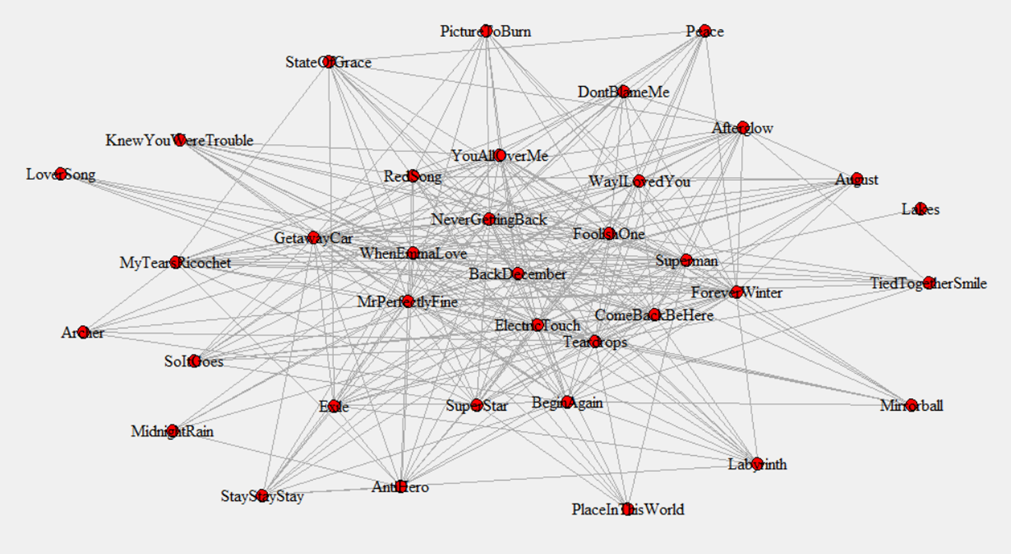
Group 2 song map: Longing and Regret
3. Stories of Finding the Extraordinary in the Ordinary: These songs are most scattered throughout the discography. Although they find their peak prominence in Folklore and especially Evermore, they appear early on too; indeed, her very first single “Tim McGraw” is an example of this song type. In these songs, rich sensory details serve as a window into deeper meanings in Taylor’s inner life. In “Tim McGraw” it’s the “old faded blue jeans” and the “moon like a spotlight on the lake”; in “All Too Well” it is that iconic red scarf; in “Champagne Problems,” it’s the “Midas touch on the Chevy door,” among many other details. Again, although these songs shine in the two indie albums, really it’s a foundational form of sensory storytelling throughout the Taylorverse. Following symbolic convergence theory, this story type emphasizes the setting and how it resonates with the emotional meaning of the story.
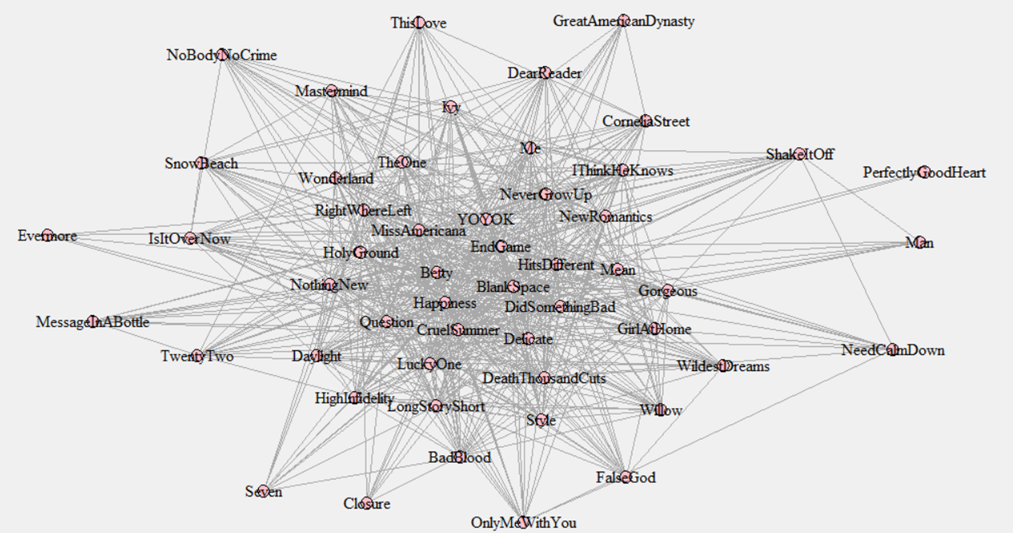
Group 3 song map: Finding the Extraordinary in the Ordinary
4. Stories of Empowered Voice: These are virtually absent in the early albums, until “Mean.” Doing this research project helped me see how important this song is in the discography. No longer is Taylor singing about romantic partners, but about a music critic; she’s addressing her career, and the challenges she faces within it as a woman. That song was a seed that grew a genre of story that is common from 1989 onward, characterized by sarcastic humor (“Blank Space,” “I Did Something Bad”), social commentary (“The Man,” “You Need to Calm Down”) and continued reflection on her own career (“The Last Great American Dynasty,” “You’re on Your Own, Kid,” “Mastermind,” “Long Story Short”). Following symbolic convergence theory, Taylor Swift is no longer a victim; she has become the sanctioning agent, or authority, that grants legitimacy to her (and her audience’s) perspectives and experiences.
Group 4 song map: Empowered Voice
Taylor Swift’s Rhetorical Vision: From Victim to Voice
The final step of a symbolic convergence theory analysis is to look for the overarching story that seems to unite the community. This is known as a rhetorical vision. In the published paper, I summarize the overarching story of the Taylorverse as this:
“The overarching rhetorical vision of the Swift discography, then, is a story of a woman transforming from heartbroken victim to empowered poet. She takes her audience through a journey of finding (feminine) worth, agency, and voice in a world of (often masculine) characters that try to deny her (and her audience) those things through abandonment, neglect, betrayal, or simple unwillingness to understand. The scene reinforces the vision, as setting her stories in commonplace (often domestic) locations builds a strong sense of identification between Swift and her audience (Morris, 2024), and the movement from rural to urban represents growing voice and confidence. The locus of the vision is not so much an external quest for influence, but rather an internal quest for self-value and understanding while ‘living in a world built for someone else’ (Heggeness, 2024).” (Ledbetter, 2024, pp. 20-21)
So, those are the four types of Taylor Swift songs identified in the analysis, and the overarching vision these four core stories create. Clearly, this overarching vision has artistic, cultural, and economic impact. But, not all Taylor Swift songs are equally popular; there seems to be a real difference in enthusiasm between “Blank Space” and “All Too Well” on one hand and, say, “Girl at Home” and “How You Get the Girl” on the same albums. (No disrespect intended if you like the latter two songs!… just looking at stream count…) In the next post, I consider the other major part of the paper, and that is how the semantic overlap between songs predicts a song’s popularity.
And, here is how the song types break down by album era:
Album
Group 1:Villains and Heroes
Group 2:Longing and Regret
Group 3: Extraordinary Meaning
Group 4:Empowered Voice
Debut
Cold as You The Outside Stay Beautiful Should’ve Said No Invisible
Picture to Burn Teardrops… Guitar Place in This World Tied… With a Smile
Tim McGraw Mary’s Song Our Song
Only Me… With You Perfectly Good Heart
Fearless
Love Story Hey Stephen White Horse Breathe Tell Me Why You’re Not Sorry Forever & Always Change Jump Then Fall Other Side… Door Today… Fairytale That’s When Bye Bye Baby
Way I Loved You SuperStar You All Over Me Mr. Perfectly Fine
Fearless Fifteen You Belong With Me The Best Day Untouchable Come in… Rain We Were Happy Don’t You
NONE
Speak Now
Mine Sparks Fly Speak Now Dear John Story of Us Better Than Revenge Innocent Haunted Ours If This Was a Movie I Can See You
Back to December Superman Electric Touch Foolish One When Emma…
Enchanted Last Kiss Long Live Castles Crumbling Timeless
Mean Never Grow Up
Red
I Almost Do Better Man Babe
State of Grace Red I Knew… Trouble Never Getting Back… Stay Stay Stay Begin Again Come Back… Be Here Forever Winter
Treacherous All Too Well The Last Time Sad Beautiful Tragic Everything Has Changed Starlight The Moment I Knew Ronan Bet You Think… Run The Very First Night
22 Holy Ground The Lucky One Girl at Home Nothing New Message in a Bottle
1989
All… Was Stay I Wish You Would How You Get the Girl I Know Places Clean Slut! Say Don’t Go Now… We Don’t Talk
NONE
Welcome to NY Out of the Woods You Are in Love Suburban Legends
Blank Space Style Shake it Off Bad Blood Wildest Dreams This Love Wonderland New Romantics Is It Over Now?
Reputation
… Ready For It? Dress Can’t… Nice Things Call… You Want
Don’t Blame Me So It Goes… Getaway Car
Look What… Do King of My Heart Dancing… Tied New Year’s Day
End Game I Did Something Bad Delicate Gorgeous
Lover
NONE
Lover The Archer Afterglow
Forgot… You Existed Paper Rings London Boy Soon… Get Better Nice to Have a Friend
Cruel Summer The Man I Think He Knows Miss Americana… Cornelia Street Death… 1000 Cuts False God Need to Calm Down ME! Daylight
Folklore
This is Me Trying Mad Woman
Exile My Tears Ricochet Mirrorball August Peace The Lakes
Cardigan Illicit Affairs Invisible String Hoax
The One Great American Dynasty Seven Betty
Evermore
Dorothea
NONE
Champagne Problems Gold Rush ‘Tis the Damn Season Tolerate It Coney Island Cowboy Like Me Marjorie It’s Time to Go
Willow No Body, No Crime Happiness Ivy Long Story Short Closure Evermore Right Where…
Midnights
Lavender Haze Vigilante Shit Sweet Nothing The Great War Glitch You’re Losing Me
Anti-Hero Midnight Rain Labyrinth
Maroon Bejeweled Karma Bigger… Whole Sky Paris Would’ve… Could’ve
Snow on the Beach You’re on Your Own, Kid Question…? Mastermind High Infidelity Dear Reader Hits Different
Normally I review Taylor Swift’s songs and albums, which is really fun, but here I’m reviewing something much less fun: Our bathroom remodel with Nebraska Furniture Mart (NFM).
We have been NFM customers for almost 20 years, furnishing our first apartment as a newly-married couple out of the Omaha store, and much of our Texas home from the location at The Colony. Among the options available, we chose NFM for the renovation due to this longstanding customer relationship and their brand reputation.
Here’s some videos and pictures from the 5-6 week project that turned into a 6+ month renovation nightmare that still isn’t settled.
The waterfall flood
Nebraska Furniture Mart @nfmtweets did this to our home during our renovation. And when we requested an inspector, they wouldn't give us the report about the water damage.
It appears NFM used an unlicensed plumber. One of many reasons a 5-6 week job became a 6+-month nightmare. pic.twitter.com/fmNxcRmrlZ
The first time we tried to use the upstairs shower, we discovered that NFM had actually installed this new ‘water feature’ in our master bedroom. They paid for a third party inspector, who discovered that NFM’s incompetent subcontractor, who was probably unlicensed, caused it due to misinstallation. More on the quality of their work in a moment.
We’ve asked for licensing information about the plumbers who did the work, and NFM has refused to provide it. One NFM employee did, however, cite their longstanding relationship with this subcontractor in an email to us (“Since we use the subcontractor for many different projects, we do not have access to what staff have been requested for each home”).
We’ve also asked to see the inspection report, and NFM won’t give us that either.
Here’s more detail on the incompetence that caused the flood. (I wish I’d caught on camera how the fixtures moved up and down, but that was a crazy week…)
But it is apparent that the subcontractors should have known about the misinstallation. Because we were replacing our master ceiling fan at the time, our master bedroom mattress was right below the vent at the time the workers installed the shower. That earlier flood destroyed the mattress and the bed.
Valve leak and the bathroom cabinet
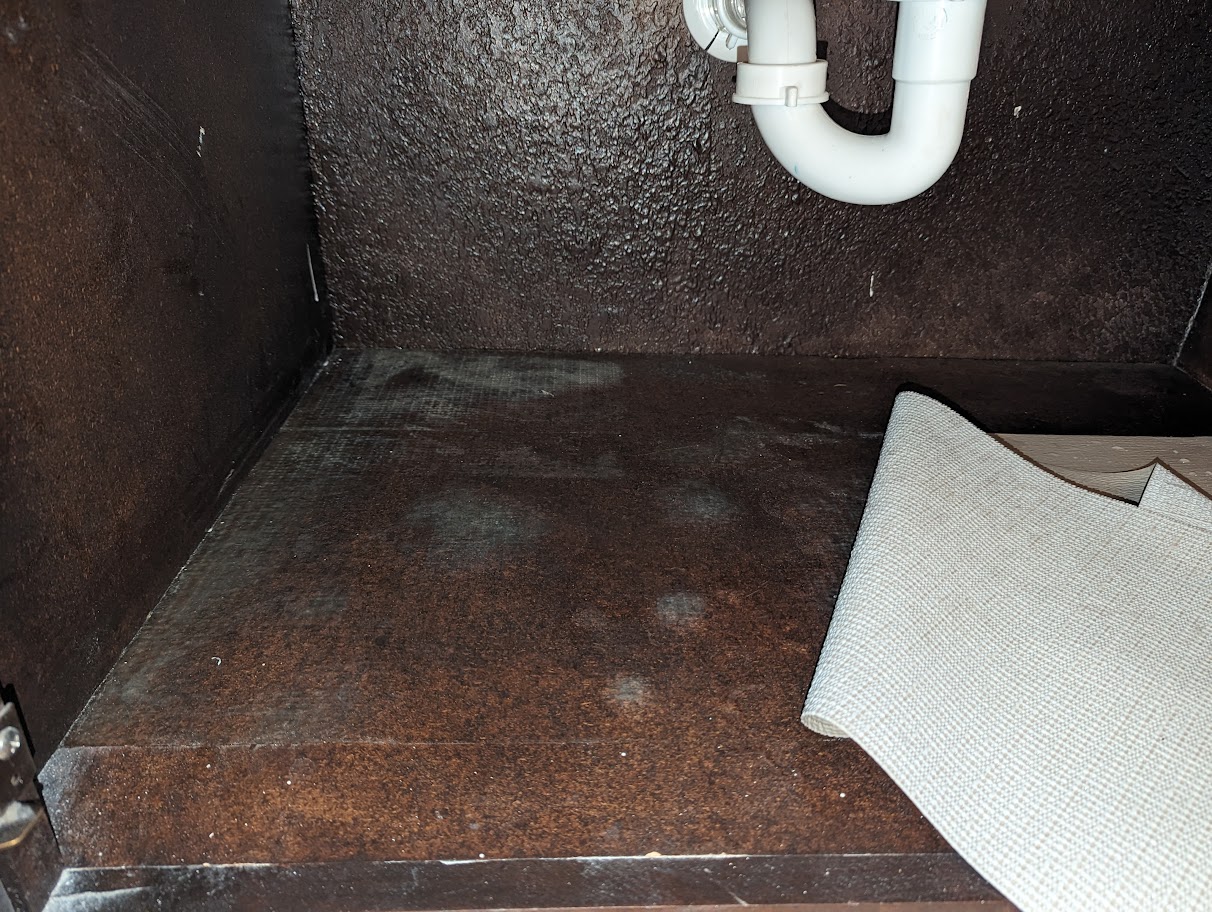
NFM incorrectly installed the shutoff valve in an upstairs bathroom sink. It leaked every 8 seconds for a week and damaged the bottom of the cabinet.
No O-ring means no seal, which would mean a rather short bath.
Trashy, smelly garage
NFM said the worker’s trash wouldn’t be stored on site. Yet our garage was filled with trash for weeks. What this picture can’t capture is the rancid stench from the workers’ leftover food as it decayed in the sweltering Texas summer heat.
Questionable quality
Here’s the niche in the upstairs shower. The workers made it rather small. Notice the messy grout around the edges, and the way the gray grout bleeds into the white grout. And the tiny triangles at the top are a strange way to cut the tile. This is but one example of many quality issues during the initial install.
Firing the subcontractor and discovering even more problems
After 8 weeks of dealing with these quality issues, culminating in the flood, we were livid. We insisted, and NFM fired their incompetent subcontractor they use “for many different projects” and hired someone who was actually competent to do the work. And that contractor discovered many, many problems with the first contractor’s work. So, after moving out of the house for 8 weeks to avoid living through a renovation… well, we lived through a months-long renovation anyway.
Lack of upstairs tub support
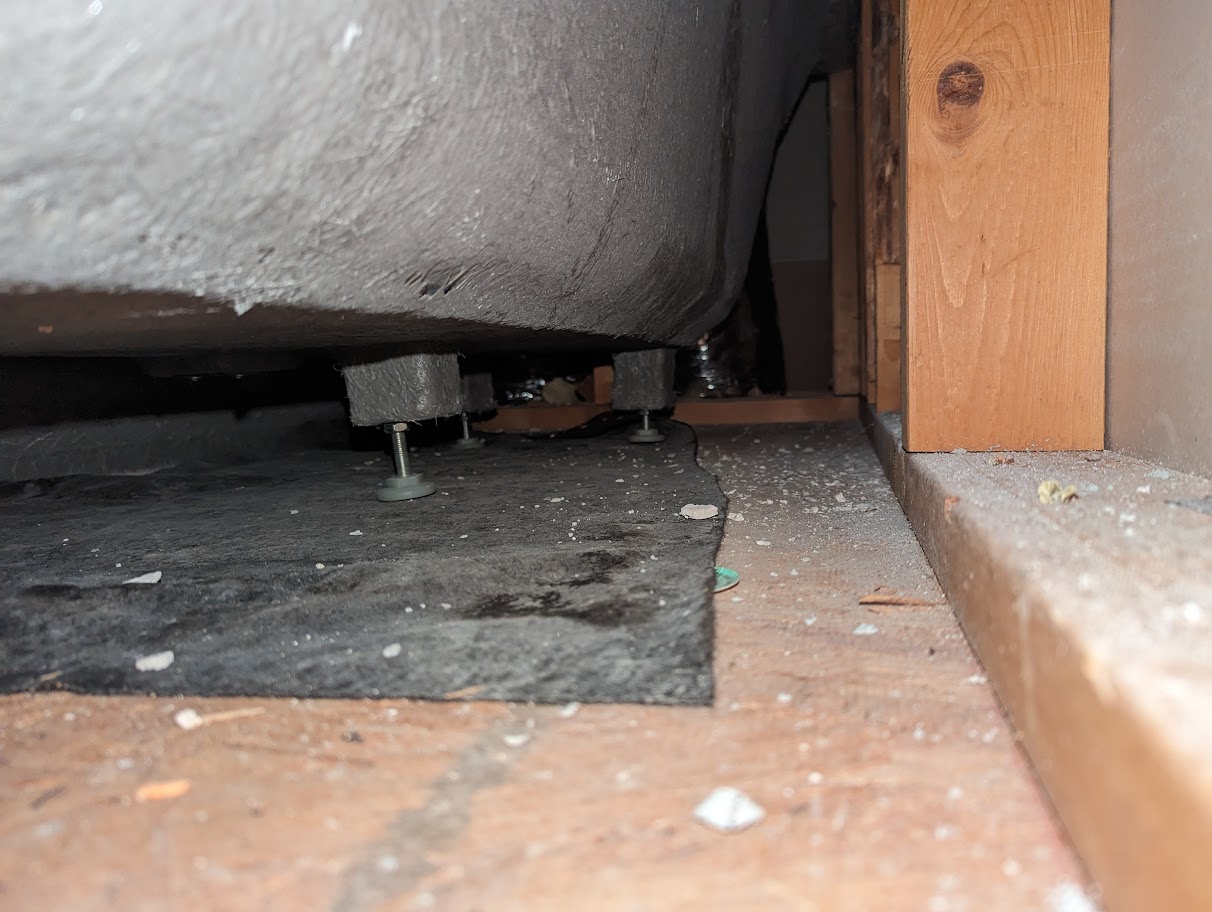
The waterfall flooding wasn’t the only issue with the upstairs tub/shower. NFM didn’t bother to put support underneath, per installation instructions. Instead, it was sitting on leveling feet, and those feet weren’t even level. For about three months this was our only working shower (once the flooding issue was repaired, of course). Not real fun as a family of four, and the tub bottom felt squishy and unstable while using it. Our entire family continually felt like we might fall through the floor of the tub at any moment while showering.
Wrong lumber in the master shower
I’m no expert on these things (and it appears NFM might not be, either), but apparently you’re supposed to use pressure-treated lumber for a shower, given the dampness of the area. NFM used plain old lumber. I’m told NFM used the wrong type of concrete as well. This meant that the shower floor had to be completely ripped out, all the way back down to the foundation to redo it properly and then have it permitted and inspected, which the original NFM contractor never did.
Uneven backsplash
Here's how @nfmtweets initially installed our master bathroom backsplash. Totally uneven. When we pointed this out to the installer, he shrugged and said there was nothing he could do. Can't blame him, really. It was late on Friday afternoon and I'm sure he had weekend plans. pic.twitter.com/e2aBlStYCi
Of course the bathroom mirror glass couldn’t be installed until this was done. It took the countertop folks about four trips to the house and weeks of delay to finally get it right.
No insulation for a pipe on an external wall
Our new standing tub needed pipes to run along an exterior wall for the placement of the fixture. Even though I’m no expert, I know insulation is needed so that pipes don’t freeze. But NFM didn’t put any in there. And to have the new pipes on this exterior wall required cutting through some studs that hold up the roof of the house. You guessed it, improper support was provided where the studs were notched.
Improperly installed tile
For the shower tile, @nfmtweets put the mortar on in globs, which would allow moisture to run under the tile. The proper approach would be to spread the mortar on the tile evenly. pic.twitter.com/6iPun1DDcY
This video also shows the bags of tile debris, which definitely does not contain insulation (see above).
Wrong color grout for the master shower floor
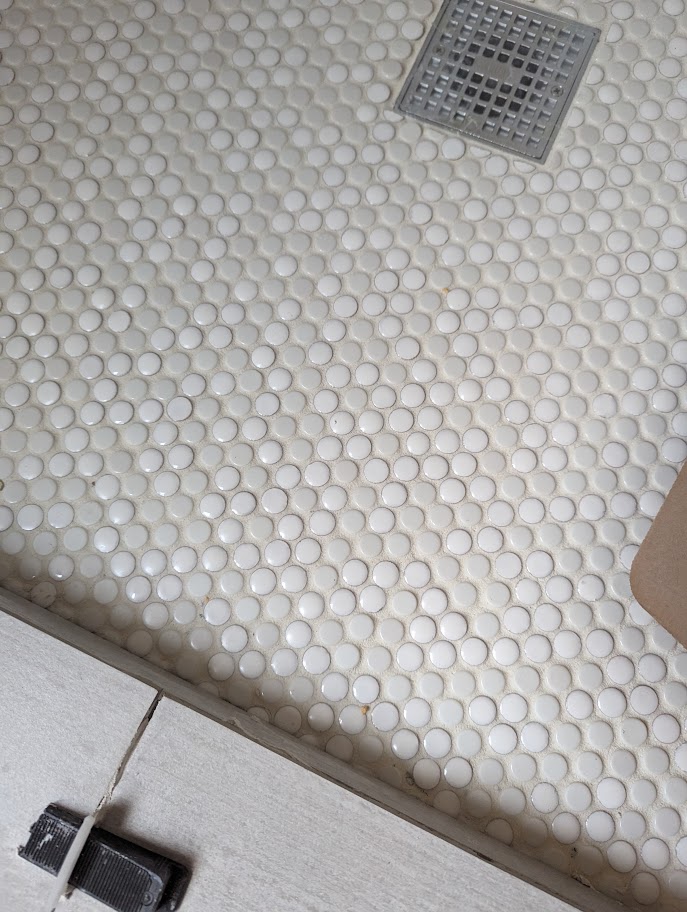
If white grout around white tile is your thing, hey, you do you. But to us, it looks washed out and bleh. Before work began, we made it clear that we wanted gray grout around the white tile. NFM didn’t communicate this to the original subcontractors. Even though the subcontractor called me to clarify, they still misinstalled it, so they did it again. Then the new contractor had to rip it all out… but NFM miscommunicated again, and we had white on white a second time (!). They finally got it right the fourth time.
Not getting proper permits and inspections for plumbing work
For the two drains in the master bathroom, @nfmtweets did not seek proper permitting during the initial installation. pic.twitter.com/W8FXh4O5Yl
Even with reliance on a subcontractor, I don’t know how this procedural and legal detail escaped NFM’s attention. And the shower drain was loose, so water could have traveled along the drain pipe down into the foundation of the house.
What about the aftermath?
I wish I could say that, in the aftermath of all of this, NFM has engaged in good customer service, treating us like longtime customers who spent a lot of money in their store on this project. That has only been the case regarding actually fixing the work. In the end, the bathrooms turned out fine.
Disappointing customer service
Making things right has been another story. We spent thousands of dollars to cope with the flood in August (hotel fees, replacing the master bed, etc.). NFM wasn’t interested in reimbursing that money until the work was done… in January.
And by that point, they were uninterested in talking directly to us at all. They just wanted to push us off onto their insurance claims adjuster (who, obviously, works to serve NFM, not help us). Nearly a month ago, I asked for a high-level member of their customer service team to call us to discuss what happened and how to make it right. Other than a few curt and uninformative emails from the store manager at The Colony, we’ve heard nothing. At one point, we called and left a voicemail. NFM never returned the call.
But when I tweeted about the flood, they did tweet back. “Just talk with us through the BBB” is painful to hear after our experience.
Hi @dr_ledbetter, we're sorry to hear and see this and have been working with you through the BBB, CASE 21188996. Please continue to respond through the BBB. Thank you for your understanding.
Dealing with NFM’s financial practices also has been frustrating and confusing. We took some credit from NFM to fund the project. By the time the initial subcontractor was fired in late summer, NFM said we owed a certain amount, and that amount was consistent with our agreement when we contracted for the work.
Then in September, the amount dropped by a few hundred dollars.
In October, our bill was over $1000 less than the prior month.
Then in November, $6500 less!
But in December, it was $6300 more.
And in January, another $1200 more.
We’ve asked for explanation why our bill has gone up and down. They’ve pointed to their general accounting practices–essentially, ‘this is just how we do business.’ They also sent us this spreadsheet, which isn’t exactly illuminating. It feels like NFM is making this up as they go.
Personal impact
But beyond the construction hassles, the financial wonkiness, and the poor customer service, this has just plain overshadowed so much of our lives since last June. We moved out of our house unnecessarily over the summer, during which our youngest daughter slept on an air mattress for 8 weeks.
My wife and I both work in higher education, and we planned the renovation for the summer because that is a slower and more flexible time. During fall semester and now spring, this has impacted our work productivity, between meeting with contractors and phone calls and emails.
Our house wasn’t a great place to celebrate the holidays, when the work should have been long done. It has been massive amounts of stress and time lost that we’ll never get back.
And the impact on our kids is just the worst. Here’s my oldest daughter’s narration the night of the flood, as we packed up to head to a hotel. (Admittedly, the lost wallet is my fault, not NFM’s, though the stress of this entire ordeal certainly didn’t help matters!)
The hardest part of the Nebraska Furniture Mart @nfmtweets renovation has been seeing the toll it took on our kids during the 198 days of work in the home. Here's our oldest on the night of the flood. They've persevered and I'm proud of them. pic.twitter.com/3QPDwz9npp
We regret choosing Nebraska Furniture Mart for the renovation, and we will not buy so much as a lightbulb there in the future. We hope our story helps others make informed decisions about home remodeling work.