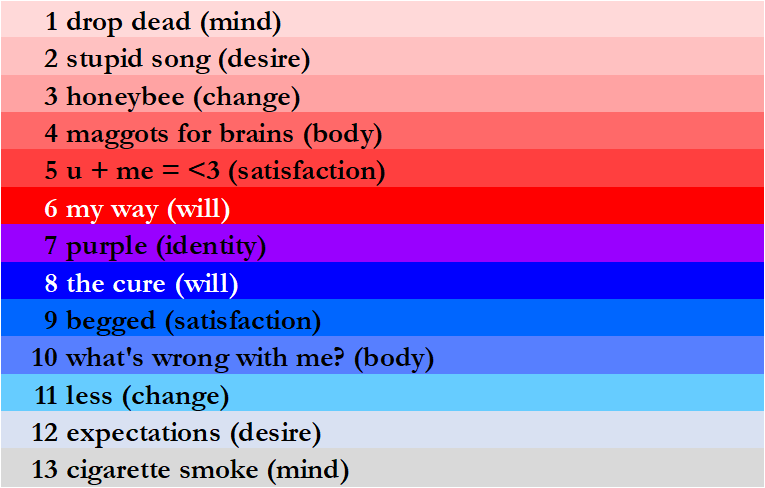
“stupid song” (track 2) & “expectations” (track 12): what relationship do I want? (Olivia Rodrigo’s YPSPFAGSIL, analyzed)

“I met him at a party,” Olivia sings at the start of “expectations.” Likewise, the first verse of “stupid song” describes a party where she feels insecure. At both there’s drug use, by her friends (“stupid song”) and her ex (“expectations”). Is it the same party? Narratively, I would say that seems to be the suggestion, whether or not that maps onto Olivia’s real-world relational history. This pair of songs presents different perspectives on that event and its consequences. As the tale unfolds, it demonstrates Olivia’s character growth across the album’s story.

And wow, what a difference in Olivia’s perspective on her (ex-)boyfriend between the two songs! In “stupid song,” she longs for him and dreams of him, speaking of her affection for him with allusion to Greek mythology (“I’m a heart made of wax and I’m melting in the sun.”) By the time of “expectations,” those wax wings have melted away, and having fallen back to Earth, she admits that his positive perception of him was a delusion (“he wasn’t smart or funny, I convinced myself he was”). Her fear in “drop dead” wasn’t just paranoia, in the end; she really did make him up.

The first verses of both songs end with an emphasis on communication, and as a communication professor that makes me happy. In “stupid song” she imagines their interaction, longing to speak with him. Yet in “expectations,” she has prevented communication by blocking his number.

The chorus of “stupid song” is a passionate statement of romantic desire, and it is a desire that is unchecked: Olivia feels like she is on fire, and like she is a “car… without a brake.” Meanwhile, “expectations” presents her brand-new relational brake system in a non-nonsense, deadpan tone: future guys can’t be passive, or indecisive, or have a fake job. She’s replaced her total insanity in “stupid song” with a grounded rationality, pouring the cold water of caution and self-respect on the flames of romantic desire, yet still holding to faith, drive, and heart.

The second verses of both songs live in the shadow of the party. In both, Olivia is in a dress: in “stupid song,” lying passively on her bed when she should be in pajamas, while in “expectations,” she’s “rocking [her] mini dress with a vodka cran and an open heart.” In “stupid song” she is a picture of desperation; in “expectations,” she is full of confidence, looking with disdain at the guys that are so “desperate for loving, but… I’m not.” Really, “expectations” proves her claim in “stupid song” wrong (“And all the girls at this party are so cool, that’s never been a thing that I could do”). Now, she has become the confident girl who owns the social scene.

There’s also something to be said about the geography of these songs and the entire album. Toward the beginning of the saga, she is in New York City; by the pivot point in “purple,” she feels at home in London. After crying on the curb at LAX in “less,” she’s still back at home in Los Angeles in “expectations,” expecting to be disappointed by the guys at a bar in the suburbs. Geographically, we’re coming back around to where the album began, moving homeward; “cigarette smoke” will soon describe the scene of emotional devastation that her home has become.

When reflecting on “u + me = <3” and “begged,” I considered social exchange theory, which uses an economic lens to evaluate relationship choices. That theory says we compare our relationships to our comparison level. That level is essentially a threshold we need to meet in order to be satisfied. When I teach my students about this concept, I tell them that the comparison level is, essentially, how “high maintenance” someone is. In “expectations,” Olivia is saying that comparison level has risen; it will take more to keep her happy than what she tolerated in her last relationship.

No other pair of songs so clearly demonstrates Olivia’s character growth across the arc of the album. One line succinctly sums up this growth and the interplay between the two songs: “Gave my heart with zero stipulations [in ‘stupid song’], now [in ‘expectations’] I take careful consideration”.

Previous posts:

“maggots for brains” (track 4) & “what’s wrong with me?” (track 10): how does my body feel in this relationship? (Olivia Rodrigo’s YPSPFAGSIL, analyzed)

Last time, I considered how “u + me = <3” and “begged” are about the exchanges that happen in relationships. And an exchange-oriented approach to relationships is inherently individualistic: it’s about what I get out of the relationship versus what you get out of the relationship. But, when we get really close to someone, our mental “balance sheet” changes. We no longer think of you and I, but rather, we think of we. My costs are your costs; really, they’re our costs. Same for our rewards. That’s the subject of self-expansion theory, which claims that when we get close to someone, we include that person in our sense of the self.

That’s the focus of “maggots for brains” (track 4) and “what’s wrong with me?” (track 10). Both tracks use medical language to describe how that self/other overlap makes Olivia feel. There’s perhaps more subject matter similarity here than any two tracks on the album. In both, Olivia is sick and her relationship is the reason why.

In the first verse of both songs, Olivia is at home, bored, and not feeling well. She’s also unable to communicate these psycho-bodily sensations clearly: In “maggots,” she “tried to write, nothing came out,” and in “what’s wrong?”, she “can’t describe this feeling [she’s] got in [her] head.” Throughout both songs she remains homebound, but with one futile exception in each, going “to a party but only on principle” or “to the doctor, and she said I was fine.”

The chorus of both songs is a description of her illnesses, a bit like the list of symptoms she’s entering into Google on “what’s wrong?” In “maggots,” she is a “zombie in her body”; “what’s wrong?” echoes this in verse 1, as she is “out of body in [her] bed.” In both songs she is helpless in the face of her symptoms (“nothing ever seems to help” and “what can I do but think of you?”). And both choruses conclude with the diagnosis: in the first case, this is “just the thing that happens when my baby goes away”; in the second case, “I think you’re what’s wrong with me.” In other words, the problem is his presence, and then later the problem is his absence.

There’s even similarity in how Olivia tries to cope with her sickness: by drinking large quantities of beverages. In “maggots” it’s “a pot of coffee”; in “what’s wrong?”, a “bottle of wine.” One is a stimulant, and the other a depressant, which fits both songs and their respective halves of the album.

In terms of self-expansion theory, these songs reflect the deep level of self-other inclusion Olivia feels in this romantic relationship. When we are so close to someone, it’s natural to feel like part of you is missing when the one you care about is gone. In many cases that’s healthy, but as “this song “maggots” looks ahead to the pivot point, we know Olivia will ultimately decide it’s not. And as “what’s wrong?” looks back on that pivot point, Olivia’s heartache is that she isn’t certain she wants to have this level of self-other inclusion anymore. Her prescription has shifted quite a bit from wishing for anything, even “a tragedy,” that would bring him near.

Finally, there’s Olivia’s curious observation on “what’s wrong?”: “lately I’ve been spiraling.” A spiral is a circle… like a ring. Perhaps this is a subtle hint that the album is spiraling around, revisiting themes. The next theme we’ll consider are the songs before/after, which chronicle the relationship’s beginning (“honeybee”) and its end (“less”).

Other posts:

“my way” (track 6) & “the cure” (track 8): what is my will for this relationship? (Olivia Rodrigo’s YPSPFAGSIL, analyzed)

In the previous post, I noted that “purple” is the track at the center of the ring. On either side of it are tracks that pertain to confidence, strength, and the will.

Their contrast is striking. In “my way,” Olivia is defiant, self-assured of victory: “So, where’d you get that confidence from? Last time that I checked, I won!” Just two tracks later, she is full of poison and doubt, “unraveled,” longing for a cure she can’t seem to find. In one song her will is strong; in the other, it’s shattered. The two tracks are a mirror, reflected around the pivot point. After the crisis of identity narrated at the end of “purple,” Olivia’s iron will has vanished, suggesting it was perhaps a show of bravado all along.

Some other lyrical details demonstrate this mirror:

  • In “my way,” Olivia is drawing the lines on the map, warning another woman to stay away from her man. But, at the start of “the cure,” the ones who are “moving the line” are “all the pretty girls in the foreground of [her] mind.”
  • In “my way,” Olivia believes the other woman is “insane,” but in “the cure,” Olivia is the one fighting “bad thoughts.”
  • The threatening woman in “my way” finds her worth in winning Olivia’s man, yet in “the cure,” Olivia realizes that she has been finding her worth in her man too (even though “it’s not enough”).
  • And so “my way” Olivia tries to convince the other woman to leave (to no effect), while her boyfriend tries to convince “the cure” Olivia to quiet her doubts (to no effect).
  • The other woman lingers “like a bad perfume” in “my way,” while Olivia’s doubts linger in “the cure.”
  • The “my way” girl plays a game with “amateur moves,” and the Olivia in “the cure” plays a mind game with herself (“I used to play a game in my head when I’d date a guy…”).

Perhaps the greatest point of connection between the two songs is the presence of female competition. More than any other tracks, both “my way” and “the cure” present other women as a threat to the romantic relationship. In “my way” it is a specific woman who is pursuing Olivia’s man, and in “the cure” it is a broader chorus of “pretty girls,” including those her boyfriend has slept with in the past.

Speaking of mirrors, George Herbert Mead’s symbolic interactionism (a foundational theory in the social sciences) believes we understand who we are via a process called the looking-glass self. To know our physical self, we look in a mirror. But to know our social self, the “looking-glass” is the reactions of other people. How they treat us tell us something about who we are.

That looking-glass self is at play in the games described by this pair of songs. In “my way,” the actions of the other woman make Olivia feel how committed and defensive she is about the relationship. She’s willing to play the game and she’s sure that she’ll win it.

But, “the cure” takes place after the all-important pivot in “purple.” After that crisis of relationship identity, female competition makes Olivia feel like she doesn’t measure up, like she’s never “done enough.” And now, in her state of mental paralysis, it is her boyfriend fighting for the relationship, trying to remove the “toxins in [her] bloodstream.”

Rodrigo has said that “the cure” is the album’s thesis statement. That fits the ring cycle theory: after setting the stage with the album’s first half, it makes sense to put a thesis statement about the entire work right at the start of the second half. Elaborating on the doubts first voiced at the end of “purple,” “the cure” makes it clear that this album is a tragedy. Olivia has been trying to find ultimate satisfaction in a romantic relationship, but it will never be the cure, and instead her flaws will contribute to the relationship’s demise.

Not her flaws alone, of course. She’ll aim criticism at her man in the coming tracks. But in “the cure,” she owns that her own fears have shattered the force of will she had back in “my way.” The overidentification described in “purple” now reveals that a romantic partner, as important and meaningful as they can be, cannot solve all of a person’s problems. If we expect another person to do so, that is unreasonable and will damage the relationship, perhaps even leading to its demise.

Other posts: