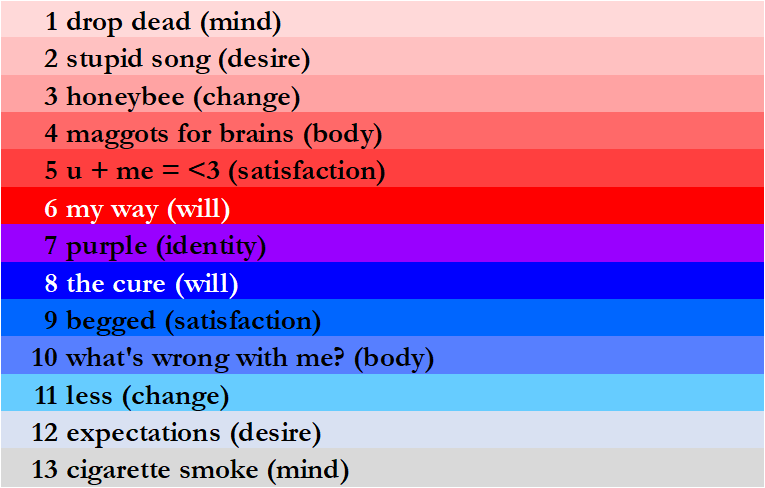
“I met him at a party,” Olivia sings at the start of “expectations.” Likewise, the first verse of “stupid song” describes a party where she feels insecure. At both there’s drug use, by her friends (“stupid song”) and her ex (“expectations”). Is it the same party? Narratively, I would say that seems to be the suggestion, whether or not that maps onto Olivia’s real-world relational history. This pair of songs presents different perspectives on that event and its consequences. As the tale unfolds, it demonstrates Olivia’s character growth across the album’s story.
And wow, what a difference in Olivia’s perspective on her (ex-)boyfriend between the two songs! In “stupid song,” she longs for him and dreams of him, speaking of her affection for him with allusion to Greek mythology (“I’m a heart made of wax and I’m melting in the sun.”) By the time of “expectations,” those wax wings have melted away, and having fallen back to Earth, she admits that his positive perception of him was a delusion (“he wasn’t smart or funny, I convinced myself he was”). Her fear in “drop dead” wasn’t just paranoia, in the end; she really did make him up.
The first verses of both songs end with an emphasis on communication, and as a communication professor that makes me happy. In “stupid song” she imagines their interaction, longing to speak with him. Yet in “expectations,” she has prevented communication by blocking his number.
The chorus of “stupid song” is a passionate statement of romantic desire, and it is a desire that is unchecked: Olivia feels like she is on fire, and like she is a “car… without a brake.” Meanwhile, “expectations” presents her brand-new relational brake system in a non-nonsense, deadpan tone: future guys can’t be passive, or indecisive, or have a fake job. She’s replaced her total insanity in “stupid song” with a grounded rationality, pouring the cold water of caution and self-respect on the flames of romantic desire, yet still holding to faith, drive, and heart.
The second verses of both songs live in the shadow of the party. In both, Olivia is in a dress: in “stupid song,” lying passively on her bed when she should be in pajamas, while in “expectations,” she’s “rocking [her] mini dress with a vodka cran and an open heart.” In “stupid song” she is a picture of desperation; in “expectations,” she is full of confidence, looking with disdain at the guys that are so “desperate for loving, but… I’m not.” Really, “expectations” proves her claim in “stupid song” wrong (“And all the girls at this party are so cool, that’s never been a thing that I could do”). Now, she has become the confident girl who owns the social scene.
There’s also something to be said about the geography of these songs and the entire album. Toward the beginning of the saga, she is in New York City; by the pivot point in “purple,” she feels at home in London. After crying on the curb at LAX in “less,” she’s still back at home in Los Angeles in “expectations,” expecting to be disappointed by the guys at a bar in the suburbs. Geographically, we’re coming back around to where the album began, moving homeward; “cigarette smoke” will soon describe the scene of emotional devastation that her home has become.
When reflecting on “u + me = <3” and “begged,” I considered social exchange theory, which uses an economic lens to evaluate relationship choices. That theory says we compare our relationships to our comparison level. That level is essentially a threshold we need to meet in order to be satisfied. When I teach my students about this concept, I tell them that the comparison level is, essentially, how “high maintenance” someone is. In “expectations,” Olivia is saying that comparison level has risen; it will take more to keep her happy than what she tolerated in her last relationship.
No other pair of songs so clearly demonstrates Olivia’s character growth across the arc of the album. One line succinctly sums up this growth and the interplay between the two songs: “Gave my heart with zero stipulations [in ‘stupid song’], now [in ‘expectations’] I take careful consideration”.
Last time, I considered how “u + me = <3” and “begged” are about the exchanges that happen in relationships. And an exchange-oriented approach to relationships is inherently individualistic: it’s about what I get out of the relationship versus what you get out of the relationship. But, when we get really close to someone, our mental “balance sheet” changes. We no longer think of you and I, but rather, we think of we. My costs are your costs; really, they’re our costs. Same for our rewards. That’s the subject of self-expansion theory, which claims that when we get close to someone, we include that person in our sense of the self.
That’s the focus of “maggots for brains” (track 4) and “what’s wrong with me?” (track 10). Both tracks use medical language to describe how that self/other overlap makes Olivia feel. There’s perhaps more subject matter similarity here than any two tracks on the album. In both, Olivia is sick and her relationship is the reason why.
In the first verse of both songs, Olivia is at home, bored, and not feeling well. She’s also unable to communicate these psycho-bodily sensations clearly: In “maggots,” she “tried to write, nothing came out,” and in “what’s wrong?”, she “can’t describe this feeling [she’s] got in [her] head.” Throughout both songs she remains homebound, but with one futile exception in each, going “to a party but only on principle” or “to the doctor, and she said I was fine.”
The chorus of both songs is a description of her illnesses, a bit like the list of symptoms she’s entering into Google on “what’s wrong?” In “maggots,” she is a “zombie in her body”; “what’s wrong?” echoes this in verse 1, as she is “out of body in [her] bed.” In both songs she is helpless in the face of her symptoms (“nothing ever seems to help” and “what can I do but think of you?”). And both choruses conclude with the diagnosis: in the first case, this is “just the thing that happens when my baby goes away”; in the second case, “I think you’re what’s wrong with me.” In other words, the problem is his presence, and then later the problem is his absence.
There’s even similarity in how Olivia tries to cope with her sickness: by drinking large quantities of beverages. In “maggots” it’s “a pot of coffee”; in “what’s wrong?”, a “bottle of wine.” One is a stimulant, and the other a depressant, which fits both songs and their respective halves of the album.
In terms of self-expansion theory, these songs reflect the deep level of self-other inclusion Olivia feels in this romantic relationship. When we are so close to someone, it’s natural to feel like part of you is missing when the one you care about is gone. In many cases that’s healthy, but as “this song “maggots” looks ahead to the pivot point, we know Olivia will ultimately decide it’s not. And as “what’s wrong?” looks back on that pivot point, Olivia’s heartache is that she isn’t certain she wants to have this level of self-other inclusion anymore. Her prescription has shifted quite a bit from wishing for anything, even “a tragedy,” that would bring him near.
Finally, there’s Olivia’s curious observation on “what’s wrong?”: “lately I’ve been spiraling.” A spiral is a circle… like a ring. Perhaps this is a subtle hint that the album is spiraling around, revisiting themes. The next theme we’ll consider are the songs before/after, which chronicle the relationship’s beginning (“honeybee”) and its end (“less”).
Their contrast is striking. In “my way,” Olivia is defiant, self-assured of victory: “So, where’d you get that confidence from? Last time that I checked, I won!” Just two tracks later, she is full of poison and doubt, “unraveled,” longing for a cure she can’t seem to find. In one song her will is strong; in the other, it’s shattered. The two tracks are a mirror, reflected around the pivot point. After the crisis of identity narrated at the end of “purple,” Olivia’s iron will has vanished, suggesting it was perhaps a show of bravado all along.
Some other lyrical details demonstrate this mirror:
In “my way,” Olivia is drawing the lines on the map, warning another woman to stay away from her man. But, at the start of “the cure,” the ones who are “moving the line” are “all the pretty girls in the foreground of [her] mind.”
In “my way,” Olivia believes the other woman is “insane,” but in “the cure,” Olivia is the one fighting “bad thoughts.”
The threatening woman in “my way” finds her worth in winning Olivia’s man, yet in “the cure,” Olivia realizes that she has been finding her worth in her man too (even though “it’s not enough”).
And so “my way” Olivia tries to convince the other woman to leave (to no effect), while her boyfriend tries to convince “the cure” Olivia to quiet her doubts (to no effect).
The other woman lingers “like a bad perfume” in “my way,” while Olivia’s doubts linger in “the cure.”
The “my way” girl plays a game with “amateur moves,” and the Olivia in “the cure” plays a mind game with herself (“I used to play a game in my head when I’d date a guy…”).
Perhaps the greatest point of connection between the two songs is the presence of female competition. More than any other tracks, both “my way” and “the cure” present other women as a threat to the romantic relationship. In “my way” it is a specific woman who is pursuing Olivia’s man, and in “the cure” it is a broader chorus of “pretty girls,” including those her boyfriend has slept with in the past.
Speaking of mirrors, George Herbert Mead’s symbolic interactionism (a foundational theory in the social sciences) believes we understand who we are via a process called the looking-glass self. To know our physical self, we look in a mirror. But to know our social self, the “looking-glass” is the reactions of other people. How they treat us tell us something about who we are.
That looking-glass self is at play in the games described by this pair of songs. In “my way,” the actions of the other woman make Olivia feel how committed and defensive she is about the relationship. She’s willing to play the game and she’s sure that she’ll win it.
But, “the cure” takes place after the all-important pivot in “purple.” After that crisis of relationship identity, female competition makes Olivia feel like she doesn’t measure up, like she’s never “done enough.” And now, in her state of mental paralysis, it is her boyfriend fighting for the relationship, trying to remove the “toxins in [her] bloodstream.”
Rodrigo has said that “the cure” is the album’s thesis statement. That fits the ring cycle theory: after setting the stage with the album’s first half, it makes sense to put a thesis statement about the entire work right at the start of the second half. Elaborating on the doubts first voiced at the end of “purple,” “the cure” makes it clear that this album is a tragedy. Olivia has been trying to find ultimate satisfaction in a romantic relationship, but it will never be the cure, and instead her flaws will contribute to the relationship’s demise.
Not her flaws alone, of course. She’ll aim criticism at her man in the coming tracks. But in “the cure,” she owns that her own fears have shattered the force of will she had back in “my way.” The overidentification described in “purple” now reveals that a romantic partner, as important and meaningful as they can be, cannot solve all of a person’s problems. If we expect another person to do so, that is unreasonable and will damage the relationship, perhaps even leading to its demise.
“Gray November, I’ve been down since July.” The opening lyric from the “Evermore” title track hits different now. In July, the surgeon removed the polyp that revealed the presence of stage 3 rectal cancer. And I spent the entire month of November in daily chemoradiation to treat it.
I’m 46. This all emerged after my first routine colonoscopy. If you are 45 or older, get one; if you are 40 or older, and you have any ability to have a colonoscopy done, I hope you will. It is a very good idea and not as onerous as people make it sound. I certainly wish I had. I’d go back in time and change that, but I can’t.
During my screening MRIs, I asked the technicians to play Taylor Swift while I was in the tube. It was a practical decision as well as an emotional one. I know the length of many Swift songs, at least roughly, so when they told me the scan would take about 45 minutes, Taylor both entertained me and let me know how much time I had remaining.
Fast forward to October 27, the first day of radiation treatment. The nurses asked what music I wanted, and when I said Swift, one of the nurses lit up. “We don’t get many Swifties around here!” she said.
“Are you a Swiftie?” I asked. Indeed she was! Later, I learned that she rearranged her schedule so she could have me as a patient and listen to Taylor Swift with me during my treatment. By the end, Nurse Allison even knew how to seed the Pandora station so that it gravitated toward my favorites.
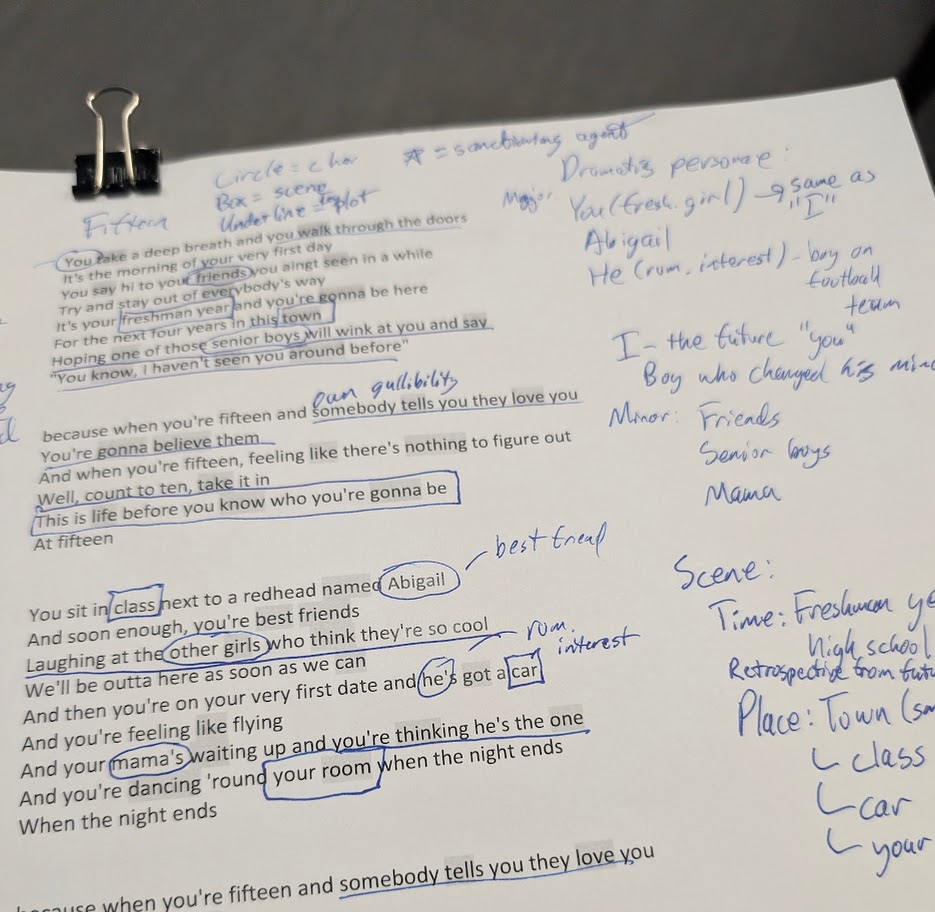
Then there’s the waiting for appointments, an inevitable part of any major medical issue. Early in the treatment cycle, I printed out the lyrics of some of Swift’s most semantically-central songs. I don’t want to steal my own thunder for what might become a future paper, but suffice it to say that, as I sat waiting for radiation therapy, a hospital robe my only clothing to speak of, I busied and distracted myself with a pen and paper, conducting rhetorical analysis of some of her most famous lyrics. I hate it here, so analyzing those lyrics became lunar valleys in my mind.
Now we are back to December, the season of Advent (and, for many Swifties, of the Evermore album). I have finished five weeks of chemoradiation, and later this month, I will begin a chemotherapy regimen that will last 3 months. The hope is that this will take care of the cancer, and that future scans and scopes will reveal no tumor. If so, life continues. If not—and there is a substantial chance the treatment will not be completely effective—I likely will need surgery to remove my rectum. That would be life-changing.
If the opening line of “Evermore” is uncanny, the bridge, that powerful duet between Justin Vernon and Taylor Swift, is an emotional gut-punch. I mean, so many of her bridges are, but this one has taken on deep subjective meaning for me. It’s likely not with meaning she intended, but that’s ok; such is art, whose meaning often is a joint creation between the artist and the audience.
Vernon: Can’t not think of all the cost, and the things that will be lost. Oh, can we just get a pause? To be certain we’ll be tall again. Whether weather be the frost, or the violence of the dog days I’m on waves, out being tossed; is there a line that I could just go cross?
Taylor (as Vernon repeats his section in call-and-response): And when I was shipwrecked, I thought of you. In the cracks of light, I dreamed of you. It was real enough to get me through. But I swear, you were there.
I’ve already felt the cost of my cancer, the things lost: time, energy, professional opportunities, mental drain, the pain of side effects, the burden on my family. And much greater costs may lie ahead. I’ve longed for the kind of pause that Vernon describes, and have appreciated those times of rest when they have come. I’ve also felt shipwrecked, storm-tossed, and the imagery here calls to mind the lament of the psalmist in pain: “All your breakers and your waves have gone over me” (Psalm 42:7, ESV).
A foundational aspect of the lyrical anatomy of almost every Taylor Swift song is this: It is sung in first person, by an “I” (usually but not always Taylor Swift) singing to a “you.” There’s almost nothing in the way of a third-person story about a girl named Lucky, and when Taylor gets close to something like that, she still shows up to buy the Rhode Island mansion at the end of the song. Normally the “you” is easy to identify, at least generally, if not specifically. Often “you” shows up in the first verse.
Not in “Evermore.” “You” doesn’t show up until this bridge. And it’s never entirely clear who this “you” is, present in the cracks of light in the midst of a shipwreck storm.
The imagery calls to mind the “Cardigan” music video, too.
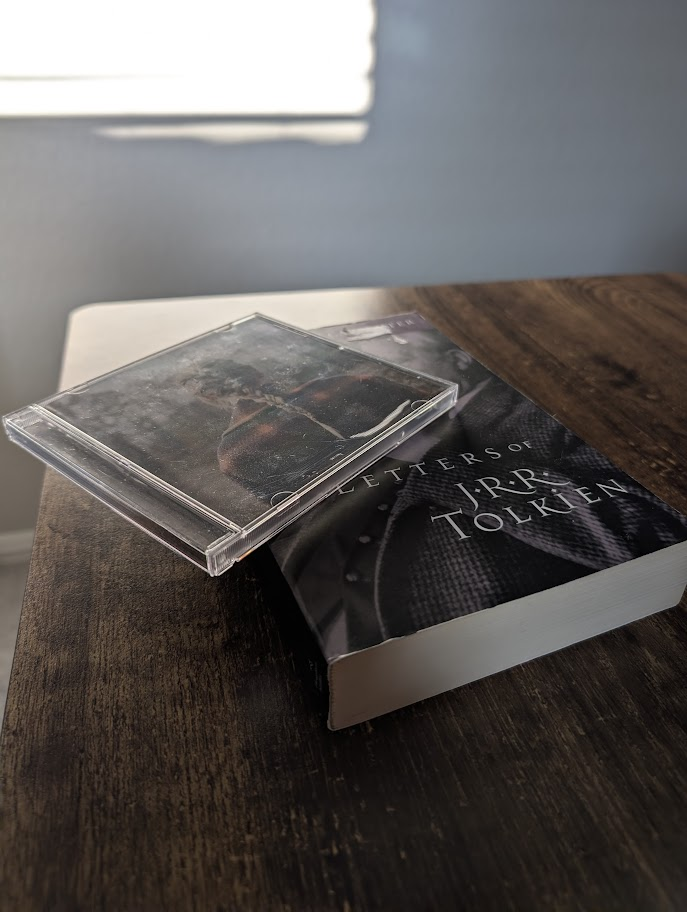
I don’t know how much overlap there is between the Swiftie and Tolkien fan bases, but I’m in the center of that Venn diagram. I adore Tolkien, not only as a fantasy author, but as an academic who put his faith in conversation with his scholarship. During my cancer journey, I’ve thought not only of Taylor shipwrecked on the sea, but also of suffering Frodo, faithful Sam, and the grace of God that brought about the culminating victory at Mount Doom.
Tolkien wrote fantasy, and he theorized about it. As a communication theory textbook author, I approve. In his essay “On Fairy Stories,” he coined a memorable new word: “eucatastrophe.” In a letter to his son, he defined the term succinctly: “the sudden happy turn in a story which pierces you with a joy that brings tears.” The endings of Lord of the Rings, Harry Potter, and The Lion, the Witch, and the Wardrobe are good examples. In the Taylorverse, examples might include “Love Story” (with her dad’s unexpected change of heart) and “Long Live” (where the “band of thieves of ripped up jeans” unexpectedly gets to “rule the world”).
For Tolkien, the eucatastrophe is more than a literary device. It is a window into a deeper truth about the way the world works. Much of human life involves sorrow, pain, heartbreak, and death. We inhabit a world filled with conflict and war, cancer and disease, decay and loss.
It would be easy to conclude that this is the permanent, inevitable way of things. But Tolkien did not believe this. Nor do I. The eucatastrophe “denies (in the face of much evidence, if you will) universal final defeat and in so far is [gospel], giving a fleeting glimpse of Joy, Joy beyond the walls of the world, poignant as grief.“
Here, in this season of Advent, Tolkien’s most famous quote about the eucatastrophe clarifies why he had such hope: “The Birth of Christ is the eucatastrophe of Man’s history. The Resurrection is the eucatastrophe of the story of the Incarnation. This story begins and ends in joy.“
“What does this have to do with ‘Evermore’??“, the patient Swiftie reading this may wonder. Well, further into Tolkien’s letter, I was struck by the parallel between his words and the lyrics of “Evermore:” “In the Primary Miracle (the Resurrection) . . . you have not only that sudden glimpse of the truth behind the apparent [nature] of our world, but a glimpse that is actually a ray of light through the very chinks of the universe about us.” That sounds a lot like cracks of light through the storm clouds on a shipwrecked sea.
Tolkien further describes riding his bicycle past an infirmary, when he “had one of those sudden clarities which sometimes come in dreams. . . . I remember saying aloud with absolute conviction: ‘But of course! Of course that’s how things really do work’. But I could not reproduce any argument that had led to this, though the sensation was the same as having been convinced by reason (if without reasoning).” Swift expresses a similar sentiment, more concisely and beautifully, in the closing verse of “Evermore”:
And I was catching my breath Floors of a cabin creaking under my step And I couldn’t be sure I had a feeling so peculiar This pain wouldn’t be for Evermore
Let me be clear: I’m not saying that Taylor Swift wrote “Evermore” to express faith-based ideas. The popular theory is that the song is about her famously difficult year in 2016 and how Joe Alwyn (a.k.a. William Bowery, who has songwriter credit on “Evermore”) brought joy out of that season. It’s also a song released during the pandemic, and during that long season, I certainly longed for a pause to be certain we’d all be tall again.
Yet it is also a song that is a powerful, beautiful, and general artistic description of pain, grief, and loss. And in writing about such things, I cannot help but have the sense that the lyrics find their way to something deep and true for those who are in Christ.
If I may be permitted one more moment of listener interpretation that surely moves beyond what the writers of “Evermore” intended, I was struck by Vernon’s cry: “Is there a line that we could just go cross?” The lyric seems to express a desire for relief, for refuge, maybe even in death. Of course, “cross” here is used as a verb; but the word is also a noun. A particularly sacred noun. In my pain, in my fear, in my longing to not be a burden on my family, in my guilt about not paying attention to those very few signals that might have led me to get a colonoscopy sooner—in those moments most overwhelming, the cross of Jesus, an emblem of brutal death that has become an emblem of unending life, has been my only refuge, the only place I can go to find relief.
I long for my current story to be one that ends in eucatastrophe during my mortal life, to get scans that speak to a cancer thoroughly destroyed, whether as a miraculous answer to prayer or the Lord working through the power of modern medicine. That may not happen. But the cross and the empty tomb speak to a more-than-certain hope, a feeling so peculiar, an absolute conviction that, one day, the world will be made right and I will have a resurrected body, like that of Jesus, that is cured of cancer. It is a hope “beyond the walls of the world” available to all who put their faith and trust in Christ.
I cannot speak definitively to the authorial intent of “Evermore,” and I am not a postmodernist; I believe authorial intent matters. But in the corridors of my mind, the shipwreck is my cancer diagnosis; the waves are the challenges and suffering of treatment. And the cracks of light are the love and support of family and friends, in part. But that undimmable light, more real than even the reality of my suffering, is most supremely the gospel, the good news in which is all my hope: that Christ came as a baby, fully God and fully human, lived the perfect life I could not, died the death and took the wrath of God that I deserved, and three days later walked out of his own tomb.
And the mysterious “you” in “Evermore” is for me, then, Emmanuel, God with us: the Wonderful Counselor, the Mighty God, the Everlasting Father, the Prince of Peace. This December, as I sing Advent songs with tears in my eyes, this is my joy and hope, and why I am certain my pain won’t be for evermore.